





Ahead of midterms, Native voters face increasing challenges
New report outlines major barriers for voters


The National Voter Registration Act of 1993 made voter registration more accessible to many marginalized groups. Known widely as the “Motor Voter Act” because it allowed state departments of motor vehicles to register voters, the legislation nonetheless puttered out in Indian Country. Many of the changes designed to make it easier to vote didn’t reach Indigenous communities, and new research indicates Native voters face growing barriers in the democratic process ahead of the November midterm elections.
“Geographic isolation, unreliable mail service, nonstandard addressing systems, limited internet access, and inadequate polling resources all combine to make voting harder in heavily Native American counties than anywhere else in the country,” the Native American Rights Fund research team writes in their new report on voting data.
The 1993 act expanded voter registration options to include government touchpoints like the DMV and Medicaid offices, but federal agencies that specifically serve Native populations, like Indian Health Services, were excluded from these new provisions.
“This system has been built throughout a history that has mostly disenfranchised Native people completely,” said Allison Neswood (Navajo), a NARF attorney who worked on the new report. “Healing those things and addressing the systemic barriers takes investment.”
Neswood and the NARF researchers looked at U.S. Election Assistance Commission data for 2020, 2022 and 2024. They compared national voting outcomes to outcomes in 30 select counties where Native Americans constitute more than 25% of the population.
In measures like voter registrations, registration rejections and turnout, outcomes were notably worse in the select counties than the national trends.
New voter registrations declined precipitously in the select counties with higher Indigenous populations, sinking 59% over the four-year period while nationwide registrations went down 22% in that timeframe.
Registration rejections in the select counties also differed significantly from the national rejection statistics. In the select counties, mail rejections went up 224.4% over the four-year-span, and DMV rejections increased 176.8%. Nationally, these types of rejections declined during the same period.
Turnout was lower in the select counties than in the respective statewide data as well, and the discrepancy was more pronounced in presidential election years than in other election years.
In the midst of the many data points is a disheartening story of consistent barriers to voting for Native Americans, Neswood said.
“What this report is doing is measuring outcomes,” she said. “How many times are people able to register? How many of those registrations stick? All of these outcomes sort of add up to fewer registrations because of X,Y, Z structural issues.”
New rules exacerbate old disparities in Montana
In Montana, Native voters are facing increasing state-specific challenges. Alex Rate is the deputy director and legal director of the American Civil Liberties Union of Montana, and he detailed how new rules impacting the 2026 midterms contribute to the ongoing disenfranchisement of Indigenous Montana voters.
Two notable changes will be in play this November: a new step asking voters to sign their birth year on the outside of mail-in ballot envelopes and a more restrictive list of acceptable forms of official identification during in-person voting.
“These are basically just naked attempts to disenfranchise certain segments of the voting public,” Rate said. “In fact what they're doing is making it more confusing and creating processes that are more byzantine that will result in potential inaccuracies.”
Rate said voters have already expressed confusion about whether they need to sign their birth year or the election year for the mail-in ballots, and he also highlighted how the changes to official voter ID could create additional roadblocks for folks who show tribal ID at the polls.
The new rules, billed as ways to root out voter fraud, really serve to complicate the voting process and hamper electoral efforts, Rate said.
“This is the classic solution in search of a problem,” said Rate. ““Instances of voter fraud in Montana are exceedingly rare.”
Election Day in-person voter registration remains intact, but Rate explained how the ACLU has worked alongside Montana tribes to fight off repeated attacks to last-minute registration options. As recently as May, a Montana District Court ruling blocked a state law that would have restricted same-day voter registration at the polls.
Election Day registration can be helpful to any voter, but the data demonstrates that Indigenous voters disproportionately rely on that method, said Rate. He highlighted how the lack of access to nearby polling places and reliable mail service make it harder for Native Montanans to register ahead of time.
“I don’t think that means that when the Legislature reconvenes in January that they're not going to try it again,” he added. “The government has been attempting to disenfranchise Indigenous voters for centuries. That goes without saying. They’ve gotten progressively more clever.”
Bright spots on the horizon
Despite the obstacles, advocates working in Montana Native communities still see reason for optimism. Ronnie Jo Horse, executive director for Western Native Voice, said she is part of only the second generation in her family to vote, but the organization has made encouraging progress building civic engagement and education throughout Montana’s tribal communities.
Horse is Oglala Lakota with ties to South Dakota and a descendant of the Northern Cheyenne Nation in eastern Montana. Western Native Voice is a 4-year-old Montana nonprofit that works on reservations and in urban centers to advance voter resources.
“We’re very new to the process and we’re still getting used to it,” she said, noting how Native Americans have been navigating ever-changing dynamics in the electoral process since the 1924 Indian Citizenship Act.
From limitations that originally only allowed Indigenous veterans to vote, to compromises that allowed Native folks to vote if they gave up their tribal affiliation, to tax requirements that created disparities between tribal members living on reservations and those in other parts of Montana, there have been challenges at every turn for Indigenous voters over the state’s history.
“It’s not really a part of our traditions yet,” Horse said. “We’re making it a tradition at Western Native Voice.”
Horse said some of the most effective messaging in Indian Country helps potential voters see their impact on the local level and appreciate how voter engagement shapes daily life in their communities. She feels hopeful, too, because of the connections Western Native Voice has helped generate with county elections offices in Montana.
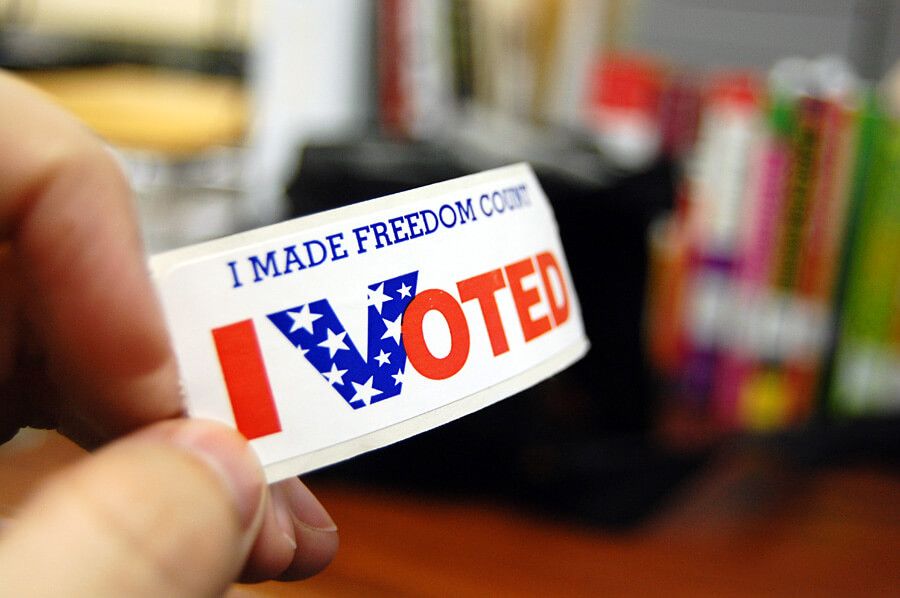
“We work well together,” Horse said of county officials, pointing to “I voted” stickers in different Native languages as a positive sign. “I think we’re growing in a really good partnership. A lot of people are starting to turn out and feel comfortable.”
The threats detailed in the NARF report are real, Horse acknowledged, and Montana’s legislative landscape presents constantly changing challenges for her organization’s work.
“I like to remind folks that this is a new process to us,” Horse said. “We have to overcome all these barriers over these years. It’s a new process to us, and that’s OK.”
Even Neswood at NARF said there are a few promising parts of the new report that show opportunities for Native civic engagement. Ballot curing, for instance, is a process where election officials reach out to voters if they discover something amiss with their ballot, rather than outright rejecting it. This ballot curing process appears to occur more successfully in the select counties with more Native voters, according to new data.
Neswood said there are also legislative avenues that can spur the investment needed to improve electoral access for Native Americans. NARF supports a federal Native American Voting Rights Act, and she said state-level interventions in Washington State, New Mexico, Nevada and Colorado all demonstrate potential paths forward.
“Different states are stepping up in different ways,” she said, spotlighting major turnout increases in Colorado after the secretary of state implemented voting centers on tribal lands. The Ute Mountain Ute Tribe’s active voter turnout increased by nearly 14% in the first year after the voting centers came to town in 2020. Turnout among active voters living on Southern Ute Tribal lands grew even more – up nearly 30% that first election year.
“When it comes down to it, what it requires is investment in our communities,” Neswood stressed. “Colonization is really a process of taking resources…The federal government hasn’t ever really lived up to its trust and treaty obligations to compensate us for that. It’s the same for voting.”
Sharing Is Caring
This article is not included in our Story Share & Care selection.
The content may only be reproduced with permission from the Indigenous Media Freedom Alliance. Please see our content sharing guidelines.
© Buffalo's Fire. All rights reserved.
We provide independent Native-focused reporting that gives our communities the context and the facts they need to make informed decisions.
Respect The Fire
At Buffalo's Fire, we value constructive dialogue that builds an informed Indian Country. To keep this space healthy, moderators will remove:
- Personal attacks, harassment, or hate speech
- Spam, misinformation, or unsolicited promotion
- Off-topic rants and excessive shouting (All Caps)
Let’s keep the fire burning with respect.