






Buffalo’s Fire built an interactive map to track missing Indigenous people, and we need community help
Vital information is often buried, hard to find. We’re asking our communities to send us tips and corrections



At Buffalo's Fire, we have been working for the last year on a database and interactive map to document the names and stories of missing and murdered Native people — an effort born of both necessity and anguish. We are building this database to fill the gaps left by official agencies: their goal is to support investigations; ours is to put faces and stories to these numbers, and we need the help of the community to make it possible. While this must be considered a work in progress, we decided it is time to share it with the public, hoping many will contribute their comments, testimonies, corrections, updates and tips.
The database currently holds records for 1,158 individuals, though this represents only a partial count of an often-silent tragedy for Native peoples. The project merges fragmented data from multiple public agencies. Sources at this time include the Bureau of Indian Affairs Missing and Murdered Unit, the national NamUs database, and others like the North Dakota Attorney General’s list and the South Dakota Missing Persons Clearinghouse. For the moment, we list only names from the United States, but borders are nominal, and we will add Canada and Mexico as soon as we are able.
Most official sources do not provide openly accessible, machine-readable public feeds, such as APIs or download-ready datasets that a database like ours can seamlessly consult and integrate. Some sources permit manual exports, including NamUs, but these are account-based workflows rather than public data services. We manually compiled an initial snapshot to serve as the foundation for the database. It is meant as a starting point. We organize the data by tracking leads from multiple sources, updating them over time and building a case directory that ultimately populates the map. We are working to find ways to improve the data and expand the database as we move forward. While the newsroom will do its best to monitor changes and updates, the technological hurdles are substantial, and we need the community's help.
Send us tips, corrections and flyers
We encourage readers to send us tips, as well as share memories, testimonies and thoughts in the comments of each case page. Though it will take some time, we also plan to release the database as a public API as soon as we are able. We offer two types of submissions: you can send us a flyer — just like those posted on Facebook — or you can enter information directly into a form. Direct data entry is much more precise. We will also display any flyers we receive on our public Flyer Board.
A disconnected and outdated infrastructure
The agencies investigating MMIP cases are largely disconnected from one another, communicating vital information through websites that are often outdated and convoluted. It is as if this information — which relies heavily on clarity and urgency to effectively reach the community — is trapped in a system designed to restrict its flow.
In the absence of a modern network, Facebook has become the principal tool for reaching communities, search parties and relatives. This is true for tribes and nations, as well as local police departments actively searching for missing people.
When a person goes missing, the information is almost always released in the form of digital flyers. On Facebook, the flyers are posted as images with captions and comments. Relatives' associations help with outreach, distributing flyers and connecting families with one another to fill institutional gaps. Frequently, the image is the only place where the name of the missing person appears, which means Facebook's internal search engine does not capture it, nor do external search engines.
While it is a lifeline, Facebook is also the least modern and least efficient way to manage critical data. Meta strictly prohibits API access to extract information from its groups and pages, and image-based flyers are difficult for search engines to capture and index. Although thousands of people are working tirelessly on this crisis every day, the information ecosystem feels almost purposefully built to be scattered, fragmented and ultimately lost.
Recognizing the complex and often contradictory nature of data on missing people, Buffalo’s Fire attempts to bring order to it. When a new name appears or case details change, a member of our editorial team will review the information. Over time, this will guarantee that individuals who appear on multiple agency lists, sometimes with varying spellings or conflicting details, are merged into a single record so nobody is counted twice. Source entries are preserved separately to maintain transparency about where each fact originated.
We want to be upfront about the project’s limitations. The official lists disagree with each other, and a person can be missing for years before they are documented. The local agencies that are conducting the investigations and have the most up-to-date information don't always have a digital presence. Nor do they maintain a data stream of updates or have a website. In the best-case scenario, they update a Facebook page or group. Finally, the database is a record of what has been published or shared directly, not a definitive count of the crisis.
Navigating the map
Our public-facing map currently displays about 1,026 missing people — representing cases where the location is known and permission has been granted to share the information publicly.
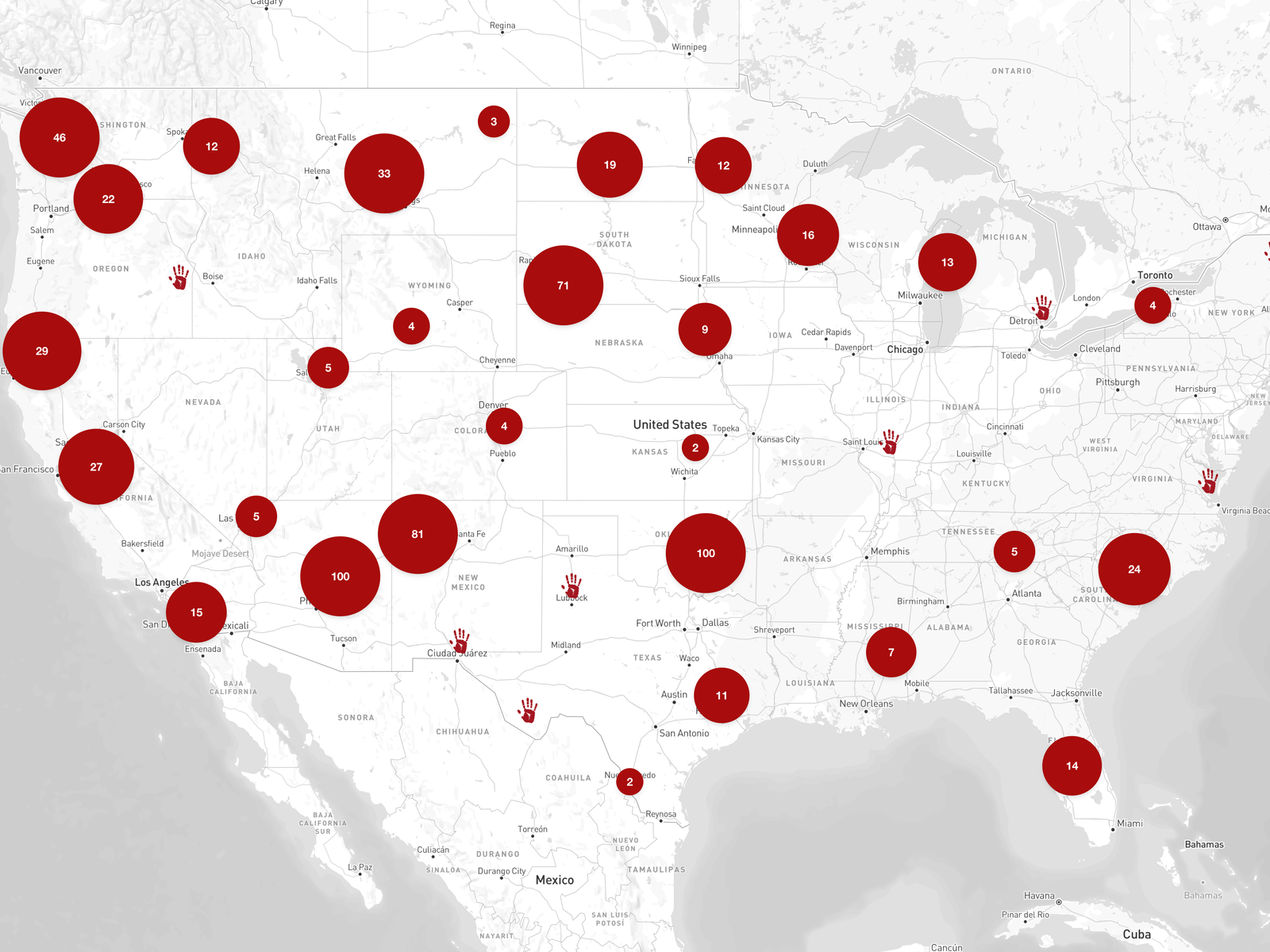
Each individual is represented on the map by a hand icon. Tapping a hand opens a card with case specifics and instructions on how to submit corrections or comments. Each person has a separate page on Buffalo's Fire where we will collect the full set of information. These pages will grow over time and can feature links, images, and testimonies. They will also include identifying information, such as age, last-known whereabouts, etc) to help locate the person.
The hand icons are color-coded to show case status:
|
Coral |
Reported missing within the last 30 days |
|
Crimson |
Missing and actively listed by the reporting agency |
|
Blue |
No longer on the official list, but with no explanation provided |
|
Black |
Found deceased |
|
Green |
Found safe |
Please note that for "Found safe" and "Found deceased," this reflects cases resolved since the database launch.
We also keep track of the people who have been found safe, and we may display them on a separate map in the future.
The "darker red" category represents the systemic gap in missing persons data. When an agency stops listing someone, it does not mean they were found safe; sometimes, lists are simply reclassified. Rather than removing these individuals, Buffalo's Fire retains their records on the map: until we know they were located, they are still missing, whether a government agency keeps them on its website or not.
There are other reasons an individual might not appear on the map, including missing location data. It is quite common for a name to be listed with almost no information about the circumstances. We may also make mistakes, especially in this early phase, and we ask our readers to be understanding. Our goal is to create a comprehensive public database of all missing people, though we are well aware we are not there yet.
The database will slowly integrate with the work of the newsroom, so articles we write about missing people will be listed on their MMIP pages.
Submitting Information
The newsroom encourages the public to submit tips, flyers and photographs. Every submission is read and verified by a staff member before publication; the process is never automatic. When photos are submitted, the newsroom downloads and securely stores its own copies, ensuring images aren't lost if a user deletes their social media account or removes a post.
If you spot an error — such as a misspelled name, an incorrect date or a person listed as missing who has since been found — we encourage you to report it to our submissions page or to reach out to staff at contact@buffalosfire.com.
Heartbreak is at the center of this project — for the hundreds of lives represented as hands on the map and the thousands of relatives, friends and investigators searching for them. Buffalo's Fire acknowledges that a complete, precise picture of the crisis is likely unknowable, but our goal is to try to count them anyway.
If you are working on a similar project, please get in touch.
We want to give a shout-out to Oregon: the Oregon State Police maintains a clearinghouse of missing persons and provides the option to download it as a CSV (comma-separated values) or JSON file. However, the feed currently exposes no durable per-person ID or detailed URL, and all of the data is formatted entirely in capital letters.
Corrections
An earlier version of this article incorrectly stated that none of the official sources offered accessible digital exports. NamUs allows registered users to manually export publicly viewable search results as CSV files. This is a useful option for individual research but it remains an account-based, manual export process. It does not provide a continuously available, machine-readable public data service.
Pier Paolo Bozzano
Sharing Is Caring
This article is not included in our Story Share & Care selection.
The content may only be reproduced with permission from the Indigenous Media Freedom Alliance. Please see our content sharing guidelines.
© Buffalo's Fire. All rights reserved.
We provide independent Native-focused reporting that gives our communities the context and the facts they need to make informed decisions.

Respect The Fire
At Buffalo's Fire, we value constructive dialogue that builds an informed Indian Country. To keep this space healthy, moderators will remove:
- Personal attacks, harassment, or hate speech
- Spam, misinformation, or unsolicited promotion
- Off-topic rants and excessive shouting (All Caps)
Let’s keep the fire burning with respect.