






On the Blackfeet Reservation, families learn to search for their own missing relatives
As Indigenous people go missing and are murdered at disproportionately high rates, families learn forensic skills to find their own loved ones.



Sheltering from the July heat at Sleeping Wolf Campground in Browning, Shelby Feirstein read a scenario to a small group gathered in the shade of a large cottonwood tree.
“There was a young adult male visiting Browning from Idaho on his way to Glacier National Park,” said Feirstein, a forensic and anthropology doctoral student at the University of Montana, reading notes off her phone. “He was unfamiliar with the area and stopped in to a local gas station to ask about local campgrounds. That was the last time he was seen or heard from. Glacier Park rangers confirmed he never checked in at the park and the gas station clerk gave the individual a list of options, including Sleeping Wolf Campground, which is why we are starting here today.”
About a dozen of us were here to take a two-day class about how to search for missing people. The course was taught by Haley Omeasoo, the founder of Ohkomi Forensics, a nonprofit that exclusively offers forensic services to families affected by the Missing and Murdered Indigenous People (MMIP) crisis. Feirstein and Samantha Hofland, another University of Montana PhD student, helped Omeasoo administer the training.
Native Americans go missing and are killed at disproportionately high rates nationwide, including in Montana. While Native Americans account for about 7% of Montana’s population, Indigenous people comprised about 31% of the state’s missing person cases in 2025, according to a recent report from the state’s Missing and Murdered Indigenous Persons Advisory Council.
Law enforcement in rural and tribal areas is often understaffed, underresourced and tangled in a complex web of legal jurisdictions, sometimes leading to frustrations with the professionalism and pace of searches for missing persons. So when loved ones and community members go missing, Indigenous families and friends often conduct their own searches.
“We shouldn’t have to start an organization for this,” Omeasoo told us on the first day of class. She said she founded Ohkomi Forensics, in part, because her high school classmate Ashley Loring Heavyrunner went missing in 2017. Almost a decade later, Loring Heavyrunner has not been found.
“These cases should have been handled by law enforcement and the people that are supposed to be protecting us and serving us,” Omeasoo told us. “But we still have to keep fighting for justice for all of them, and so we’ll all just keep fighting and keep searching.”
In the seven years that I’ve written about Indigenous affairs in Montana, I’ve reported on community search efforts, resource gaps within law enforcement, stalled investigations, awareness-raising efforts and many families’ continuing calls for justice. I attended Omeasoo’s class to write about the crisis from a different perspective — the viewpoint of the people left searching.
Everyone in the July class has a connection to the crisis. Brendan MacDonald’s 22-year-old cousin Clarence McNabb went missing and was found dead in 2017. MacDonald, a mail carrier in Great Falls said he wants to learn how to look for signs of missing people. Wilma Fleury has participated in multiple searches for missing community members and took the class to learn how to better organize search efforts. Rhonda Connelly’s nephew Matthew Grant went missing and was found dead on the Blackfeet Reservation in 2016. Deana LaMere’s husband, Larry Dean Running Crane, went missing in 1988 and was found dead weeks later in the Flathead River. Asiah and Irene Pepion’s relative Arden Pepion went missing in 2021 at age 3 and has not been found. Mariah Racine said she’s had more friends and relatives go missing than she can count.
Since Omeasoo started Ohkomi Forensics in 2023, she’s assisted in searches for at least five missing Indigenous people in Montana. And she’s learned that searches conducted by nonprofessionals, if done poorly, can have devastating consequences. That’s why she offers this two-day search-and-recovery training, where she and two University of Montana graduate students teach community members how to prepare for and conduct searches for missing people, and how to identify bones in the event a search-and-rescue effort turns into a search-and-recovery mission. The July class marked the second time Omeasoo offered the training. Attendees paid $25 each to attend, a price that was subsidized by several Blackfeet tribal programs.
The main goal of the class, Omeasoo told us, “is to bring our relatives home so that our communities can begin to heal.”
The mechanics of a search
Back at Sleeping Wolf Campground, I joined attendees practicing a technique called a line search. Standing next to each other, about an arm’s length apart, five of us slowly walked forward in unison, scanning the ground for out-of-place objects, tire tracks, trash, clothing, patchy soil or other disturbances. We looked for insect activity, new plant growth, bear scat and animal tracks.
“Stop!” Connelly yelled to the group. She bent down to place an orange flag next to a mound of dirt on the otherwise grassy ground. Mounded dirt or disturbed soil, we had learned the day before, could signal a burial site. The flag was meant to alert experts, whether law enforcement or a member of Omeasoo’s team, to a possible finding. And if no expert is on-scene, the flag serves as a marker for when they are able to get there. Omeasoo and our other instructors had stressed the day before to flag — but not to touch — a possible evidence site. Once a scene is disturbed, they warned, it can never be the same again.
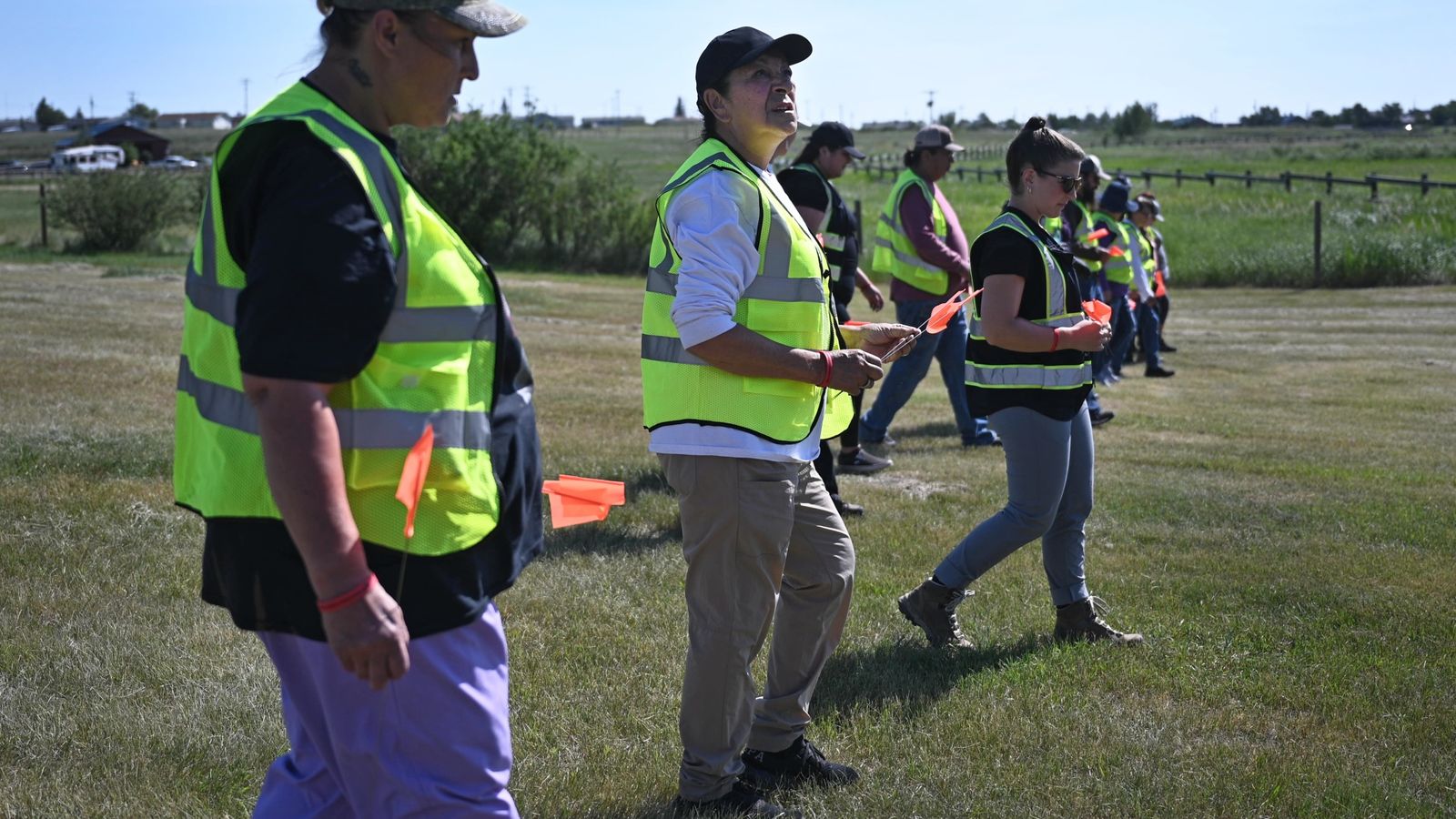
The group waited until the flag was firm in the ground. “OK, go!” Connelly called again, and we inched forward.
Our line search was more complicated than I expected. Many animal bones look like human bones. And many bones look like sticks, rocks or dirt. Trash can be relevant evidence, or not. Shadows make it hard to see small objects in the grass. I kept forgetting to look up from the ground and running into branches.
The day before, in a hotel conference room in Browning, Omeasoo, Feirstein and Hofland had warned us of the hazards facing searchers. On scene, they said, searchers should be prepared for long days and variable weather. Watch for heat distress and hypothermia. Look out for bears, rattlesnakes and mountain lions. Wear appropriate clothing and footwear. Bring water, flashlights and whistles. Carry maps and GPS devices.
At Sleeping Wolf Campground the next day, our line search slowly approached a tree near a creek. Hidden in the tall grass at my feet were plastic replicas of human bones.
“Stop!” I called to the group. Two women planted flags next to the bones, which were accompanied by two black and white sneakers.
“Oh goodness,” Connelly said. “I think we found him.”
The day before, Hofland had explained the importance of not touching evidence. Contaminated evidence, she told us, can be difficult for law enforcement and expert witnesses to analyze, and can be rejected in court by defense attorneys. Moving evidence, like a weapon, can also make it harder for experts to determine if a death was a homicide or suicide.
If we found a bone, Hofland said, we should note its location and GPS coordinates in an app like CalTopo and photograph it beside a credit card, phone, or quarter to show scale. Then call law enforcement, wait until they arrive, record which agency took the evidence and their contact information.
A few days after finishing Omeasoo’s class, I called Guy Baker. He retired from the Missoula Police Department in 2025 after 35 years of service and recently launched his own company, IV0VI (406 in Roman numerals) Investigations & Consulting. Baker has participated in dozens of searches for Jermain Charlo, who went missing from Missoula County in 2018, and said that while community searchers have good intentions, “their lack of knowledge and criminal procedure can sometimes complicate the situation.”
“They could’ve found something, and we say, ‘OK, where did you find this?’” he explained. “But if they didn’t drop a pin and can’t find that location again, it’s not much help to us.”
While searches that combine community manpower with law enforcement resources are ideal, Baker said, they aren’t always possible. Sometimes law enforcement needs to keep a scene to itself to keep sensitive information or leads confidential. And sometimes, he said, community members conduct searches when law enforcement doesn’t have the staff or resources to do so.
“I think it’s absolutely advantageous if people can be better educated as to what to look for and understand what they find,” he said of Omeasoo’s training. “That’s only going to help law enforcement.”
Failed searches
One night in December 2016, Rhonda Connelly’s nephew Matthew Grant didn’t come home. Connelly remembers walking the frozen streets of Browning with her family for more than two weeks looking for him. They climbed over snowdrifts and searched inside abandoned homes and trailers. Connelly drove 240 miles roundtrip to Great Falls, chasing what turned out to be a dead-end lead. Matthew, 21, was eventually found dead in an alley in Browning 16 days after he’d gone missing. Almost a decade later, there have been no charges in his case.
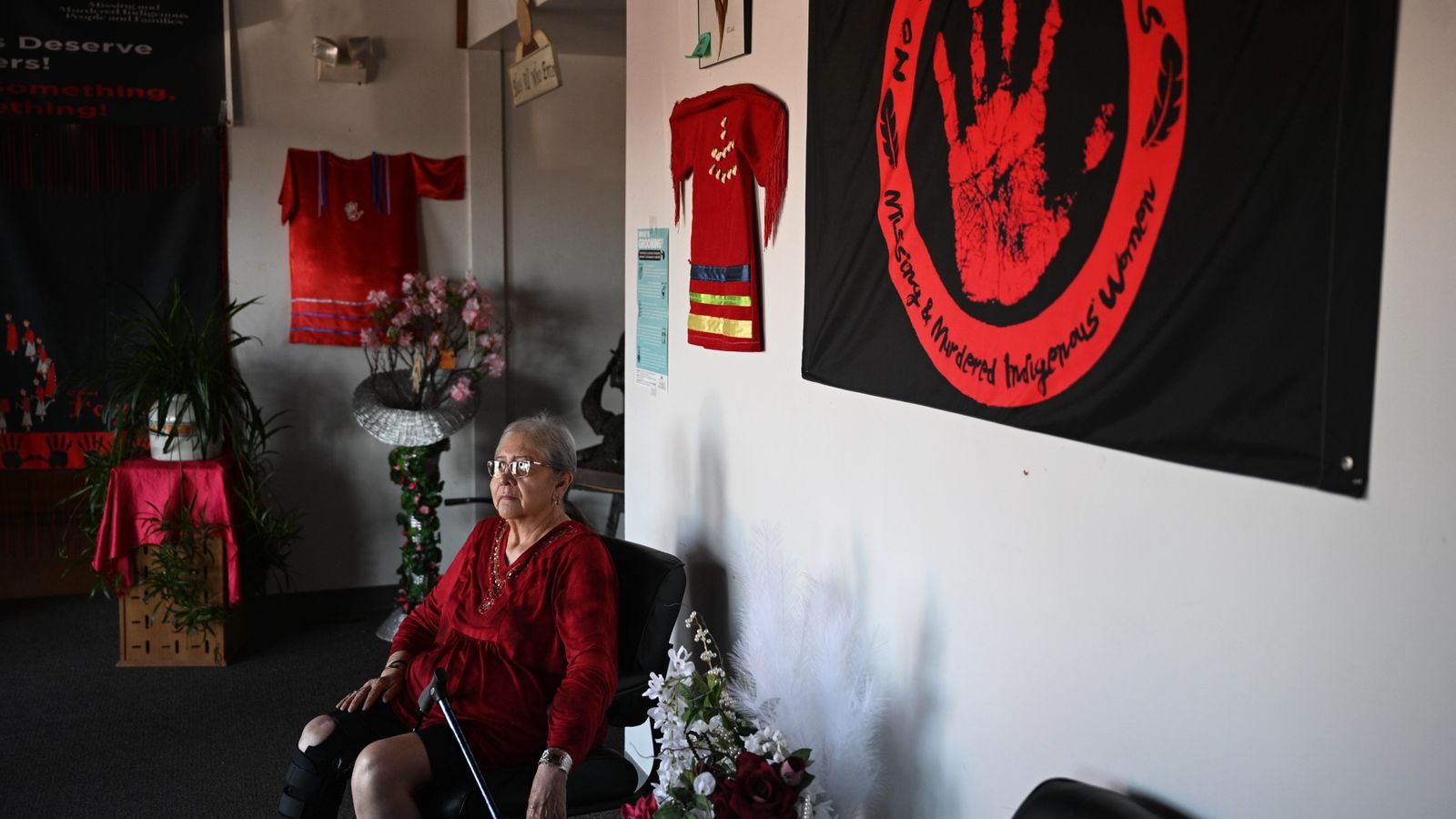
Determined to seek justice, in 2023 Connelly founded Blackfeet MMIP, a nonprofit that raises awareness and supports families whose relatives have gone missing or been killed. Sitting in the organization’s office before the second day of our training, Connelly told me she took Omeasoo’s class so she can organize more effective searches.
“I felt helpless,” she said of the searches for Matthew. “For one thing, we were all going in circles. We should’ve done a grid search. We should’ve had it mapped out, so that way we weren’t duplicating anybody else’s work.”
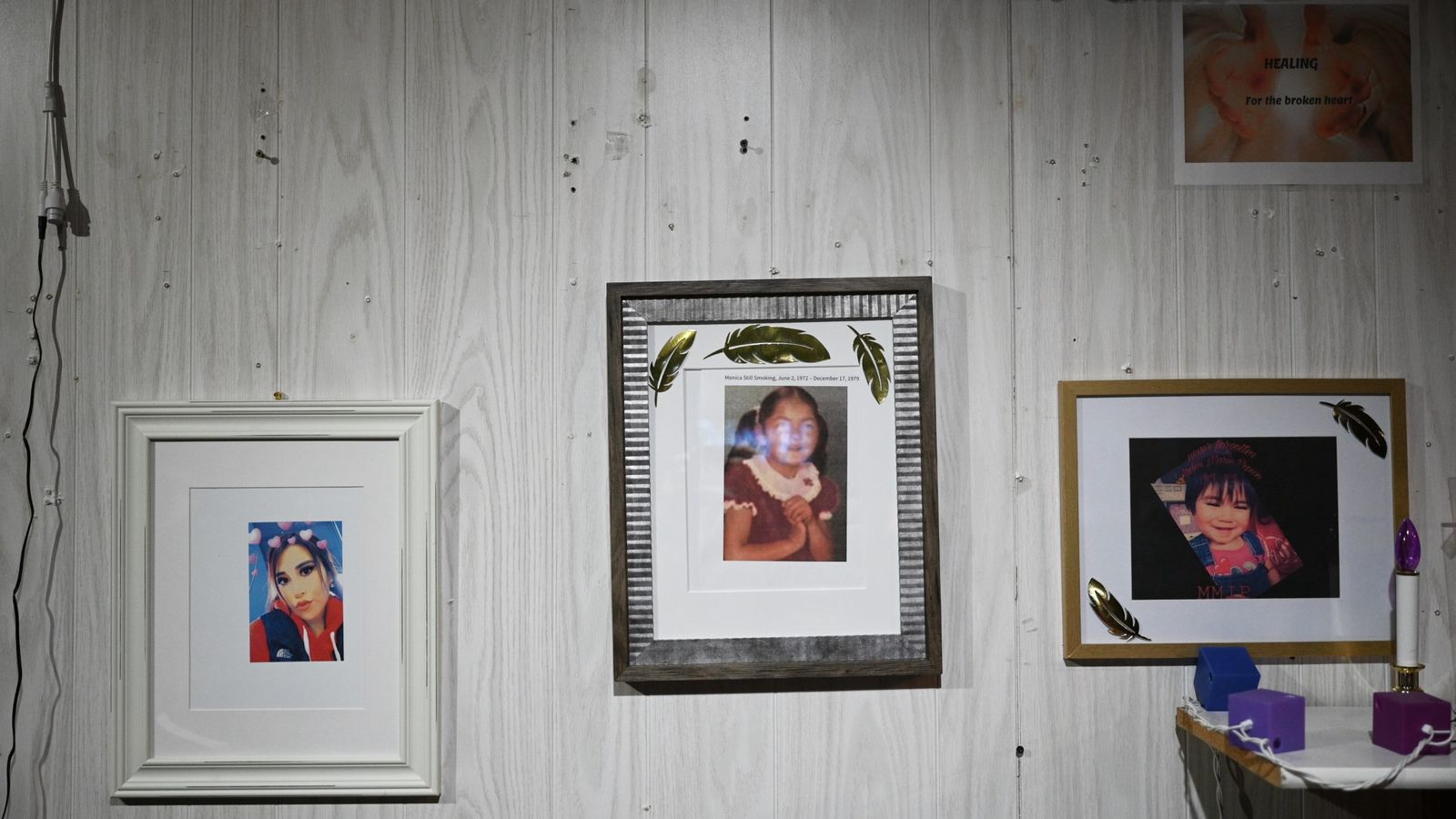
After our practice line search at Sleeping Wolf Campground, I sat with Deana LaMere and Mariah Racine at a picnic table for lunch. Racine spoke of her cousin’s daughter, Hailey Perkins, who was shot and killed just before her 14th birthday. She told us that her 7-year-old niece Monica Still Smoking went missing and was found dead two weeks later on the Blackfeet Reservation in 1979.
LaMere also knew Still Smoking.
“Monica,” LaMere said, staring into the distance. “She was my friend. My really good friend.”
In the 1970s, LaMere said, the two would meet on a corner after elementary school to walk home together. One day, Still Smoking didn’t show up. About a decade later, LaMere’s husband, Larry Dean Running Crane, went missing. LaMere and her family searched between Browning and Kalispell for days with no luck.
“This would have been helpful back then,” she said of Omeasoo’s training. “We didn’t line up like this. We didn’t take notes or have coordinates or maps. I wish we’d been organized. I wonder how many people we walked past.”
Identifying bones
Inside the conference room, on day one of the training, Omeasoo placed dozens of bones on tables draped in black cloth. It was our job to identify whether each bone was human or animal.
If a person has been missing more than 10 days, Omeasoo explained, searchers may reorient their efforts to look for human remains. Recovering remains, she said, can illuminate details of a case and provide family members with answers. Experts like Omeasoo can conduct forensic analyses on a person’s bones to determine whether their death was a homicide, or if a victim sustained injuries before they died.
“Recovery matters because it’s still helping the family get answers,” she said. “It’s still giving the family some closure, hopefully. And when you’re doing it right, it could help in a case that could potentially go through the justice system.”
As I walked around the tables, certain bones stood out. A femur the size of a skateboard and a pointy jawbone with jagged teeth were obviously not human, but other bones were hard to distinguish.
Connelly walked next to me, wearing purple rubber gloves and peering down at the bones.
“I want to say this is a bear,” she said, pointing to a skeletonized hand. “Or, wait. Is it human?” I couldn’t tell either.
“This,” Connelly said, picking up a curved bone about the size of a ruler. “When we were searching for Gabriel, I found something similar to this.”
Gabriel Calfbossribs, a 42-year-old man, went missing from the Blackfeet Reservation in 2024. Connelly joined other Blackfeet Reservation residents in searching for him. In the conference room, Connelly took off her rubber gloves and pulled up a photo on her phone of a long, white bone that she’d taken during Calfbossribs’ search. Connelly couldn’t tell if the bone she’d found at the time was human or animal. Her picture didn’t capture the ends of the bone, which, Omeasoo said, have the most detailed features.
“Hmm, it’s hard to tell,” Omeasoo said, peering over Connelly’s shoulder to look at the photo. “Maybe it’s a rib, but it’s hard to tell when there’s no scale and the ends are cut off.”
“I’m so mad at my photo!” Connelly said. “I should’ve got the ends.”
Omeasoo held a rib bone in front of the class.
“What do we think this is?” she asked. The bone was too big to be human, we agreed, and Omeasoo nodded.
“Actually, that one looks like my bone,” Connelly said. “Yeah, that looks like the one I found.”
‘We had no plan’
At Sleeping Wolf Campground the next day, Irene and Asiah Pepion stared at a replica human skeleton our instructors had lain in the grass as Hofland pointed out different bones and their distinguishing features. Our foreheads glistened in the heat. Behind us, dogs lurked in the tall grass, eyeing the animal bones that were also scattered for display.
Asiah told me she was taking the class to learn how to better coordinate community searches for her three-year-old niece Arden, who was last seen in 2021. Arden’s grandmother Irene said that in the early days after her granddaughter’s disappearance, searches were uncoordinated.
“We had no plan,” she said. “They were taking truckloads of people out to go look, but we just had no plan.”
Now, Irene and Asiah are planning another search for Arden, set for Aug. 28.
Irene bent down and picked up a rib bone from the skeleton and eyed it carefully.
“So,” she said to Hofland. “For a three-year-old, how big would the ribs be?”
Nora Mabie covers Indigenous affairs at Montana Free Press. She previously covered Indigenous communities at the five Lee Montana newspapers: the Missoulian, Billings Gazette, Independent Record (Helena), Ravalli Republic and Montana Standard (Butte). Prior to that, she covered tribal affairs for the Great Falls Tribune. Nora's reporting about the return of ancestral remains and disparities in Native life expectancy have received state and national journalism awards. She was a 2023 National Fellow at the USC Annenberg Center for Health Journalism and a McGraw Center for Business Journalism Fellow from 2024 to 2025. She is a graduate of Northwestern University’s Medill School of Journalism. She is based in Missoula. Reach her at nmabie@montanafreepress.org and follow her on Facebook.
Lauren Miller joined Montana Free Press as a multimedia journalist and visual storyteller in 2025. She is 2025 Visual Fellow with Report For America/Catchlight. A graduate of Syracuse University, she previously worked at the Casper Star-Tribune and Bozeman Daily Chronicle. In 2023, she was a recipient of the Photographer of the Year/Dailies award from the Wyoming Press Association. Her storytelling spans photography, cinematography, portraiture, audio and archival research. Miller is driven by an interest in daily life’s quieter moments — both mundane and extraordinary — and adapts her approach to suit each subject. Based in Helena, Lauren can be reached at lmiller@montanafreepress.org.
Nora Mabie and Lauren Miller, Montana Free Press
Sharing Is Caring
This article is not included in our Story Share & Care selection.
The content may only be reproduced with permission from the Indigenous Media Freedom Alliance. Please see our content sharing guidelines.
© Buffalo's Fire. All rights reserved.
We provide independent Native-focused reporting that gives our communities the context and the facts they need to make informed decisions.
Respect The Fire
At Buffalo's Fire, we value constructive dialogue that builds an informed Indian Country. To keep this space healthy, moderators will remove:
- Personal attacks, harassment, or hate speech
- Spam, misinformation, or unsolicited promotion
- Off-topic rants and excessive shouting (All Caps)
Let’s keep the fire burning with respect.