






Multiple tribal organizations join MHA Nation in honoring two members of Congress
Senator Lisa Murkowski received a Mandan name, Congresswoman Nancy Pelosi presented with blanket

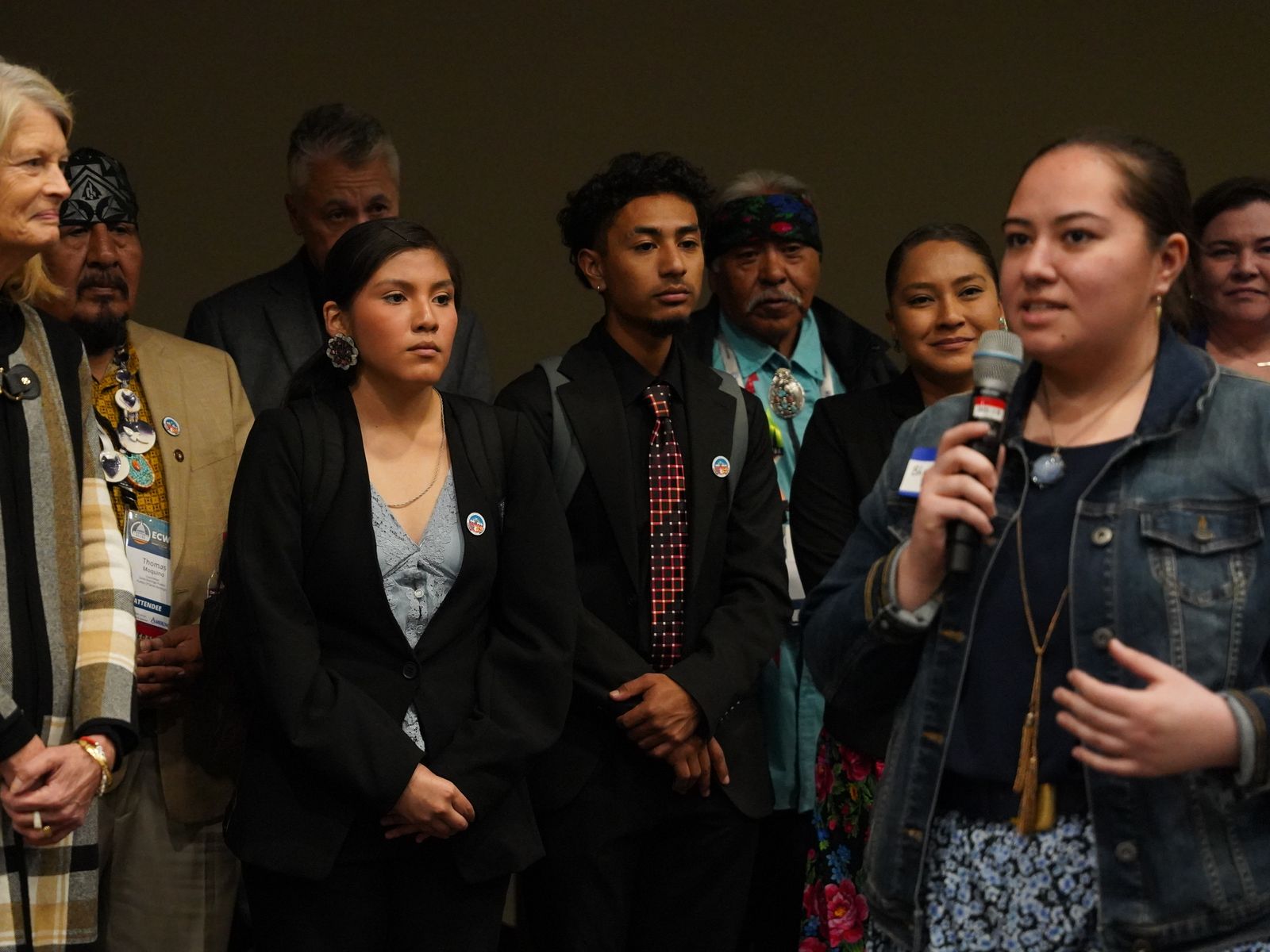

On Feb. 11, multiple Native organizations joined the Mandan, Hidatsa and Arikara Nation at a reception in Washington, D.C., to honor both Senator Lisa Murkowski and Congresswoman Nancy Pelosi for their support in protecting Native children.
The congressional leaders sponsored the Alyce Spotted Bear and Walter Soboleff Commission on Native Children Act, which was introduced in January 2015 by Heidi Heitkamp, a former senator from North Dakota.
The legislation established the Alyce Spotted Bear and Walter Soboleff Commission on Native Children in the Department of Justice’s Office of Tribal Justice, which was named in honor of influential Native leaders: Soboleff, a revered Tlingit elder and advocate for cultural education, and Spotted Bear, former MHA chairwoman.
The commission was composed of 11 members, all but one from Indian Country. Together, they conducted a three-year study of federal, state, local and tribal programs that serve American Indian, Alaskan Native and Native Hawaiian children from birth through age 24 with the goal of finding solutions for how the federal government could better serve Native children.
At the reception, which took place in the Hart Senate Office Building, Murkowski was given the Mandan name Hó' Hsį́į́he — meaning “strong voice”— by MHA tribal member Bheri Rose Hallam, whose paternal grandmother was Alyce Spotted Bear.
“When everyone described her to me, they always said, ‘She has a real strong voice about different topics’ and mentioned what kind of a person she is,” Hallam told Buffalo’s Fire. “People have said that she would stand up for and acknowledge those who have been overlooked.”
In February 2024, the commission published “The Way Forward,” a 242-page report stemming from ten regional hearings, 25 virtual hearings and 26 site visits. The report made 29 recommendations and highlighted the need to implement culturally relevant programming, to improve better data collection to support programs and to create more services for Native children, youth and families.
As a result of the report’s findings, Murkowski, who chairs the Senate Committee on Indian Affairs, drafted the Native Children’s Commission Implementation Act, which would expand protections and investment in Native youth.
“Hearing that Lisa Murkowski and the United States Senate Committee on Indian Affairs are reconvening to advance legislation that transforms our commission’s recommendations into action is deeply encouraging,” Melody Staebner, one of the report’s commissioners and a citizen of the Turtle Mountain Band of Chippewa Indians, told Buffalo’s Fire. “It gives me hope that the voices of tribal nations will lead to real and enduring change for our children and future generations.”
“When a committee chair offers their support to a bill, that’s a significant victory,” said Ryan Wilson, an Oglala Lakota citizen who was delegated by the MHA Nation to organize the reception. “It basically clears it for greater advancement and deference from the other committee chairs, including [Senate Majority Leader John] Thune, who controls the agenda.”
He added, “There will be less effort to block it, because of her ownership of the bill.”
The reception was sponsored by the MHA Nation and co-organized by the Rocky Mountain Tribal Leaders Council, the Navajo Nation, Great Plains Tribal Chairmen’s Association, Affiliated Tribes of Northwest Indians, United South and Eastern Tribes, Inc., the National Indian Education Association, the Midwest Alliance of Sovereign Tribes, the All Pueblo Council of Governors and the National Congress of American Indians.
“The reception was designed on two things — one was to maintain the legacy of Alyce Spotted Bear attached to the bill and engender that spirit in Murkowski, which included giving her a name from Alyce’s tribe,” Wilson said. “But it was really to show the committee chair that all of Indian Country is behind her on this.”
Murkowski announced in August that she would be hosting hearings on how to invest in the development and protection of Native youth. The draft of her bill addresses a wide range of issues affecting the welfare of Native children and families, including physical, behavioral, and environmental health; housing and homelessness; education; child care and the expansion of research and data capabilities.
Wilson said the bill, if passed, would “heighten awareness” of Native children and elevate them “closer to American’s agenda than probably they have ever been.”
It’s not often that multiple organizations unite on federal Indian legislation. Wilson said it usually happens once every couple of years.
“It’s been a long time since we have seen a bill as positive as this,” Wilson said, “It seems like we’re always mitigating something that’s bad or trying to fix something. This is something that says from a strength-based perspective that this is what we want to do for Native children in America.”
At the reception, Pelosi was given a blanket by National Congress of American Indians Executive Director Larry Wright Jr. and President Mark Macarro. She spoke to the hundreds of guests, sharing her more than 20 years of history working alongside Macarro and his wife, Holly Cook Macarro, a Washington lobbyist.
“I want to congratulate you all for the Alyce Spotted Bear and Walter Soboleff Commission and the fact that you put this together to demonstrate how we care for our Native children,” Pelosi said. “Thank you for honoring what the commission was established to do, and I’m congratulating you on the way forward.”
Darren Thompson
(Lac du Flambeau Ojibwe)Former Reporter
Sharing Is Caring
This article is not included in our Story Share & Care selection.
The content may only be reproduced with permission from the Indigenous Media Freedom Alliance. Please see our content sharing guidelines.
© Buffalo's Fire. All rights reserved.
We provide independent Native-focused reporting that gives our communities the context and the facts they need to make informed decisions.
Respect The Fire
At Buffalo's Fire, we value constructive dialogue that builds an informed Indian Country. To keep this space healthy, moderators will remove:
- Personal attacks, harassment, or hate speech
- Spam, misinformation, or unsolicited promotion
- Off-topic rants and excessive shouting (All Caps)
Let’s keep the fire burning with respect.