






The Daily Spark
Small sparks from Indian Country, built to catch fire
Family calls for accountability in killing of Lakota woman on Air Force base
Airman faces a murder charge in the death of Sahela Sangrait as advocates cite missed warning signs and plan a protest
More than 50 people gathered in Rapid City, South Dakota, on March 26 to honor Sahela “Toka Win” Sangrait and call for justice. According to a report by ICT, federal prosecutors have charged United States Airman Quinterius Chappelle with first-degree murder in connection to Sangrait’s death, which authorities said occurred Aug. 10, 2024, on Ellsworth Air Force Base in South Dakota. Family members and advocates said warning signs were missed and the crime could have been prevented.
ICT reports that Chappelle had a prior aggravated assault conviction from a February 2024 incident that was handled by Air Force authorities and that on the night of Sangrait’s death local law enforcement responded to a domestic violence report at his residence without contacting anyone inside. Community members are planning a demonstration outside the base, while Chappelle and Drew Durand, who faces related charges, are scheduled to appear in federal court in May.
Montana awards $100K for tribal tourism projects
Two tribal governments will split state grants to repair campgrounds and upgrade a key event site, projects aimed at strengthening tourism and local economies
The Montana Department of Commerce announced that two tribal governments will share $100,000 in grant funding through its Tribal Tourism Grant Program, according to reporting by the Daily Montanan. The program supports the development, expansion and improvement of tribal tourism assets and local economies.
According to the report, the Blackfeet Nation will receive $50,000 for repairs and upgrades to tribally owned campgrounds in multiple locations. The Fort Belknap Indian Community will receive $50,000 for repairs, mobility improvements and upgrades to the Milk River Indian Days arbor site in Fort Belknap Agency.
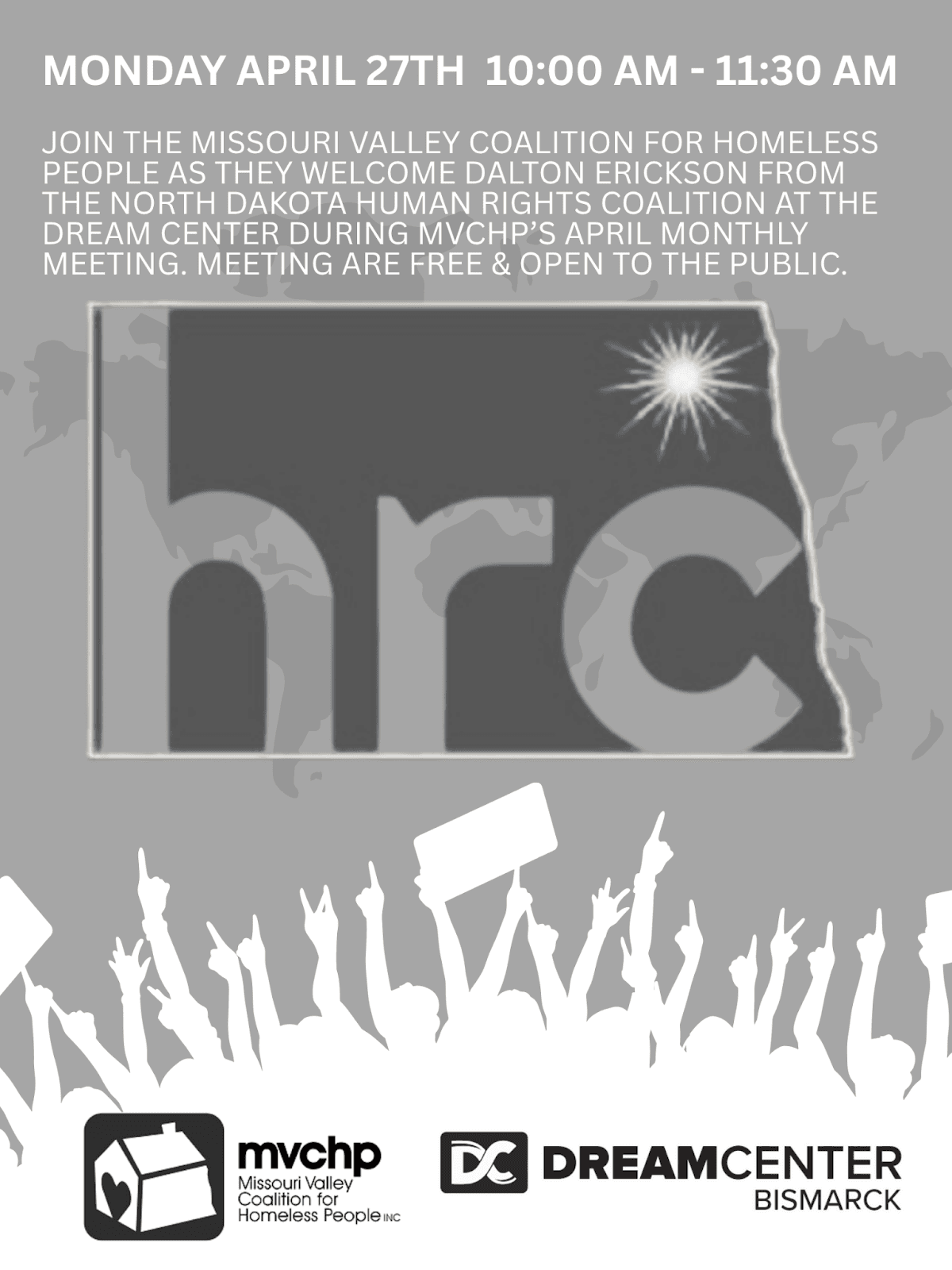
Dalton Erickson to speak at MVCHP meeting in Bismarck
Dalton Erickson of the North Dakota Human Rights Coalition will speak at a free Missouri Valley Coalition for Homeless People meeting in Bismarck
The Missouri Valley Coalition for Homeless People will host its April monthly meeting on Monday, April 27, from 10 to 11:30 a.m. at the Dream Center in Bismarck, according to event materials.
Dalton Erickson of the North Dakota Human Rights Coalition is scheduled to speak. The event is free and open to the public. Organizers said the gathering will take place at the Dream Center as part of MVCHP’s regular monthly meeting schedule.
Time Out Wacipi Powwow set for April 17-18 in Grand Forks
The annual powwow at Alerus Center will feature dance contests, head staff and a public feed, with grand entries scheduled across two days
The 54th Time Out Wacipi Powwow will take place Friday, April 17, and Saturday, April 18, at the Alerus Center in Grand Forks, North Dakota, according to event materials. The event is hosted by the University of North Dakota Indigenous Student Center. Grand entry is scheduled for 7 p.m. on Friday and 1 p.m. and 7 p.m. on Saturday.
Admission is free and a public feed will be held Saturday at 5 p.m., according to the event listing. Head staff include Host Drum Young Enemy, emcees Wes Jourdain and Keveon Kingbird and Arena Director Rusty Gillette. Dance categories include women’s, men’s, teen, junior and golden age divisions, with cash prizes listed for top placements. Registration begins on site Friday at 4 p.m.
Seminole Nation bans data center development on tribal lands
A 24-0 council vote pauses AI tech and hyperscale data centers after a startup proposal raised environmental and sovereignty concerns
The Seminole Nation of Oklahoma has enacted a moratorium on generative artificial intelligence technology and hyperscale data center development on its lands, according to Futurism. The tribal council voted 24-0 after a tech startup approached the Nation about building a data center and requested a non-disclosure agreement and letter of intent. Mekusukey Band Representative Glen Chebon Kernell introduced the resolution and raised concerns during a March 3 assembly.
According to Futurism, tribal members and community residents raised concerns about the environmental impact of data centers. The tribal council worked with Honor the Earth, an Indigenous-led climate organization, to inform the public. Kernell said there was little opposition once the proposal became public, and leaders described the decision as part of broader concerns about environmental impact and sovereignty.
IHS works through decades-old backlog on Native health facilities
A new Santa Ana Pueblo medical center is set for 2027 as IHS targets a decades-old list, but officials say billions more are still needed
The Indian Health Service is moving forward on long-delayed construction projects aimed at replacing aging health facilities that serve Native communities, according to The Associated Press. At Santa Ana Pueblo, a new 235,000-square-foot medical center is expected to break ground in 2027 and provide services including dialysis, diabetes care and optometry. Tribal leaders said the project is expected to ease pressure on the Albuquerque Indian Health Center, a federal facility built about 90 years ago.
According to The Associated Press, the Albuquerque center remains on a 1993 priority list of clinics and hospitals identified for replacement. In February, Health and Human Services Secretary Robert F. Kennedy Jr. pledged $1 billion toward delayed projects, including $22 million for the Santa Ana Pueblo center. Federal officials said about $8 billion is still needed to complete the remaining projects on the list.
Arizona mining push targets protected lands near Grand Canyon
A state proposal asks federal officials to lift mining limits near the Grand Canyon and speed permits, raising concerns about environmental and cultural impacts
Arizona lawmakers are considering a measure urging the Trump administration to ease restrictions on mining in protected areas, including land near the Grand Canyon, according to Arizona Mirror. House Concurrent Memorial 2009 asks federal officials to repeal policies that limit mineral extraction and to streamline permitting for new mines. Supporters said the proposal is aimed at expanding access to copper and other minerals that are restricted by federal land protections.
Opponents raised concerns about environmental impacts and the protection of culturally significant lands. State Sen. Theresa Hatathlie, a citizen of the Navajo Nation, criticized the proposal during a committee hearing, while supporters said it seeks to balance conservation with resource access. The lands referenced in the proposal include areas designated as national monuments, which tribes have identified as culturally and spiritually significant, according to Arizona Mirror.
Washoe Tribe completes landback purchase near Lake Tahoe
A four-year effort with partners raised $69 million to acquire and rename Loyalton Ranch, with plans for stewardship, culture and fire mitigation
The Washoe Tribe of Nevada and California has completed a landback purchase of more than 10,000 acres in the Sierra Nevada, according to ICT. The land, formerly known as Loyalton Ranch, has been renamed the WélmeltiɁ Preserve. Chairman Serrell Smokey told ICT the property will support cultural practices, land stewardship and reconnecting youth with the land and Native language.
According to ICT, the acquisition followed four years of work with partner organizations including the Northern Sierra Partnership, Feather River Land Trust and the Wildlife Conservation Board. Partners raised $6.9 million for the purchase, including $5.5 million from the California Wildlife Conservation Board and private donations. Tribal leaders said plans for the land include conservation, restoration and fire mitigation and described the return as part of a broader healing process following forced removal from the area.
Upper Sioux solar dispute heads to Minnesota regulators
Minnesota regulators will weigh a dispute over a 25-megawatt tribal solar project that could affect how tribes self-generate power while tied to utilities
A dispute between the Upper Sioux Community and Minnesota Valley Cooperative Light & Power Association could shape whether tribal nations in Minnesota can generate more of their own electricity while remaining connected to local utilities, according to MPR News. The case is before the Minnesota Public Utilities Commission after the cooperative argued the tribe’s 2.5-megawatt solar array violates co-op policy and state law. The Upper Sioux Community said the project was designed to help power Prairie’s Edge Casino Resort while keeping the electricity on tribal land.
The Minnesota Department of Commerce sided with the tribe in recent briefs, arguing federal law requires utilities to support customers who self-generate. The outcome could affect other tribal nations pursuing similar projects, including White Earth Nation, which is building a large solar array backed by a federal grant, according to MPR News.
Rapid City council races highlight Native candidates, housing priorities
Eleven candidates, including two Native contenders, compete for five Rapid City Council seats as voters weigh housing, infrastructure and equity issues
Rapid City, South Dakota, will see contested races in every city council ward in the June 2 municipal election, with 11 candidates filing, including two Native candidates, according to Native Sun News Today. One seat in each of the city’s five wards is up for election, and four incumbents are seeking another three-year term. Ward 5 Council President Rod Pettigrew is not running again, leaving an open seat.
At a recent candidate forum, candidates outlined priorities including affordable housing, infrastructure and clean water. Valeriah Big Eagle, director of He Sapa Initiatives at NDN Collective, emphasized housing, education and addressing racism in Rapid City, according to Native Sun News Today. Other candidates highlighted growth, public transportation and collaboration. Early voting begins April 17.
Montana expands Native tuition waiver eligibility, draws mixed response
Rule change removes blood quantum and adds descendants to a waiver used by about 800 students, drawing questions from some tribal leaders over process
Starting July 1, Montana will expand eligibility for its American Indian tuition waiver, allowing more students to qualify for the program that covers tuition costs, according to reporting by Montana Free Press. The change removes the blood quantum requirement and extends eligibility to unenrolled tribal descendants, while maintaining financial need and state residency requirements. About 800 students currently receive the waiver, which costs the state about $3.8 million annually, according to Montana Free Press, citing the Office of the Commissioner of Higher Education.
Officials said the update aims to broaden access to higher education, but some tribal leaders raised concerns about the reasoning behind the change and lack of consultation. Lawmakers said the adjustment followed a 2025 executive order on diversity, equity and inclusion policies.
Medicine Wheel Ride set for May 1-2 across Arizona communities
A two-day ride across San Carlos, White River and Coal Mine aims to raise awareness for Missing and Murdered Indigenous Relatives and invite public participation
The Medicine Wheel Ride will travel through the Arizona communities of San Carlos, White River and Coal Mine May 1-2 to raise awareness for Missing and Murdered Indigenous Relatives, according to a statement from organizers. The ride will bring participants together in unity, prayer and purpose while honoring those who are still missing, according to the organizers, who said each mile and stop is intended to build connection and uplift communities. The ride is open to all participants.

Wolf Point fire chief charged with felony theft in tribal court
Clint Bushman is on leave after about $120,000 in transactions surfaced in a nonprofit account, with the case filed in tribal court
Wolf Point Fire Chief Clint Bushman has been charged with felony theft in the Fort Peck Assiniboine and Sioux Tribes Tribal Court, according to reporting by the Daily Montanan. During a February city council meeting, Wolf Point Mayor Chris Dschaak said Bushman had been placed on administrative leave. According to court documents cited by the Daily Montanan, at the end of 2025, Dschaak discovered missing funds from a Volunteer Ball Association account, a nonprofit fund separate from city and county fire department budgets.
The Daily Montanan reported that Dschaak identified about $120,000 in suspicious transactions, including $40,000 in cash withdrawals and $20,000 in Amazon purchases that were not approved by association members. The information was provided to the Roosevelt County Sheriff’s Office, the Federal Bureau of Investigation and the Fort Peck Tribes Department of Law and Justice. Felony theft in tribal court carries a maximum penalty of one year imprisonment, a $5,000 fine or both, according to the Daily Montanan.
Indigenous student prevails in dispute over hair at BYU
A Kainai Nation student can keep his braids and stay in class and on a dance team after challenging BYU's grooming rules
An Indigenous student reached a resolution with Brigham Young University after challenging school policies requiring him to cut his hair, according to the Daily Mail. Jerrhan First Charger, a member of the Kainai Nation of the Blackfoot Confederacy, filed a federal lawsuit after being told he could be removed from class and suspended from the BYU Living Legends dance team for wearing long braids tied to his culture. Brigham Young University is owned by The Church of Jesus Christ of Latter-day Saints.
University officials later allowed First Charger to continue his studies and remain on the dance team with an exception to its Honor Code grooming standards. The university said the policy remains in effect but may allow rare exceptions on a case-by-case basis. First Charger said his hair reflects his cultural identity and traditions, and he sought recognition of that significance in his communications with the school.
Washington housing reform bill stalls after debate over Native homeownership program
House Bill 2527 failed after reports that 300-plus homes were not transferred to Native buyers; the sponsor plans to revive it
A Washington bill aimed at strengthening oversight of a state-managed federal housing program for Native families died in committee this legislative session, according to Underscore Native News and ICT. House Bill 2527 was introduced after reporting found that more than 300 homes eligible for transfer to Native homeowners had not been conveyed. The measure would have allowed the Washington Housing Finance Commission to penalize private developers who failed to meet tenant ownership obligations.
State Rep. Gerry Pollet, D-Seattle, said confusion about the program and misleading testimony from commission staff contributed to the bill’s failure. According to Underscore Native News and ICT, he plans to revise the legislation and reintroduce it in 2027.
Idaho officials begin outreach to tribes for America250 events after concerns raised
After tribal leaders raised concerns about exclusion, Idaho officials reached out in February to involve tribes in America250 planning, with more formal
Idaho officials began contacting tribal representatives about participating in America250 celebrations after tribal leaders raised concerns about a lack of inclusion, according to an article in the Idaho Capital Sun. During a Feb. 18 Idaho Council on Indian Affairs meeting, according to the article, Shoshone-Paiute Tribes Vice Chairman Arnold Thomas said tribal leaders had not been contacted about plans and expected greater involvement from the state.
State Rep. Brandon Mitchell, co-chairman of the America250 in Idaho Advisory Council, told the Idaho Capital Sun that he reached out to representatives on Feb. 20 to coordinate participation, and a spokesperson for Idaho Treasurer Julie Ellsworth’s office said staff were working to formalize consultation with tribes. On March 18 Thomas told the Sun that outreach following the meeting was “very informal” and said the anniversary should recognize tribal nations and their sovereignty.
New video game supports Ojibwe language learning beyond classroom
“Reclaim! Azhe-giiwewining” uses story-driven gameplay and Ojibwe voice work to move language practice into daily life, developers say
A new video game aims to expand opportunities for Ojibwe language learning outside traditional classroom settings, according to MPR News. “Reclaim! Azhe-giiwewining,” released Thursday, follows a teen character named Miskwaa as she navigates a dreamlike world using cultural teachings and Ojibwe language skills to return home. The game is voiced in Ojibwe and playable in both Ojibwe and English.
Developed by Grassroots Indigenous Multimedia in partnership with the University of Minnesota and the Massachusetts Institute of Technology, the project involved Ojibwe speakers from Canada and Minnesota to ensure language accuracy. Director Mary Hermes told MPR News the game was designed to bring language use into homes and everyday life. The project reflects efforts to create engaging spaces for Indigenous language learning across generations, according to MPR News.
Pine Ridge student Cody Two Bulls receives national Citizen Honors Award
Cody Two Bulls, one of six honorees nationwide, was recognized March 25 in Washington for founding Backpacks & Baseball on Pine Ridge
Senior Cody Two Bulls has been named a 2026 Citizen Honors Award recipient by the Congressional Medal of Honor Society, according to a news release from Maȟpíya Lúta. He is one of six honorees selected nationwide and was recognized by a panel of Medal of Honor recipients. The awards are presented annually on National Medal of Honor Day, March 25, in Washington, D.C., and recognize civilians who demonstrate courage, service and integrity in their communities.
Two Bulls was honored in the Youth Service category for founding Backpacks & Baseball, an initiative serving children and families on the Pine Ridge Reservation. According to Maȟpíya Lúta, his work has included distributing backpacks, meals, holiday gifts and essential supplies. He is also a student-athlete at Maȟpíya Lúta, where he participates in track and field and basketball.
Indigenous chef Crystal Wahpepah releases first cookbook
The Kickapoo and Sac and Fox chef’s first book offers 125 recipes and a focus on seasonal cooking, foraging and cultural ties
Indigenous Chef Crystal Wahpepah released her first cookbook, “A Feather and a Fork: 125 Intertribal Dishes from an Indigenous Food Warrior,” on March 17, according to ICT. The book features more than 125 recipes and highlights seasonal cooking, foraging and connections to land and culture. Wahpepah, who is Kickapoo and Sac and Fox, said the project took five years to complete.
Wahpepah said she hopes readers understand where food comes from and its cultural significance. “I want to take other people on that journey where we are so well connected with our food,” she told ICT. The cookbook includes dishes such as blue cornbread, Three Sisters salad and bison recipes. A foreword by author Tommy Orange describes Wahpepah as a “tremendously talented, heart-and-soul-driven chef,” according to the report.
Minnesota schools fall short on Native language, culture requirements
A report finds districts lack more than 150 teachers to meet requirements, citing recruitment and funding hurdles and limited instructional support
Minnesota school districts required to offer American Indian language and culture classes are not meeting state requirements, according to MPR News. State law requires districts with at least 5% American Indian enrollment or 100 or more Native students to provide the classes, but a recent report found districts would need more than 150 additional language teachers to reach compliance.
The report identified a teacher-to-student ratio of 1:257 and found only 98 American Indian language educators among about 200,000 licensed teachers statewide, according to MPR News. Gimiwan Dustin Burnette, president and executive director of the Midwest Indigenous Immersion Network, said many instructors work part time and lack support, with 78% responsible for developing their own curriculum. Districts cited recruitment challenges and funding limitations as key barriers, according to MPR News.