

















Tohono O’odham chairman on sacred site destruction: ‘If this can happen to us, it can happen to each and every one of you out there’
The 83rd annual National Congress of American Indians convention began Monday

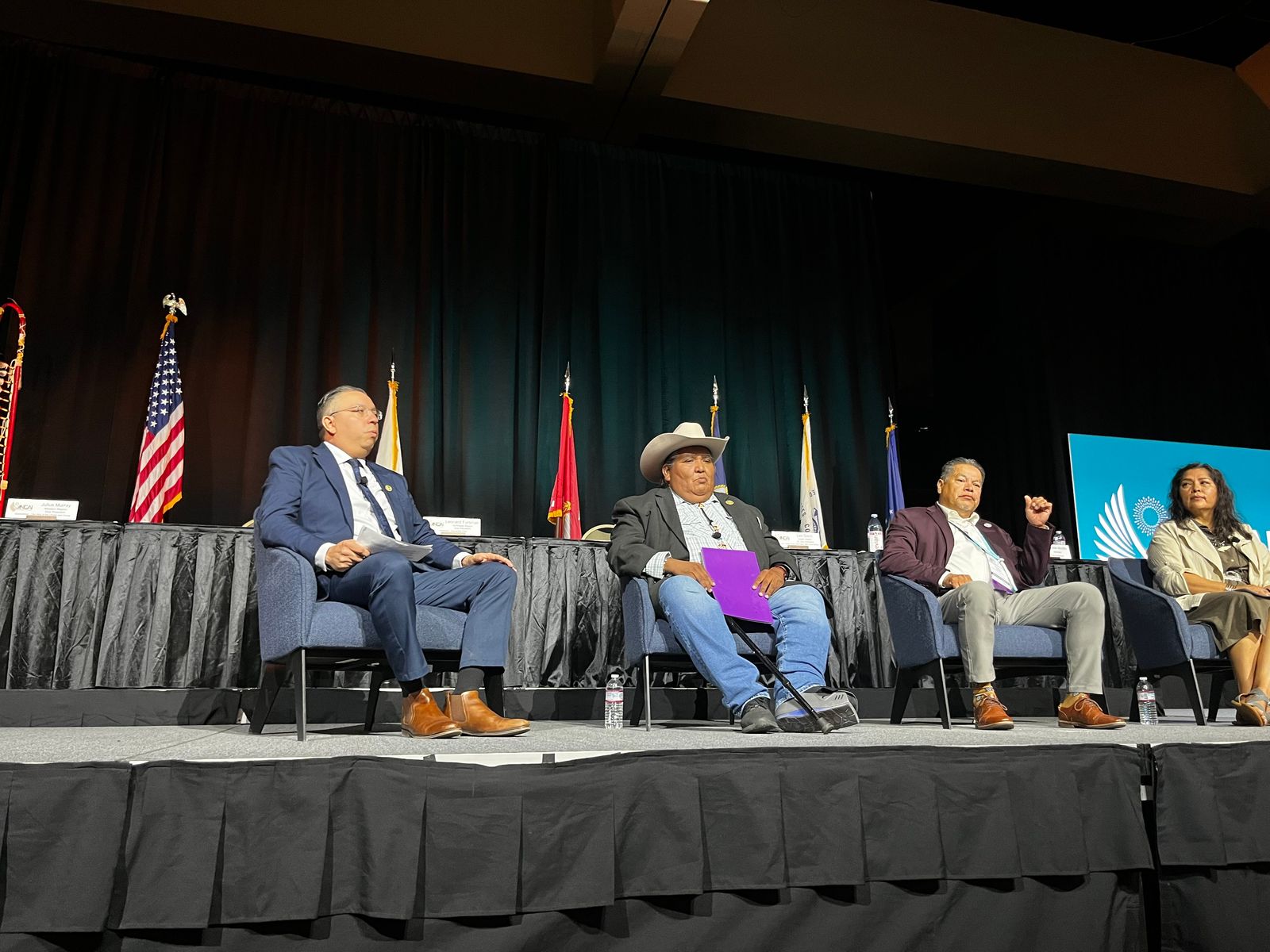
The United States government wants to destroy thousands of saguaro cacti for border wall construction near the Tohono O’odham Nation in what tribal leaders say would be another attack against sovereignty laws meant to protect land-based religions.
On Monday, Tohono O'odham Nation Chairman Verlon Jose told Native American leaders from tribal nations across the country that the border wall project has already desecrated sacred sites.
“They want to kill our family, our sacred saguaros,” he said. “They have personhood and they’re gonna murder them with federal authority.”
Jose spoke alongside Santo Domingo Pueblo Governor Raymond Aguilar, Jr., and Davina Smith-Idjesa (Diné), the co-chair of the Bears Ears Inter-Tribal Coalition, during the opening general assembly of the National Congress of American Indians.
The preeminent lobbying group is holding its 83rd annual convention this week in Palm Springs, California.
At the convention, tribes generate policy resolutions based on their experiences with federal, state and local governments. NCAI’s advocacy work reaches federal agencies and congressional leaders responsible for services to all 575 federally recognized tribes. Representatives from at least 250 of those tribes are active members of the NCAI, which focuses on tribal governance structures, such as legal frameworks and business, and then evaluates how to implement priorities through government-to-government relationships.
This year, topics under discussion include sacred site protection, hiring freezes in the Bureau of Indian Affairs, gaming tribes’ response to predictive markets, education reform, voting advocacy, Native American Graves Protection and Repatriation Act reform and free press.
The free press resolution on the agenda is sponsored by Jodi Rave Spotted Bear, founder of Native Media Freedom Alliance and editor-in-chief of Buffalo’s Fire.
More than 50 other resolutions were introduced Monday. Most will be voted on in committees on Tuesday. The full NCAI membership votes Wednesday and Thursday. Anything passed will become reference for how Indian Country views policy on pressing matters.
Kim Craven, attorney general for the Cheyenne River Sioux Tribe, said policies NCAI adopts are vital for lobbying the U.S. Congress in Washington, D.C., during budget discussions.
“When we go to lobby, we say, ‘Look, this is what the NCAI resolution says about this matter,’” said Craven, a lifetime NCAI member. “And then Congress can get kind of a general sense of what the tribes as a large body think around a general topic. That's where I find the most helpful: lobbying, appropriations, things like that.”
Craven submitted seven resolutions on behalf of the tribe’s leadership that are on the agenda this week. They include responses to issues tribes are currently facing with housing development, tribal transportation grants, artificial intelligence and energy access.
“It's kind of a nice historical body of work,” she said. “A resolution is only as good as the person that wants it and the person that actually uses it. Otherwise it's just like any other kind of reports that you get done and you have on the shelf.”
She pointed to prior resolutions addressing law enforcement needs in Indian Country that eventually turned into tangible results, like a new federal police training program in North Dakota.
“There was only one place for training tribal law enforcement and it was in Artesia, New Mexico,” she said.
NCAI advocacy can also directly address ongoing court battles that have longstanding precedent for tribal sovereignty matters, like the border wall construction issues in Tohono O’ohdam. Discussions are intended to provide public awareness in a space where tribes have control over their own message.
In August, a federal judge denied Tohono O’odham’s request to stop border wall construction. The tribe appealed, and last week the U.S. government filed its response.
“Hopefully the D.C. circuit will take this up quickly,” Matthew Campbell, staff attorney with Native American Rights Fund, said in an update to tribal leaders during Monday’s Litigation & Governance Committee, which he chairs. “It’s a very important issue for tribal sovereignty, jurisdiction and sacred places as well.”
In his speech to the full convention, Jose stressed that prayer and ceremony with tribal solidarity would be most impactful now for Tohono O’odham’s fight against intrusive U.S. land policies.
“If this can happen to us, it can happen to each and every one of you out there,” he said. “We must stand together even stronger. We must rise and tell the federal government, ‘No more.’”
Sharing Is Caring
This article is not included in our Story Share & Care selection.
The content may only be reproduced with permission from the Indigenous Media Freedom Alliance. Please see our content sharing guidelines.
© Buffalo's Fire. All rights reserved.
We provide independent Native-focused reporting that gives our communities the context and the facts they need to make informed decisions.
Respect The Fire
At Buffalo's Fire, we value constructive dialogue that builds an informed Indian Country. To keep this space healthy, moderators will remove:
- Personal attacks, harassment, or hate speech
- Spam, misinformation, or unsolicited promotion
- Off-topic rants and excessive shouting (All Caps)
Let’s keep the fire burning with respect.