






Syndication
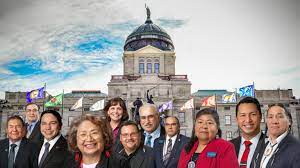
The Montana governor signed a flurry of legislation in the past two weeks which included a few high-priority bills from the Montana American Indian Caucus.
Gov. Greg Gianforte signed both the Montana Indian Child Welfare Act and the Indian Education For All bill into law earlier this week. The first bill secures Indigenous family protections in the state, and the second revises how Native history is taught in schools.
Both bills were sponsored by Rep. Jonathan Windy Boy, D- Box Elder, who had fought throughout the session to ensure that these issues involving Montana’s Indian Country were being addressed at the state-level.
Montana is the latest state to codify the Indian Child Welfare Act into state law, after the Wyoming legislature passed its own bill earlier this year. A main push for getting this bill into law came from the pending Supreme Court Case involving the federal ICWA, Brackeen v Haaland, which could change how ICWA works throughout the nation.
Montana ICWA, or MICWA, had a tough battle by undergoing a few amendments including one that implemented a termination date, which was later removed. Another amendment removed a section describing how to handle children in the system whose native status is pending – essentially giving the state liberty to identify Indigenous children – an issue that Windy Boy said infringes on tribal jurisdiction.
“That needs to go,” Windy Boy said during the conference committee where the amendments were deliberated. “It’s not fair for the tribe to not be at the table because they make those determinations through their enrollment certification process. “State of Montana has no business in making that determination of that Indian child.”
Windy Boy’s bill seeking to revise the state’s Indian Education for All program passed through the statehouse with some challenges. An attempted amendment tried to amend the original education program language, taking it from a requirement as defined by the state constitution to a “recommendation.” However, that amendment was eventually removed and original language was restored in the final version of the bill.
Now, the newly signed law calls on Montana's Office of Public Instruction and Board of Public Education to strengthen the reporting requirements that school districts must follow when spending Indian Education For All funds.
Indian Education for All is a mandatory requirement that was incorporated into Montana's constitution in 1972. Under the state statute, it states that “every Montanan, whether Indian or non-Indian, be encouraged to learn about the distinct and unique heritage of American Indians in a culturally responsive manner,” and that all educational agencies within the state will work with tribes when providing curricula.
However, there is a current lawsuit filed by the American Civil Liberties Union Montana and the Native American Rights Fund against the Office of Public Instruction and the Board of Public Education that is representing several Montana tribes as well as individuals after complaints that some school districts are not implementing the education requirement thoroughly enough.
The Native American Rights Fund staff attorney, Melony McCoy stated on the rights fund website that, “Montana is the first and to date only state to constitutionally require the teaching of Indian education to all students in its public schools. That is a stunning testament to the people of Montana who are not getting what they voted for and what their public money is being allocated for.”
The case is set to go to trial during August of 2024.
This story is co-published by Montana Free Press and ICT, a news partnership that covers the Montana American Indian Caucus during the state’s 2023 legislative session. Funding is provided in part by the Headwaters Foundation.
Spotted an error? Suggest a correction.
We provide independent Native-focused reporting that gives our communities the context and the facts they need to make informed decisions.
Respect The Fire
At Buffalo's Fire, we value constructive dialogue that builds an informed Indian Country. To keep this space healthy, moderators will remove:
- Personal attacks, harassment, or hate speech
- Spam, misinformation, or unsolicited promotion
- Off-topic rants and excessive shouting (All Caps)
Let’s keep the fire burning with respect.