






The Daily Spark
Small sparks from Indian Country, built to catch fire
Proposed federal budget targets cuts to minority-serving colleges, IAIA funding
Mohawk-led center plans cultural education and youth programming as land return supports Haudenosaunee stewardship
New Mexico officials, tribal colleges and universities criticized a proposed federal budget that would cut funding for minority-serving institutions and eliminate support for the Institute of American Indian Arts, according to Source NM. The proposal, submitted to Congress on April 3, calls for removing $354 million in discretionary funding for colleges serving Asian, Black, Indigenous and Hispanic students and ending IAIA’s $13 million budget.
IAIA President Dr. Shelly C. Lowe urged Congress to reject the proposal, saying the school plays a key role in supporting Indigenous artists and communities. University leaders in New Mexico said previous federal cuts have already reduced funding and supported programs, while U.S. Sen. Ben Ray Luján said he plans to oppose the proposal, according to Source NM.
Oregon school board weighs closure of Siletz Valley School after compliance concerns
Community members rally to keep Siletz Valley School open as board reviews compliance issues ahead of April 14 decision
Dozens of students, teachers and community members gathered March 31 outside the Lincoln County School District offices to urge officials not to close Siletz Valley School, a K-12 charter school in Oregon facing 12 compliance issues, according to an article by Underscore Native News and ICT. The article reports that more than half the students at the school are Indigenous and many are citizens of the Confederated Tribes of Siletz Indians.
The public hearing, requested by acting superintendent Debra Barnes, addressed concerns including teacher licensure, attendance planning and required student programs. Barnes told the board the school has taken steps over the past eight months to address the issues and remains committed to meeting requirements. More than 60 people attended the hearing, with additional attendees in an overflow room. The Lincoln County School Board is expected to decide April 14 whether to revoke the school’s charter agreement.
BIA identifies remains of missing Chickasaw Nation citizen Molly Miller
Federal officials confirm identification of remains nearly 12 years after disappearance, as investigation into the deaths continues
The Bureau of Indian Affairs Missing and Murdered Unit has identified human remains as those of Molly Miller, a citizen of the Chickasaw Nation who disappeared in 2013, according to a Department of the Interior announcement. The remains were found Feb. 18 during a search led by the unit and the Chickasaw Lighthorse Police Department in Love County, Oklahoma. The Oklahoma Office of the Chief Medical Examiner confirmed the identification March 31, and Miller’s family was notified April 6.
A second set of remains was identified as Colt Haynes, and both families have been notified, according to officials. The search covered more than 1,000 acres and involved multiple agencies, including the FBI and Oklahoma Highway Patrol. Authorities said the area had not been previously searched and was identified through new information. The investigation into the deaths remains ongoing.
Medicaid cuts delay doula services on Northern Cheyenne Reservation
Budget shortfall pauses planned Medicaid coverage for doulas, delaying paid support services for Northern Cheyenne families
Montana health officials have postponed adding doula services to the state’s Medicaid program, citing a budget shortfall, according to KFF Health News. The decision halts a plan approved last year that would have reimbursed doulas up to $1,600 per pregnancy.
The delay affects providers like Misty Pipe, a Northern Cheyenne doula who offers unpaid support in a community about 100 miles from the nearest hospital that delivers babies, according to KFF Health News. Officials project a $146.3 million Medicaid funding shortfall and said additional service reductions may follow as the state evaluates spending.
U.S. Supreme Court declines to hear Oklahoma tribal tax case
The court’s decision leaves in place a ruling requiring some tribal citizens to pay Oklahoma state income tax, as Muscogee Nation leaders consider next steps
The U.S. Supreme Court declined to review Stroble v. Oklahoma, a case involving whether tribal citizens must pay state income tax, according to KOSU. The decision means an Oklahoma Supreme Court ruling requiring some tribal citizens to pay state income tax will stand. The case involved Alicia Stroble, a Muscogee Nation citizen who sought a tax exemption for 2017 to 2019 while living and working within the reservation, according to the report.
Muscogee Nation Principal Chief David Hill said in a statement the tribe is considering next steps, including possible action in lower federal courts, according to KOSU.
Osage LLC names Randall Burke as CEO, announces leadership transition
Osage LLC appoints Randall Burke as CEO as longtime leader Russell Goff shifts to a senior adviser role following years of company growth
Osage LLC has named Skyway Range Executive Director Randall Burke as chief executive officer, effective April 6, according to an official statement by Osage LLC. Burke replaces Russell Goff, who has served as CEO for the past five years and will transition to senior adviser to the Osage LLC Board of Directors. Skyway Range is a subsidiary of Osage LLC, a wholly owned company of the Osage Nation.
Goff led the company through expansion, including four consecutive years of profitability and dividends to the Osage Nation and a more than 300% increase in total assets, according to the statement. Burke, an Air Force veteran and citizen of the Chickasaw Nation, was named executive director of Skyway Range in 2024 and has more than 36 years of aviation and program experience.
Immersion program uses cultural practices to teach Ojibwe and Dakota languages
Students learn Ojibwe and Dakota through hands-on cultural practices as an immersion program works to grow the next generation of speakers in Minnesota
Students in an Indigenous language immersion program in Minnesota are learning Ojibwe and Dakota through cultural activities, including a field trip to a maple tapping camp, according to MPR News. The program, Wicoie Nandagikendan, teaches students entirely in Indigenous languages, with lessons that include traditional food preparation and harvesting practices. Teacher Liz Zoongwegiizhigook Zinsli said she speaks only Ojibwe with students to support language development.
Program leaders said fewer than 1,000 fluent Ojibwe speakers remain in Minnesota, with even fewer Dakota first language speakers, according to MPR News. Executive director Fawn Youngbear-Tibbetts said the goal is to build the next generation of speakers. The program recently faced funding freezes but remained open with support from local organizations. Leaders said a Dakota immersion classroom is expected to reopen in the fall, expanding language learning opportunities for students.
Tribal leaders raise concerns over prediction markets at gaming convention
Leaders say platforms may evade gambling rules and threaten tribal revenue, as lawsuits from states and tribes challenge their legality
Tribal leaders raised concerns about the growth of prediction market platforms during the Indian Gaming Association’s annual convention in San Diego, according to the Associated Press. Chairman David Bean said platforms such as Kalshi and Polymarket may be misrepresenting their products to avoid federal, state and tribal gaming regulations. “This is unlawful gambling dressed up as finance,” Bean was quoted as saying during a news conference.
The association called on Congress to regulate prediction markets and announced a defense fund to support legal action. Platform operators say users are participating in futures trading, not gambling. According to the Associated Press, lawsuits filed by more than a dozen states and four tribal nations argue the platforms violate existing laws and tribal-state compacts, raising concerns about impacts to tribal gaming revenue that funds essential services.
Anishinaabemowin conference marks 32 years of language revitalization efforts
Participants from Canada and US Ojibwe communities met in London, Ontario, to share tools, teaching methods and ideas to expand language revitalization
Hundreds of speakers, learners and teachers gathered March 26-28 in London, Ontario, for the 32nd annual Anishinaabemowin Language Conference, according to ICT. The event, coordinated by Anishinaabemowin-Teg Inc., brought together participants from across Canada and Ojibwe-speaking communities in the United States to share resources, teaching strategies and cultural knowledge aimed at sustaining the Anishinaabe language.
Organizers said the conference has grown over three decades and remains largely self-funded through registration fees and donations. Workshops this year focused on immersion learning, online language tools and historical teachings. Speakers emphasized the role of community-based programs and youth engagement in preserving language, with participants sharing ideas to expand revitalization efforts in their home communities, according to ICT.
Second Black Hills mining proposal selected for fast-track federal permitting
Federal officials placed the Bear Lodge project on a faster permitting path, a move that could trim review time and revive a delayed rare earth effort
Federal officials have selected the Bear Lodge Rare Earth Mining Project in northeastern Wyoming for expedited permitting under the FAST-41 process, according to reporting by South Dakota Searchlight. The project, located on the Wyoming side of the Black Hills, is expected to produce rare earth elements used in alloys and magnets. The federal Permitting Council said the FAST-41 process is designed to improve coordination among agencies and could reduce review time by about 18 months.
The project has faced delays due to permitting challenges, market saturation from China and difficulty raising capital, according to the Cowboy State Daily. Wyoming U.S. Sen. Cynthia Lummis said in a news release the project could become a key domestic source of elements used in defense systems and high-tech manufacturing. A separate Black Hills mining proposal, the Dewey-Burdock uranium project in southwestern South Dakota, has drawn opposition from the Oglala Sioux Tribe, NDN Collective and the Black Hills Clean Water Alliance, according to South Dakota Searchlight.
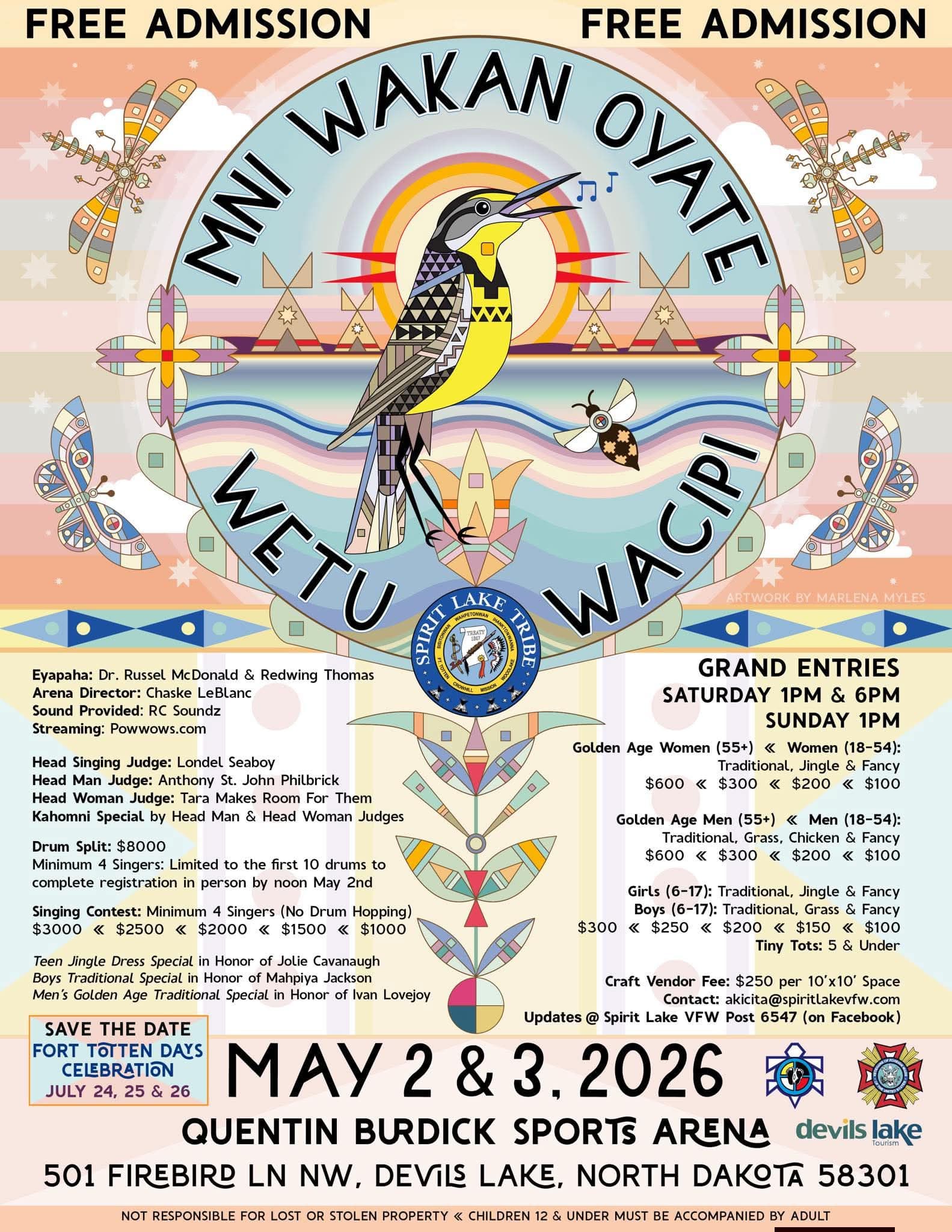
Mni Wakan Oyate Wetu Wacipi set for May 2-3 in Devils Lake
The Mni Wakan Oyate Wetu Wacipi will be held May 2-3 in Devils Lake, featuring dance and singing contests and free admission
The Mni Wakan Oyate Wetu Wacipi will be held May 2 and 3 at Quentin Burdick Sports Arena in Devils Lake, North Dakota, according to the event flyer. Admission is free. Grand entries are scheduled for 1 p.m. and 6 p.m. Saturday and 1 p.m. Sunday.
According to the flyer, the event will include dance and singing contests, with categories for women, men, youth and tiny tots. The flyer lists Dr. Russel McDonald and Redwing Thomas as eyapaha, Chaske LeBlanc as arena director and RC Soundz as sound provider. It also names Londel Seaboy as head singing judge, Anthony St. John Philbrick as head man judge and Tara Makes Room For Them as head woman judge. Updates are posted through Spirit Lake VFW Post 6547 on Facebook.
Funding ends for Winnemem Wintu salmon restoration effort
Drought-linked funds are running out, ending support for a Winnemem Wintu effort to return Chinook to the McCloud River after more than 80 years
California is ending funding for a salmon restoration project led by the Winnemem Wintu Tribe, according to CalMatters. The project aimed to return endangered winter-run Chinook salmon to the McCloud River, where the fish had not been present for more than 80 years. State officials said the funding was tied to drought response efforts and has now been exhausted.
According to CalMatters, the tribe received more than $6 million since 2023, with funding expected to end by June. Tribal leaders said the loss of funding is leading to layoffs and could halt restoration work, including efforts to reintroduce salmon and restore genetic diversity. State officials said the pilot project established a foundation for future work, but no plans are in place to continue transporting fertilized eggs above dams this year.
Federal operation expands resources for Indian Country cases
Justice Department and FBI detail a fourth-year surge that sends rotating teams to 11 field offices to work unresolved violent crime cases in Indian Country
The U.S. Department of Justice and FBI announced April 2 a personnel surge under Operation Not Forgotten 2026 to support investigations in Indian Country. The initiative, now in its fourth year, focuses on unresolved violent crime cases, with priority on cases involving violence against women and children, including those who are missing or murdered.
According to a DOJ press release, the operation will deploy investigative, intelligence and victim-service personnel on rotating assignments across 11 FBI field offices, including Phoenix. The FBI is coordinating with U.S. Attorneys’ Offices, the Bureau of Indian Affairs Missing and Murdered Unit, the Bureau of Alcohol, Tobacco, Firearms and Explosives and tribal law enforcement. Officials said prior deployments supported more than 700 cases, resulting in recoveries of child victims, arrests and federal indictments.
U.S. attorney’s office marks Sexual Assault Awareness Month
A federal office in Wisconsin highlights Sexual Assault Awareness Month and cites more than $56 million in victim service grants for 2025
The U.S. Attorney’s Office for the Eastern District of Wisconsin is observing Sexual Assault Awareness Month in April alongside the U.S. Department of Justice, the Office on Violence Against Women and tribal nations, according to a statement released April 2.
According to the statement, the Office on Violence Against Women awarded more than $5.6 million to Wisconsin grantees in fiscal year 2025 through programs including the Tribal Sexual Assault Services Program, Legal Assistance for Victims Program and Transitional Housing Assistance Grants. The Department of Justice also funds victim services through the Office for Victims of Crime. Officials encouraged the public to learn the signs of abuse and connect victims to available resources, including national and Native-focused helplines.
Tribal colleges host Red Sand events across North Dakota
Tribal and state colleges will hold April 7 events using Red Sand displays, speakers and booths to spotlight trafficking and support affected communities
The five tribal colleges in North Dakota, along with participating state colleges, will host Red Sand Awareness events April 7, according to the First Nations Women’s Alliance. The events are part of the Red Sand Project, a visual campaign that raises awareness about human trafficking and exploitation by filling sidewalk cracks with red sand to symbolize people who fall through gaps in systems and communities.
Participating colleges include Turtle Mountain Community College, United Tribes Technical College, Nueta Hidatsa Sahnish College, Cankdeska Cikana Community College and Sitting Bull College. According to the announcement, each location will offer informational booths, a short video, a speaker and opportunities for attendees to take part in the Red Sand activity. Organizers said the events aim to bring communities together to increase awareness and support those affected.
Descendants of Choctaw code talkers honored with historical marker in Fort Worth
A Fort Worth marker recognizes Choctaw soldiers who sent coded World War I messages, highlighting 19 troops who trained at Camp Bowie
Descendants of Choctaw code talkers gathered April 1 in Fort Worth for the unveiling of a historical marker recognizing Native soldiers who used their language to transmit encrypted messages during World War I. The ceremony at Veterans Memorial Park was hosted by the Choctaw Nation, the Texas Historical Commission and the city’s parks and recreation department, according to the Fort Worth Report.
Nuchi Nashoba, president of the Choctaw Code Talkers Association, told the Fort Worth Report the marker helps preserve the group’s legacy. The code talkers were among 19 Native soldiers who served in northern France and were sworn to secrecy for decades. Officials said the men trained at Camp Bowie in Fort Worth and used their Choctaw language to send messages that enemy forces could not decipher, according to the Fort Worth Report.
USDA cancels tribal agriculture grants, projects face uncertainty
Cuts include nearly $9M for a Blackfeet Reservation institute; leaders say projects, jobs and training tied to a $300M program are at risk
The U.S. Department of Agriculture has terminated dozens of agricultural grants, including nearly $9 million awarded to the Piikani Lodge Health Institute on the Blackfeet Reservation, according to Montana Free Press.
The funding was part of the Increasing Land, Capital and Market Access Program, which distributed about $300 million to 50 grantees in 2023. USDA officials said the program involved “discriminatory preferences” tied to Diversity, Equity and Inclusion and “wasteful spending.” Tribal leaders and project organizers disputed that characterization, calling the cancellations “devastating,” according to Montana Free Press. The grants supported projects including land purchases, farmer training and food production infrastructure, and leaders said the loss of funding threatens jobs, training programs and economic development efforts.
Fort Totten man pleads guilty to assault and voluntary manslaughter in Spirit Lake cases
Kolby Jae McKay admitted to assault and a 2024 killing on the Spirit Lake Reservation; sentencing is set for July 22, 2026
A Fort Totten man pleaded guilty to multiple federal charges tied to two incidents on the Spirit Lake Reservation, according to a statement from the U.S. Attorney’s Office for the District of North Dakota. Kolby Jae McKay, also known as Kolby Woods, 33, pleaded guilty to assault with a dangerous weapon, assault of a spouse, intimate partner or dating partner by strangulation and voluntary manslaughter before Chief Judge Peter D. Welte. Sentencing is scheduled for July 22, 2026.
According to the statement, the assault charges stem from a March 13, 2024, incident involving a woman identified as “Jane Doe.” He also pleaded guilty to voluntary manslaughter in the April 3, 2024, killing of Monte Ray Herman Sr. McKay fled after the killing, prompting a curfew and reward notice by the Spirit Lake Tribal Council, according to the statement.
Warm Springs chief Delvis Heath Sr. dies at 87
Delvis Heath Sr, a hereditary chief since 1984, died March 29, the Confederated Tribes of Warm Springs said, marking the loss of a cultural leader
Warm Springs Chief Delvis Heath Sr. died March 29, according to a statement from the Confederated Tribes of the Warm Springs Reservation of Oregon. He served as the Warm Springs people’s hereditary chief for 42 years and took on the role in 1984.
Heath was a ceremonial leader, Sahaptin language speaker and longtime participant in Longhouse traditions, including dancing, drumming and singing, according to the statement. He also served as Board Member Emeritus for the Museum at Warm Springs and worked as a liaison with federal and state governments during his time on Tribal Council. Heath advocated for tribal sovereignty, treaty rights, natural resources, fishing rights and health issues. He was born Sept. 26, 1938, near Simnasho and married Shirley Stahi in 1960.