






The Daily Spark
Small sparks from Indian Country, built to catch fire
Lawsuit challenges Forest Service permit for graphite drilling at Pe’ Sla
Advocacy groups say the Forest Service bypassed full environmental review for a multiyear graphite project and seek a court order to stop it
NDN Collective, Black Hills Clean Water Alliance and Earthworks filed a lawsuit against the U.S. Forest Service over its February decision to approve exploratory drilling at Pe’ Sla, according to a statement from the groups. The lawsuit argues the agency improperly used a “categorical exclusion,” which allows projects to proceed without a full environmental review, despite the graphite project being expected to last at least three years.
The groups say the project could harm the site’s cultural and religious uses and impact water in the Rapid Creek watershed. According to the statement, a 2024 memorandum of understanding between the Forest Service and Oceti Sakowin tribal nations established a 2-mile buffer zone around Pe’ Sla and recognized its cultural importance. The lawsuit asks a federal court to reverse the permit and halt further activity.
South Dakota Board of Minerals and Environment to host 5-day hearing on proposed uranium drilling permit near sacred site in Black Hills
Hearing to be first in state history to accept Lakota language
The South Dakota Board of Minerals and Environment is hosting a five-day hearing, beginning April 13, at the Mueller Civic Center in Hot Springs, regarding an application for uranium drilling in the southern Black Hills. The Canadian firm Clean Nuclear Energy Corp. is seeking a permit to explore the area known as Craven Canyon for uranium deposits. The firm wants to drill up to 50, 700-foot-deep test holes adjacent to sites listed on the National Register of Historic Places.
Lakota elders, tribal nations, landowners and community members oppose the project, saying the location is a sacred site. Opponents plan to hold a five-day prayer vigil during the hearing, with a sunrise ceremony scheduled for April 13. The meeting was initially planned in Pierre but changed to Hot Springs at the request of Lakota organizers.
The meeting will be the first in the state's history to accept comments in the Lakota language. On March 9, Gov. Larry Rhoden signed legislation requiring the state to provide translator services in official hearings. The law was named after Helen Red Feather, a fluent Lakota speaker from Wounded Knee, South Dakota. She previously provided comments about the significance of Craven Canyon in the Lakota language and was told by the South Dakota Board of Minerals that it couldn't accept comments in a language other than English. Organizers then successfully lobbied to change the law, allowing state proceedings to accept verbal submissions in any language, including the Lakota language.
Federal tax credit program offers rare path to Native homeownership
A federal Housing Tax Credit lets residents buy after 15 years, with hundreds of homes across Native nations now eligible for transfer
The Low-Income Housing Tax Credit program has become a rare path to homeownership for Native nations, where trust land and lending barriers have long limited access to mortgages, according to Underscore Native News and ICT. The Washington State Housing Finance Commission said 17 of 25 eligible eventual tenant ownership homes at Spokane Tribal housing are in the process of being transferred, while 352 more homes across seven Native nations were eligible for ownership as of 2026.
The program allows residents to purchase homes after a 15-year compliance period. Advocates told Underscore Native News and ICT that the option helps preserve affordable housing and build generational wealth in Native communities.
Proposed BIA reorganization raises concerns over staffing cuts
A reported Bureau of Indian Affairs reorganization may reduce staff and slow funding delivery, tribal leaders told Congress, citing past delays
High Country News reports the Bureau of Indian Affairs could undergo a reorganization that includes additional staff cuts, citing testimony from tribal leaders during a congressional hearing on federal funding for Indigenous communities. Mark Macarro, president of the National Congress of American Indians, said the plan would reduce staff responsible for administering programs and distributing funding and was developed without consultation with tribal nations.
The proposed changes follow earlier workforce reductions within the Department of the Interior. Macarro said prior cuts have caused delays and left agencies with critical gaps, citing findings from the Government Accountability Office. Assistant Secretary for Indian Affairs Billy Kirkland said in a statement that the agency aims to improve efficiency and strengthen services, though details of the reorganization have not been released, according to High Country News.
Canadian astronaut’s Artemis II patch reflects Indigenous teachings
A Canadian Space Agency astronaut worked with Indigenous leaders to shape a mission patch that blends space imagery with cultural teachings
A mission patch created for Canadian Space Agency astronaut Jeremy Hansen incorporates Indigenous teachings and symbolism as part of the Artemis II mission, according to the Canadian Space Agency. The patch, designed by Anishinaabe artist Henry Guimond of Sagkeeng First Nation, includes references to the Seven Sacred Laws, represented through animal symbols and a heptagonal shape.
The design also features elements tied to space exploration and cultural meaning, including a bow representing Artemis, the Moon as “Grandmother Moon” and stars used for navigation. According to the Canadian Space Agency, Hansen worked with Indigenous leaders and Knowledge Keepers, including Dave Courchene III of Turtle Lodge, to reflect teachings shared with him. The agency said the design recognizes Indigenous knowledge and its role in understanding the natural world.
Antonia Gonzales steps down as National Native News host after more than 20 years
After more than two decades, host Antonia Gonzales departs March 27 as Jill Fratis steps in to lead ongoing coverage
Antonia Gonzales will step down as host of National Native News on March 27, ending more than two decades with the program, according to National Native News. Gonzales reported for 22 years and produced specials including the Climate Desk, Alaska’s Native Voice and election coverage, while also mentoring emerging journalists.
Jill Fratis, a journalist with KNBA 90.3 FM, will serve as interim host and continue the program without interruption, according to National Native News. Gonzales marked her departure during her final broadcast, thanking tribal and public radio stations, stringers and listeners for their support.
“As a longtime NNN stringer and fill-in host/producer, I wanted to give my gratitude to Antonia for her 20-plus years at the helm of this national program,” said Brian Bull, senior reporter at Buffalo’s Fire. “She delivered the latest headlines from across Indian Country with professionalism and care, and I wish her good fortune ahead as she explores new opportunities.”
Choctaw Nation purchases Durant facility amid opposition to ICE detention site
Purchase follows concerns the former Big Lots facility could house an ICE detention center; tribe now weighs uses for the property
The Choctaw Nation purchased a former Big Lots distribution facility and adjoining land in Durant after concerns the site could be used as an Immigration and Customs Enforcement detention center, according to KOSU. The Choctaw Nation Council approved the purchase March 14, and Chief Gary Batton confirmed the acquisition in a statement, calling it an opportunity to support long-term business strategy.
The facility, which closed in January 2025, previously employed more than 300 workers. Tribal leaders had raised concerns earlier this year about the potential detention site’s proximity to government headquarters and community services. The Durant City Council also passed an ordinance requiring a conditional use permit for detention centers. Batton said the tribe is evaluating future uses for the property that align with its strategic vision, according to KOSU.
Former Nike N7 founder launches Native youth wellness nonprofit
A Former Nike executive unveiled a Native-led nonprofit aiming to reach 5,000 Indigenous youth across 30 tribal communities with culture, sports and mentorship
Former Nike executive Sam McCracken announced the launch of the Sam McCracken Youth Project, a Native-led nonprofit focused on advancing mental, physical and cultural wellness for Indigenous youth, according to Underscore Native News. McCracken, a citizen of the Fort Peck Sioux Tribe, introduced the program at the Reservation Economic Summit hosted by the National Center for American Indian Enterprise Development.
The program aims to serve more than 5,000 Native youth across 30 tribal communities in its first five years by combining culture, community and athletics. Organizers said the initiative will bring programming directly into communities to reduce barriers to access. The group plans to host its first event in June at the University of Montana in Missoula and will include Indigenous athletes to support mentorship and representation, according to Underscore Native News.
Owamni to reopen as Indígena by Owamni
The award-winning Minneapolis restaurant will relaunch at the Guthrie Theater with a new name, larger space and expanded menu later this spring
Owamni, the James Beard Award-winning Indigenous restaurant in Minneapolis co-founded by chef Sean Sherman, will reopen under a new name as it moves to a larger location, according to MPR News. The restaurant will be called Indígena by Owamni and is set to open this spring at the Guthrie Theater overlooking the Mississippi River.
Sherman said the name change reflects growth rather than reinvention and draws from the Spanish word for Indigenous, referencing shared histories across Indigenous communities. The restaurant will continue operating under the nonprofit North American Traditional Indigenous Food Systems. The expanded space will include more seating and a broader menu, including bison, elk and seafood offerings. The restaurant is expected to open in late spring, according to MPR News.
Nueta Hidatsa Sahnish College president selected for national fellowship
Twyla Baker joins 23 presidents in a yearlong Aspen fellowship focused on student outcomes, labor markets and pathways to jobs or further study
Twyla Baker, president of Nueta Hidatsa Sahnish College in New Town, has been selected as one of 23 community college presidents to participate in the Aspen Presidents Fellowship, according to a report by the Minot Daily News. The yearlong program brings leaders together to develop reform agendas aimed at helping more students graduate into good jobs or continue to bachelor’s degree programs.
According to Minot Daily News, fellows will work with other college presidents and Aspen Institute College Excellence Program leaders to analyze labor markets, student outcomes and national models of excellence. “I am thrilled and honored to be selected to participate,” Baker said in a statement. “I look forward to the opportunity to learn within a community of practice and build a network of support amongst likeminded people.” The cohort includes leaders from 14 states representing a range of institutions, including tribal-serving colleges.
Family calls for accountability in killing of Lakota woman on Air Force base
Airman faces a murder charge in the death of Sahela Sangrait as advocates cite missed warning signs and plan a protest
More than 50 people gathered in Rapid City, South Dakota, on March 26 to honor Sahela “Toka Win” Sangrait and call for justice. According to a report by ICT, federal prosecutors have charged United States Airman Quinterius Chappelle with first-degree murder in connection to Sangrait’s death, which authorities said occurred Aug. 10, 2024, on Ellsworth Air Force Base in South Dakota. Family members and advocates said warning signs were missed and the crime could have been prevented.
ICT reports that Chappelle had a prior aggravated assault conviction from a February 2024 incident that was handled by Air Force authorities and that on the night of Sangrait’s death local law enforcement responded to a domestic violence report at his residence without contacting anyone inside. Community members are planning a demonstration outside the base, while Chappelle and Drew Durand, who faces related charges, are scheduled to appear in federal court in May.
Montana awards $100K for tribal tourism projects
Two tribal governments will split state grants to repair campgrounds and upgrade a key event site, projects aimed at strengthening tourism and local economies
The Montana Department of Commerce announced that two tribal governments will share $100,000 in grant funding through its Tribal Tourism Grant Program, according to reporting by the Daily Montanan. The program supports the development, expansion and improvement of tribal tourism assets and local economies.
According to the report, the Blackfeet Nation will receive $50,000 for repairs and upgrades to tribally owned campgrounds in multiple locations. The Fort Belknap Indian Community will receive $50,000 for repairs, mobility improvements and upgrades to the Milk River Indian Days arbor site in Fort Belknap Agency.
Dalton Erickson to speak at MVCHP meeting in Bismarck
Dalton Erickson of the North Dakota Human Rights Coalition will speak at a free Missouri Valley Coalition for Homeless People meeting in Bismarck
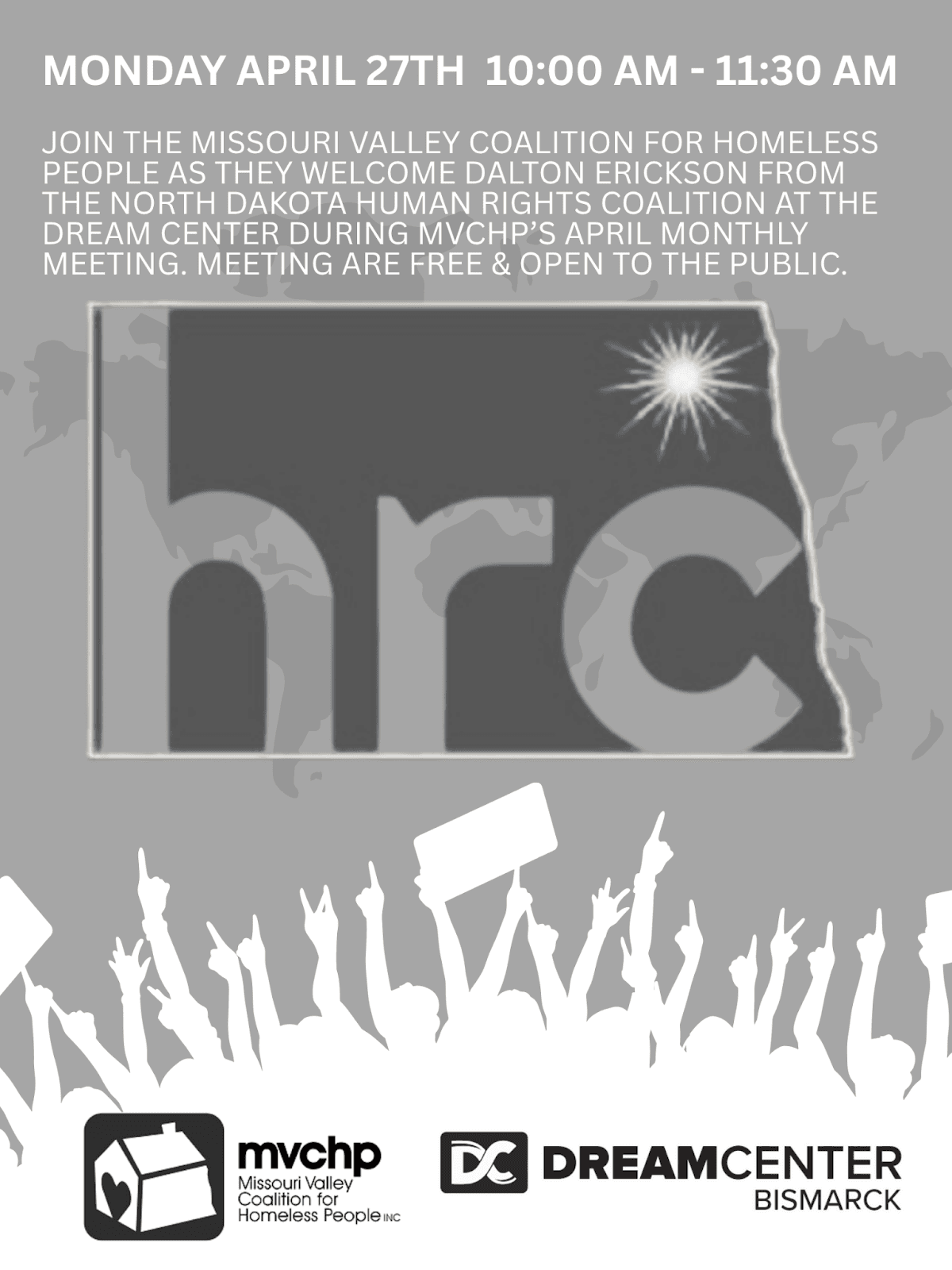
The Missouri Valley Coalition for Homeless People will host its April monthly meeting on Monday, April 27, from 10 to 11:30 a.m. at the Dream Center in Bismarck, according to event materials.
Dalton Erickson of the North Dakota Human Rights Coalition is scheduled to speak. The event is free and open to the public. Organizers said the gathering will take place at the Dream Center as part of MVCHP’s regular monthly meeting schedule.
Time Out Wacipi Powwow set for April 17-18 in Grand Forks
The annual powwow at Alerus Center will feature dance contests, head staff and a public feed, with grand entries scheduled across two days
The 54th Time Out Wacipi Powwow will take place Friday, April 17, and Saturday, April 18, at the Alerus Center in Grand Forks, North Dakota, according to event materials. The event is hosted by the University of North Dakota Indigenous Student Center. Grand entry is scheduled for 7 p.m. on Friday and 1 p.m. and 7 p.m. on Saturday.
Admission is free and a public feed will be held Saturday at 5 p.m., according to the event listing. Head staff include Host Drum Young Enemy, emcees Wes Jourdain and Keveon Kingbird and Arena Director Rusty Gillette. Dance categories include women’s, men’s, teen, junior and golden age divisions, with cash prizes listed for top placements. Registration begins on site Friday at 4 p.m.
Seminole Nation bans data center development on tribal lands
A 24-0 council vote pauses AI tech and hyperscale data centers after a startup proposal raised environmental and sovereignty concerns
The Seminole Nation of Oklahoma has enacted a moratorium on generative artificial intelligence technology and hyperscale data center development on its lands, according to Futurism. The tribal council voted 24-0 after a tech startup approached the Nation about building a data center and requested a non-disclosure agreement and letter of intent. Mekusukey Band Representative Glen Chebon Kernell introduced the resolution and raised concerns during a March 3 assembly.
According to Futurism, tribal members and community residents raised concerns about the environmental impact of data centers. The tribal council worked with Honor the Earth, an Indigenous-led climate organization, to inform the public. Kernell said there was little opposition once the proposal became public, and leaders described the decision as part of broader concerns about environmental impact and sovereignty.
IHS works through decades-old backlog on Native health facilities
A new Santa Ana Pueblo medical center is set for 2027 as IHS targets a decades-old list, but officials say billions more are still needed
The Indian Health Service is moving forward on long-delayed construction projects aimed at replacing aging health facilities that serve Native communities, according to The Associated Press. At Santa Ana Pueblo, a new 235,000-square-foot medical center is expected to break ground in 2027 and provide services including dialysis, diabetes care and optometry. Tribal leaders said the project is expected to ease pressure on the Albuquerque Indian Health Center, a federal facility built about 90 years ago.
According to The Associated Press, the Albuquerque center remains on a 1993 priority list of clinics and hospitals identified for replacement. In February, Health and Human Services Secretary Robert F. Kennedy Jr. pledged $1 billion toward delayed projects, including $22 million for the Santa Ana Pueblo center. Federal officials said about $8 billion is still needed to complete the remaining projects on the list.
Arizona mining push targets protected lands near Grand Canyon
A state proposal asks federal officials to lift mining limits near the Grand Canyon and speed permits, raising concerns about environmental and cultural impacts
Arizona lawmakers are considering a measure urging the Trump administration to ease restrictions on mining in protected areas, including land near the Grand Canyon, according to Arizona Mirror. House Concurrent Memorial 2009 asks federal officials to repeal policies that limit mineral extraction and to streamline permitting for new mines. Supporters said the proposal is aimed at expanding access to copper and other minerals that are restricted by federal land protections.
Opponents raised concerns about environmental impacts and the protection of culturally significant lands. State Sen. Theresa Hatathlie, a citizen of the Navajo Nation, criticized the proposal during a committee hearing, while supporters said it seeks to balance conservation with resource access. The lands referenced in the proposal include areas designated as national monuments, which tribes have identified as culturally and spiritually significant, according to Arizona Mirror.
Washoe Tribe completes landback purchase near Lake Tahoe
A four-year effort with partners raised $69 million to acquire and rename Loyalton Ranch, with plans for stewardship, culture and fire mitigation
The Washoe Tribe of Nevada and California has completed a landback purchase of more than 10,000 acres in the Sierra Nevada, according to ICT. The land, formerly known as Loyalton Ranch, has been renamed the WélmeltiɁ Preserve. Chairman Serrell Smokey told ICT the property will support cultural practices, land stewardship and reconnecting youth with the land and Native language.
According to ICT, the acquisition followed four years of work with partner organizations including the Northern Sierra Partnership, Feather River Land Trust and the Wildlife Conservation Board. Partners raised $6.9 million for the purchase, including $5.5 million from the California Wildlife Conservation Board and private donations. Tribal leaders said plans for the land include conservation, restoration and fire mitigation and described the return as part of a broader healing process following forced removal from the area.
Upper Sioux solar dispute heads to Minnesota regulators
Minnesota regulators will weigh a dispute over a 25-megawatt tribal solar project that could affect how tribes self-generate power while tied to utilities
A dispute between the Upper Sioux Community and Minnesota Valley Cooperative Light & Power Association could shape whether tribal nations in Minnesota can generate more of their own electricity while remaining connected to local utilities, according to MPR News. The case is before the Minnesota Public Utilities Commission after the cooperative argued the tribe’s 2.5-megawatt solar array violates co-op policy and state law. The Upper Sioux Community said the project was designed to help power Prairie’s Edge Casino Resort while keeping the electricity on tribal land.
The Minnesota Department of Commerce sided with the tribe in recent briefs, arguing federal law requires utilities to support customers who self-generate. The outcome could affect other tribal nations pursuing similar projects, including White Earth Nation, which is building a large solar array backed by a federal grant, according to MPR News.