






The Daily Spark
Small sparks from Indian Country, built to catch fire
Rapid City council races highlight Native candidates, housing priorities
Eleven candidates, including two Native contenders, compete for five Rapid City Council seats as voters weigh housing, infrastructure and equity issues
Rapid City, South Dakota, will see contested races in every city council ward in the June 2 municipal election, with 11 candidates filing, including two Native candidates, according to Native Sun News Today. One seat in each of the city’s five wards is up for election, and four incumbents are seeking another three-year term. Ward 5 Council President Rod Pettigrew is not running again, leaving an open seat.
At a recent candidate forum, candidates outlined priorities including affordable housing, infrastructure and clean water. Valeriah Big Eagle, director of He Sapa Initiatives at NDN Collective, emphasized housing, education and addressing racism in Rapid City, according to Native Sun News Today. Other candidates highlighted growth, public transportation and collaboration. Early voting begins April 17.
Montana expands Native tuition waiver eligibility, draws mixed response
Rule change removes blood quantum and adds descendants to a waiver used by about 800 students, drawing questions from some tribal leaders over process
Starting July 1, Montana will expand eligibility for its American Indian tuition waiver, allowing more students to qualify for the program that covers tuition costs, according to reporting by Montana Free Press. The change removes the blood quantum requirement and extends eligibility to unenrolled tribal descendants, while maintaining financial need and state residency requirements. About 800 students currently receive the waiver, which costs the state about $3.8 million annually, according to Montana Free Press, citing the Office of the Commissioner of Higher Education.
Officials said the update aims to broaden access to higher education, but some tribal leaders raised concerns about the reasoning behind the change and lack of consultation. Lawmakers said the adjustment followed a 2025 executive order on diversity, equity and inclusion policies.
Medicine Wheel Ride set for May 1-2 across Arizona communities
A two-day ride across San Carlos, White River and Coal Mine aims to raise awareness for Missing and Murdered Indigenous Relatives and invite public participation
The Medicine Wheel Ride will travel through the Arizona communities of San Carlos, White River and Coal Mine May 1-2 to raise awareness for Missing and Murdered Indigenous Relatives, according to a statement from organizers. The ride will bring participants together in unity, prayer and purpose while honoring those who are still missing, according to the organizers, who said each mile and stop is intended to build connection and uplift communities. The ride is open to all participants.

Wolf Point fire chief charged with felony theft in tribal court
Clint Bushman is on leave after about $120,000 in transactions surfaced in a nonprofit account, with the case filed in tribal court
Wolf Point Fire Chief Clint Bushman has been charged with felony theft in the Fort Peck Assiniboine and Sioux Tribes Tribal Court, according to reporting by the Daily Montanan. During a February city council meeting, Wolf Point Mayor Chris Dschaak said Bushman had been placed on administrative leave. According to court documents cited by the Daily Montanan, at the end of 2025, Dschaak discovered missing funds from a Volunteer Ball Association account, a nonprofit fund separate from city and county fire department budgets.
The Daily Montanan reported that Dschaak identified about $120,000 in suspicious transactions, including $40,000 in cash withdrawals and $20,000 in Amazon purchases that were not approved by association members. The information was provided to the Roosevelt County Sheriff’s Office, the Federal Bureau of Investigation and the Fort Peck Tribes Department of Law and Justice. Felony theft in tribal court carries a maximum penalty of one year imprisonment, a $5,000 fine or both, according to the Daily Montanan.
Indigenous student prevails in dispute over hair at BYU
A Kainai Nation student can keep his braids and stay in class and on a dance team after challenging BYU's grooming rules
An Indigenous student reached a resolution with Brigham Young University after challenging school policies requiring him to cut his hair, according to the Daily Mail. Jerrhan First Charger, a member of the Kainai Nation of the Blackfoot Confederacy, filed a federal lawsuit after being told he could be removed from class and suspended from the BYU Living Legends dance team for wearing long braids tied to his culture. Brigham Young University is owned by The Church of Jesus Christ of Latter-day Saints.
University officials later allowed First Charger to continue his studies and remain on the dance team with an exception to its Honor Code grooming standards. The university said the policy remains in effect but may allow rare exceptions on a case-by-case basis. First Charger said his hair reflects his cultural identity and traditions, and he sought recognition of that significance in his communications with the school.
Washington housing reform bill stalls after debate over Native homeownership program
House Bill 2527 failed after reports that 300-plus homes were not transferred to Native buyers; the sponsor plans to revive it
A Washington bill aimed at strengthening oversight of a state-managed federal housing program for Native families died in committee this legislative session, according to Underscore Native News and ICT. House Bill 2527 was introduced after reporting found that more than 300 homes eligible for transfer to Native homeowners had not been conveyed. The measure would have allowed the Washington Housing Finance Commission to penalize private developers who failed to meet tenant ownership obligations.
State Rep. Gerry Pollet, D-Seattle, said confusion about the program and misleading testimony from commission staff contributed to the bill’s failure. According to Underscore Native News and ICT, he plans to revise the legislation and reintroduce it in 2027.
Idaho officials begin outreach to tribes for America250 events after concerns raised
After tribal leaders raised concerns about exclusion, Idaho officials reached out in February to involve tribes in America250 planning, with more formal
Idaho officials began contacting tribal representatives about participating in America250 celebrations after tribal leaders raised concerns about a lack of inclusion, according to an article in the Idaho Capital Sun. During a Feb. 18 Idaho Council on Indian Affairs meeting, according to the article, Shoshone-Paiute Tribes Vice Chairman Arnold Thomas said tribal leaders had not been contacted about plans and expected greater involvement from the state.
State Rep. Brandon Mitchell, co-chairman of the America250 in Idaho Advisory Council, told the Idaho Capital Sun that he reached out to representatives on Feb. 20 to coordinate participation, and a spokesperson for Idaho Treasurer Julie Ellsworth’s office said staff were working to formalize consultation with tribes. On March 18 Thomas told the Sun that outreach following the meeting was “very informal” and said the anniversary should recognize tribal nations and their sovereignty.
New video game supports Ojibwe language learning beyond classroom
“Reclaim! Azhe-giiwewining” uses story-driven gameplay and Ojibwe voice work to move language practice into daily life, developers say
A new video game aims to expand opportunities for Ojibwe language learning outside traditional classroom settings, according to MPR News. “Reclaim! Azhe-giiwewining,” released Thursday, follows a teen character named Miskwaa as she navigates a dreamlike world using cultural teachings and Ojibwe language skills to return home. The game is voiced in Ojibwe and playable in both Ojibwe and English.
Developed by Grassroots Indigenous Multimedia in partnership with the University of Minnesota and the Massachusetts Institute of Technology, the project involved Ojibwe speakers from Canada and Minnesota to ensure language accuracy. Director Mary Hermes told MPR News the game was designed to bring language use into homes and everyday life. The project reflects efforts to create engaging spaces for Indigenous language learning across generations, according to MPR News.
Pine Ridge student Cody Two Bulls receives national Citizen Honors Award
Cody Two Bulls, one of six honorees nationwide, was recognized March 25 in Washington for founding Backpacks & Baseball on Pine Ridge
Senior Cody Two Bulls has been named a 2026 Citizen Honors Award recipient by the Congressional Medal of Honor Society, according to a news release from Maȟpíya Lúta. He is one of six honorees selected nationwide and was recognized by a panel of Medal of Honor recipients. The awards are presented annually on National Medal of Honor Day, March 25, in Washington, D.C., and recognize civilians who demonstrate courage, service and integrity in their communities.
Two Bulls was honored in the Youth Service category for founding Backpacks & Baseball, an initiative serving children and families on the Pine Ridge Reservation. According to Maȟpíya Lúta, his work has included distributing backpacks, meals, holiday gifts and essential supplies. He is also a student-athlete at Maȟpíya Lúta, where he participates in track and field and basketball.
Indigenous chef Crystal Wahpepah releases first cookbook
The Kickapoo and Sac and Fox chef’s first book offers 125 recipes and a focus on seasonal cooking, foraging and cultural ties
Indigenous Chef Crystal Wahpepah released her first cookbook, “A Feather and a Fork: 125 Intertribal Dishes from an Indigenous Food Warrior,” on March 17, according to ICT. The book features more than 125 recipes and highlights seasonal cooking, foraging and connections to land and culture. Wahpepah, who is Kickapoo and Sac and Fox, said the project took five years to complete.
Wahpepah said she hopes readers understand where food comes from and its cultural significance. “I want to take other people on that journey where we are so well connected with our food,” she told ICT. The cookbook includes dishes such as blue cornbread, Three Sisters salad and bison recipes. A foreword by author Tommy Orange describes Wahpepah as a “tremendously talented, heart-and-soul-driven chef,” according to the report.
Minnesota schools fall short on Native language, culture requirements
A report finds districts lack more than 150 teachers to meet requirements, citing recruitment and funding hurdles and limited instructional support
Minnesota school districts required to offer American Indian language and culture classes are not meeting state requirements, according to MPR News. State law requires districts with at least 5% American Indian enrollment or 100 or more Native students to provide the classes, but a recent report found districts would need more than 150 additional language teachers to reach compliance.
The report identified a teacher-to-student ratio of 1:257 and found only 98 American Indian language educators among about 200,000 licensed teachers statewide, according to MPR News. Gimiwan Dustin Burnette, president and executive director of the Midwest Indigenous Immersion Network, said many instructors work part time and lack support, with 78% responsible for developing their own curriculum. Districts cited recruitment challenges and funding limitations as key barriers, according to MPR News.
Farm bill provision could block return of Fort Reno to Cheyenne and Arapaho Tribes
A House Committee-backed bill would remove a deadline on land transfer limits, keeping Fort Reno under federal control unless Congress intervenes
A provision in a congressional farm bill could permanently prevent the Cheyenne and Arapaho Tribes of Oklahoma from regaining ownership of Fort Reno, according to a report by KOSU. The House Committee on Agriculture passed the Farm, Food, and National Security Act of 2026 on March 4, including language that would remove a 2026 expiration date on restrictions preventing the land’s transfer, making the site permanently federal unless Congress changes the law.
Cheyenne and Arapaho Gov. Reggie Wassana urged lawmakers to return the land, writing in testimony that the tribes were not repaid for 9,500 acres and that the land was not returned after military use, according to the report. “Returning Fort Reno to the Cheyenne and Arapaho is a concrete, lawful, and moral step Congress can take,” Wassana wrote. The bill now awaits consideration by the U.S. House of Representatives, according to KOSU.
Supreme Court declines to hear Chinook Indian Nation recognition case
High court leaves lower rulings that Congress must decide recognition, as Chinook Indian Nation says it will continue its efforts
The United States Supreme Court declined to take up a case that could have determined whether the Chinook Indian Nation would be granted federal recognition, according to an article in The Oregonian/OregonLive. The decision leaves in place lower court rulings that recognition is a matter for lawmakers, not the courts.
In a news release cited in the article, Chairman Tony A. (naschio) Johnson was quoted as saying the tribe will continue pursuing recognition: “It is not an end, but instead a beginning of a revitalization of our efforts.” The Chinook Indian Nation was federally recognized by the Bureau of Indian Affairs in 2001, but that status was rescinded 18 months later. Since then, the tribe has continued seeking recognition through multiple avenues, including the courts, according to the report.
New Town water tower project cleared from further environmental review
Loan request would help replace a leaking reservoir with an elevated water tower
The North Dakota Department of Environmental Quality has reviewed the proposed Sand Hill Water Tower Improvements project in New Town under the National Environmental Policy Act and determined it is exempt from further environmental review, according to the Minot Daily News. The project includes upgrades to water storage facilities, booster station pump rehabilitation and water treatment plant pump improvements. The department states the current ground storage reservoir is nearing the end of its useful life, showing external leaks, and the city has received complaints of low water pressure in some areas.
According to the Minot Daily News, the project will replace the existing reservoir with an elevated water tower to address pressure concerns and aging infrastructure. The City of New Town has applied for a Drinking Water State Revolving Fund loan to finance the project. The department states the exclusion applies because work will occur on previously disturbed land, and the Three Affiliated Tribes-MHA Nation Tribal Historic Office determined no historic properties will be affected.
Beach Ball Gala set for April 11 to support WAVI shelter and survivor services in Black Hills
Event proceeds back shelter, crisis line and advocacy work across the Black Hills
The Beach Ball Gala is scheduled for April 11, beginning with registration and cocktails at 6 p.m., followed by a plated dinner at 7 p.m., according to event organizers. The evening will also include a dessert dash and auction, and attendees are encouraged to wear tropical attire.
Proceeds from the event will support Working Against Violence, Inc., which provides a 24-hour emergency safe shelter, crisis line and advocacy services for survivors of domestic violence, sexual assault, human trafficking and stalking across the Black Hills, according to WAVI materials. WAVI also offers case management, housing navigation, legal advocacy and community education, organizers said. Tickets are available for individuals, tables or sponsorships.
Senate confirms Markwayne Mullin as Homeland Security secretary
The 54-45 vote creates a Senate vacancy in Oklahoma
The U.S. Senate confirmed Oklahoma Sen. Markwayne Mullin, Cherokee, as secretary of the Department of Homeland Security in a 54-45 vote Monday evening, according to ICT. Mullin will become the ninth secretary and the first Native American to lead the department, which has more than 260,000 employees. He is also the third Native person to serve in a president’s cabinet, according to ICT.
The Department of Homeland Security was established in 2002 after the Sept. 11 attacks and combines 22 federal agencies, including the Federal Emergency Management Agency, U.S. Immigration and Customs Enforcement, U.S. Coast Guard and U.S. Secret Service. Mullin’s confirmation creates a vacancy in the U.S. Senate, which Oklahoma Gov. Kevin Stitt is expected to fill until a special election later this year, ICT reported.
‘No Kings’ rally planned March 28 at North Dakota Capitol
Organizers plan a donation drive for Bismarck Global Neighbors during the event
A volunteer-organized “No Kings” rally is scheduled from 1 to 4 p.m. CDT on Saturday, March 28, at the North Dakota State Capitol in Bismarck, according to event organizers. The event will take place at 600 E. Boulevard Ave and is part of a nationwide mobilization, organizers said.
“We are standing together to demand an immediate end to militarized ICE raids, the removal of masked federal forces from our communities, and a total overhaul of our immigration system to ensure human rights and due process for all,” organizers wrote in event materials, which also mention accountability related to the Epstein files and the defense of democracy and civil rights.
Organizers said the rally will include a fundraising effort and in-kind donation drive for Bismarck Global Neighbors, which supports new Americans relocating to North Dakota. Suggested donations include household items such as toilet paper, paper towels, hand soap and diapers, according to the event information. Organizers said the event follows a commitment to nonviolent action and asked participants to act lawfully and not bring weapons.
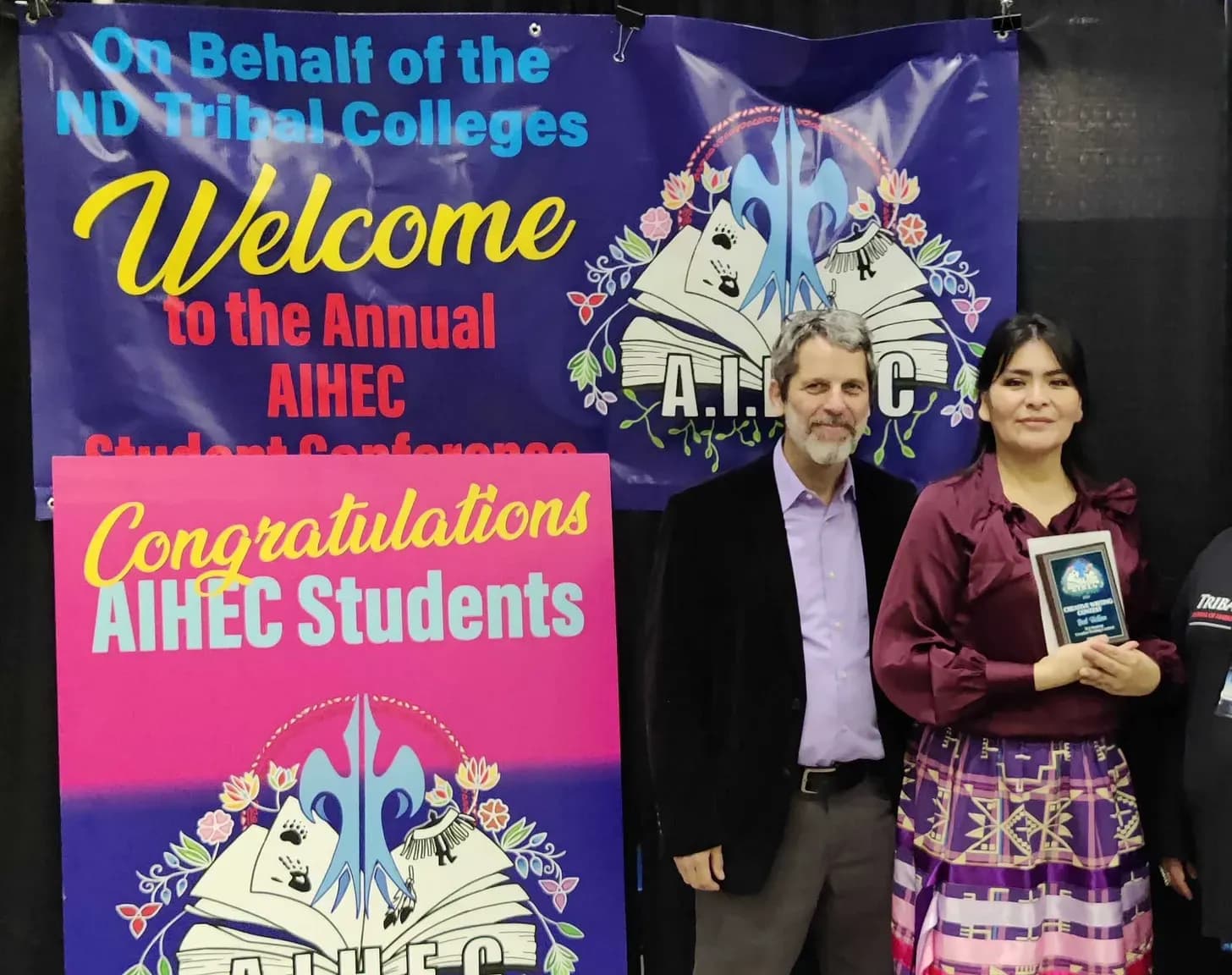
Buffalo’s Fire team member Daniela Aki wins creative writing award
Her short fiction story ‘What Are Indianettes?’ was selected as a winner in the 2026 Tribal College Journal Creative Writing, Art & Film Contest
The Tribal College Journal recognized Daniela Aki, Buffalo’s Fire’s community engagement manager, and her short story “What are Indianettes?” as a top fiction entry in its 2026 Creative Writing, Art & Film Contest. Aki, Hunkpapa Lakota from the Standing Rock Sioux Reservation and a first-generation Mexican American, is a business administration student at Sitting Bull College in Fort Yates, North Dakota. She received her award at the AIHEC annual conference in Bismarck, ND, on March 18.
“Bringing home a winner's plaque to my family meant more than anything,” said Aki, who is a married mother of five. “They swarmed me, cheering and hugging me, and their excitement helped me to feel proud of myself.”
Aki said she’s thankful to her parents, “who instilled in me a love of learning and storytelling,” and the Tribal College Journal team “for allowing students a place to be heard, seen, and celebrated.”
Tribal College Journals competition judges and guest editors Theodore C. Van Alst Jr. and Shane Hawk, editors of the 2023 Native horror anthology “Never Whistle at Night,” announced the creative writing contest winners on March 13. They chose three top entries in each category — fiction, nonfiction and poetry — and four honorable mentions. Students will have their work published in the 2026 edition of Tribal College Journal Student and on the journal’s website.

Forest Service, Great Sioux Nation sign co-stewardship agreement for Black Elk Wilderness
The memorandum covers management, consultation and access to sacred sites
The U.S. Forest Service and representatives of the Great Sioux Nation have signed a memorandum of understanding for co-stewardship of the Black Elk Wilderness in the Black Hills National Forest, according to a press release from the U.S. Forest Service. The agreement, signed March 19, outlines collaboration on wilderness management, including recreation, habitat improvement, wildlife benefit and invasive species mitigation.
The agreement provides for increased tribal consultation and guidance on resource protection, cultural interpretation and access to sacred sites, according to the statement. Tribal leaders said in the press release that the partnership supports cultural preservation and opportunities for future generations to engage with ancestral lands. Tribes represented include the Cheyenne River Sioux Tribe, Crow Creek Sioux Tribe, Lower Brule Sioux Tribe, Oglala Sioux Tribe, Rosebud Sioux Tribe, Spirit Lake Sioux Tribe, Standing Rock Sioux Tribe and others. The Black Elk Wilderness spans 13,534 acres and was designated by Congress in 1980, according to the statement.
FHWA awards $2 million to North Dakota tribes for safety projects
Grants back road realignment and walkway upgrades for two tribal nations
The Federal Highway Administration has awarded $2,057,009 to two North Dakota tribal nations through the Tribal Transportation Program Safety Fund, according to a press release from U.S. Sen. Kevin Cramer. The Standing Rock Sioux Tribe will receive $1,280,819 for the Bureau of Indian Affairs 3400 Roadway Realignment Safety Project, which includes engineering and construction to realign about 0.8 miles of roadway to address slope, drainage and crash history.
The Spirit Lake Tribe will receive $776,190 for the Oyate Walkway Thin Lift Overlay and Accessibility Improvements project, according to the release. The funding will support resurfacing, accessible landings with detectable warning panels and improvements to crosswalks, signage and pavement markings. The walkway connects to a pathway extension project between Fort Totten and Devils Lake, according to the release.