






The Daily Spark
Small sparks from Indian Country, built to catch fire
Survey examines brain injuries in Native survivors of violence
Researchers at the Urban Indian Health Institute have launched a national survey to measure the prevalence of brain injuries among Native women who have experienced sexual assault and domestic violence, according to Stateline.
Abigail Echo-Hawk, the institute’s director and a member of the Pawnee Nation of Oklahoma, said many Native women show symptoms of traumatic brain injury as a direct result of abuse. She said the new survey aims to document the scope of the problem and guide clinical care, awareness efforts and resource allocation.
The study, developed in partnership with Native Hawaiian advocates, is the first Indigenous-led survey of its kind. Nikki Cristobal, policy and research specialist for Pouhana ʻO Nā Wāhine, said health care providers need more training to recognize brain injuries in survivors of violence.
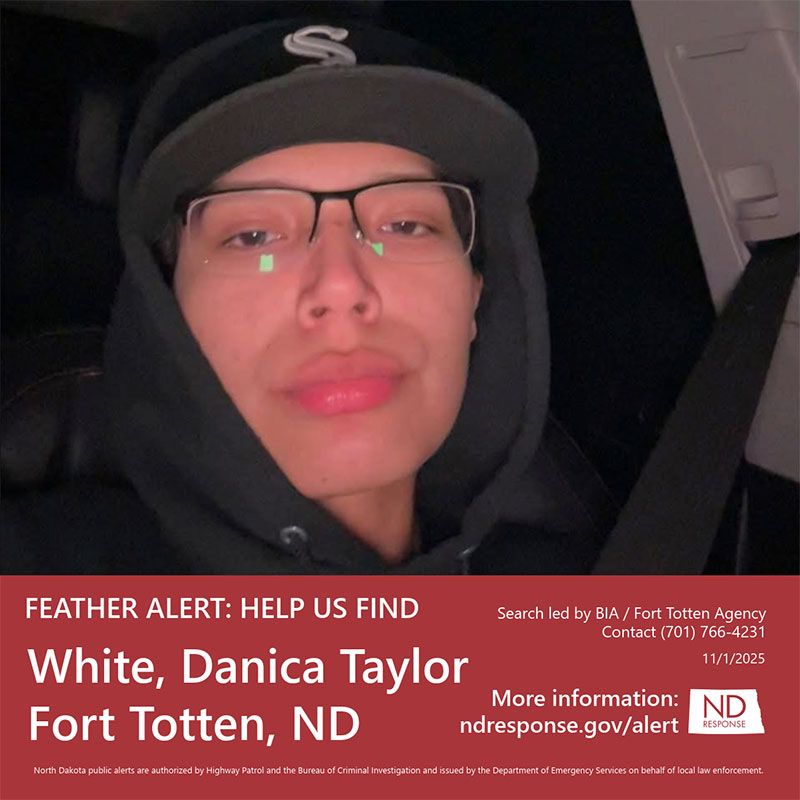
Feather Alert issued for missing woman near Fort Totten, North Dakota
The North Dakota Highway Patrol and the North Dakota Bureau of Criminal Investigation have issued a Feather Alert at the request of the Bureau of Indian Affairs for 20-year-old Danica Taylor White of Devils Lake. According to the North Dakota Department of Emergency Services, White is described as 5 feet 6 inches tall, weighing 125 pounds, with brown hair and brown eyes. She was last seen wearing blue jeans, a black hoodie with pink and purple jellyfish designs, a gray ball cap and gray low-top Nike shoes with white logos.
The alert states she has a tattoo of the number 31 on her left forearm and was last seen around 6 a.m. Nov. 1 near the Fort Totten community. Anyone with information is asked to contact the Bureau of Indian Affairs at 701-766-4231.
Tribes consider loans as reserve funds run out during federal shutdown
Tribal governments are running out of reserve funds as the federal shutdown nears its 30th day, forcing some to consider loans to maintain essential services, according to ICT.
Sarah Harris, Mohegan and the secretary of the United South and Eastern Tribes, told the U.S. Senate Committee on Indian Affairs on Oct. 29 that some tribes may need to take out lines of credit to continue operations. Several tribal nations, including the Cherokee Nation of Oklahoma, Standing Rock Sioux Tribe, Spirit Lake Sioux Tribe and Blackfeet Nation, have declared states of emergency.
Witnesses also testified that layoffs and halted funding to programs such as the Community Development Financial Institutions Fund and the Supplemental Nutrition Assistance Program are worsening conditions, particularly in Alaska Native communities still recovering from Typhoon Halong.
Leadership dispute divides Northern Cheyenne Tribe ahead of controversial election
The Northern Cheyenne Tribe is facing a leadership crisis marked by arrests, frozen bank accounts and a disputed special election that bars women from running, according to the Montana Free Press.
The conflict began after Tribal President Gene Small initiated an audit into the council’s use of federal COVID-19 relief funds, leading to his removal by the council on Sept. 11. Small and a group of traditional leaders responded by appointing a new interim council, which approved an Oct. 30 election to fill eight seats. The original council members say the election is invalid and have filed legal complaints.
Several council members were arrested earlier this month, and tribal accounts were frozen as both sides claim authority. The Bureau of Indian Affairs said it will not intervene in the dispute.
Arizona’s Turquoise Alert activated once since July launch
The Arizona Department of Public Safety said the state’s new Turquoise Alert system is functioning as intended despite being activated only once since July, according to the Arizona Luminaria.
The alert, created under House Bill 2281 and renamed in honor of 14-year-old San Carlos Apache teen Emily Pike, was designed to reach missing persons who do not qualify for Amber or Silver Alerts. Sgt. Kim Love-Ness said the alert’s limited use reflects the narrow scope established in state law, not underuse.
DPS told Arizona Luminaria each request for activation undergoes a strict review process, and most do not meet all legal criteria. The agency added that issuing alerts outside those parameters could “dilute public responsiveness and reduce overall system effectiveness.”
Early retirements and funding cuts strain Indian Health Service workforce
More than 1,000 Indian Health Service employees accepted early retirement offers in early 2025, leaving the department struggling to fill vacant positions, according to ICT.
National Indian Health Board Chief Executive Officer A.G. Locklear, Lumbee, told the Senate Committee on Indian Affairs on Oct. 29 that IHS faces its lowest offer acceptance rate in history and a 30% overall vacancy rate. Locklear said hiring freezes have further reduced the workforce tribes rely on for grant management and technical assistance.
The Trump administration’s fiscal year 2026 budget proposal outlines cuts to multiple tribal health programs and creates a new agency, the Administration for Healthy America, within the Department of Health and Human Services to oversee programs previously managed by IHS, according to the National Indian Health Board.
New Mexico volleyball team will honor MMIP at upcoming game
Mescalero Apache Lady Chiefs will play for those affected by the crisis
A New Mexico high school’s volleyball team is honoring missing and murdered Indigenous women and girls at its game on Oct. 30. Mescalero Apache Lady Chiefs junior varsity volleyball game will take place at the Mescalero Apache High School gymnasium at 4 p.m.
The event will include a bake sale and raffles, and MMIP resources will be available for families. Money raised will be donated to 4Corners K-9 Search and Rescue, a Native nonprofit that facilitates search and rescue on tribal land.
Community members are encouraged to show up in red for support.
“Let’s show up in red. Let’s fill every seat. Let’s make sure our young people see what community strength looks like,” 4Corners K-9 Search and Rescue posted on Facebook. “Every serve, every point, every cheer will echo for those who can no longer speak for themselves.”
BIA officer charged with sexual assault of Northern Cheyenne teen also linked to prior violent cases
A Bureau of Indian Affairs officer has been charged with sexually assaulting a 15-year-old Northern Cheyenne girl, according to the Daily Montanan.
Murrell D. Deela appeared in federal court in Billings, Montana, on Tuesday and denied the charge. Court documents allege Deela assaulted the teen on Aug. 7, 2024, after responding to a report of an intoxicated female in Lame Deer. The Daily Montanan reports that Deela also faces two civil lawsuits over police brutality (one brought by the victim in the sexual assault case) and was previously involved in a fatal 2021 shooting of a tribal member, for which the federal government paid $800,000 to the victim’s estate. The Northern Cheyenne Tribal Council banned Deela from the reservation in 2024.
Daily Montanan
Trump administration move to end CDFI fund threatens tribal economies
The Trump administration has issued a reduction-in-force notice to eliminate the Community Development Financial Institutions Fund, a Treasury program that supports lending in economically distressed areas, according to ICT.
The Oct. 10 notice from the Office of Management and Budget stated the fund no longer aligns with President Donald Trump’s priorities, the staff would be let go and the fund would be terminated in the midst of an ongoing government shutdown. Native financial leaders said the move would severely impact tribal economies, where CDFIs are often the only source of business and housing loans.
“Without CDFIs, there would be literally no form of funding available to start a small business, purchase homes, and provide technical assistance in rural communities,” Pete Upton, chief executive officer of the Native CDFI Network and Native360 Loan Fund, was quoted as saying.
Judge cuts Greenpeace damages in Dakota Access case to $345 million
A North Dakota judge has reduced a $660 million jury award against Greenpeace to about $345 million in a civil case brought by Energy Transfer, the developer of the Dakota Access Pipeline, according to the North Dakota Monitor.
Southwest Judicial District Judge James Gion issued the order Wednesday, finding parts of the jury’s damages lacked legal basis, were duplicative or exceeded statutory limits. The jury in March found Greenpeace liable for defamation and interference with Energy Transfer’s business during protests against the pipeline in 2016 and 2017.
Energy Transfer said it plans to ask the North Dakota Supreme Court to reverse Gion’s revisions, while Greenpeace said it will seek a new trial or appeal once the final judgment is entered.
North Dakota tribal colleges seek increased non‑beneficiary funding
Leaders of the North Dakota Tribal College System requested the state raise its non‑beneficiary appropriation to $1.6 million — a $200,000 increase — before the Senate Appropriations, Education and Environment Division, according to an article by Citizen Portal.
Executive Director Tracy Bauer testified the system served about 2,600 students and 650 full‑time staff in 2022–23, noting an economic‑impact study that showed $169.5 million in combined impacts and a $1.30 taxpayer return for every dollar invested.
College presidents from institutions including United Tribes Technical College and Sitting Bull College said additional funding would support tuition aid, student health services, career development and infrastructure improvements for non‑beneficiary students.
UND advances Indigenous Studies through collaboration and language revitalization
The University of North Dakota is working to strengthen relationships with tribal nations and advance Indigenous Studies as part of its UND LEADS Strategic Plan, according to UND Today. Cynthia Lindquist, director of Tribal Initiatives & Collaboration, said a work group representing North Dakota’s five federally recognized tribes developed a draft Tribal Consultation Policy now under university review.
Indigenous student Makaila Martin said UND’s Indigenous Student Center and INMED program have helped her stay connected to her culture while pursuing a doctorate in physical therapy. Teaching assistant professor Jeremy Kingsbury said he leads Ojibwe language classes and weekly language tables at the Indigenous Student Center to promote language revitalization. The programs, Lindquist said, reflect UND’s ongoing effort to build cooperative relationships with tribal nations and become a premier institution for Indigenous Studies.
Minnetonka expands Native-artist collaboration
The shoe brand Minnetonka has expanded its Reclamation Collaborative to feature Native American artists, according to Midwest Living. The group includes Adrienne Benjamin of the Mille Lacs Band of Ojibwe, Lucie Skjefte of Red Lake Nation, Hannah Standstrong of White Earth Nation and Chris Nayquonabe of the Diné Nation.
The initiative brings these artists into the design process for new footwear collections, including Skjefte’s Animikii moccasin and Nayquonabe’s Nizhoni design. According to Midwest Living, Minnetonka’s efforts also include compensating and collaborating with tribal artists as part of its reconciliation work.
Native Youth Foundation unites communities at heritage festival
The Native Youth Foundation hosted its inaugural Native American Heritage Festival on Oct. 18 at Grape Day Park in Escondido, California, according to EIN Presswire. The event, held in collaboration with tribal nations and reservations across Southern California, welcomed hundreds of attendees for a day of live music, cultural demonstrations and activities celebrating Indigenous traditions.
Escondido Mayor Dane White issued a proclamation naming Oct. 18 “Native American Heritage Festival Day.” Other local officials presented awards recognizing contributors to the event. Performances included Blue Eagle Music, Wyley & Wynter Clay and the Native American Youth Band. The Native Youth Foundation said it looks forward to continuing the festival next year to celebrate Native culture and youth empowerment.
Trump administration reopens Arctic Refuge to oil drilling
The Trump administration has finalized a plan to open Alaska’s Arctic National Wildlife Refuge to oil and gas drilling, according to the Associated Press. U.S. Interior Secretary Doug Burgum announced Thursday that the decision clears the way for future lease sales within the refuge’s 1.5 million-acre coastal plain, an area considered sacred by the Indigenous Gwich’in people.
Alaska Gov. Mike Dunleavy and the state’s congressional delegation joined Burgum for the announcement, which also reinstated leases previously canceled by the Biden administration. Leaders in the Iñupiaq community of Kaktovik support the plan, citing economic benefits, while Gwich’in leaders and conservation groups oppose it, saying it threatens the Porcupine caribou herd and the refuge’s ecosystem. The Wilderness Society and other groups said they plan legal challenges to the decision.
Ten Michigan tribal nations urge Supreme Court to return Line 5 case to state court
Ten tribal nations in Michigan filed an amicus brief with the U.S. Supreme Court asking justices to keep the Line 5 pipeline case in state court, according to Michigan Advance. The tribes urged the court to reject Enbridge Energy’s attempt to have a federal court decide the lawsuit originally filed in 2019 by Michigan Attorney General Dana Nessel.
“For many years, Tribal Amici have called on the State to uphold its public-trust obligation to protect the Straits of Mackinac and the Great Lakes,” the brief states. “Michigan’s suit against Enbridge is a long-overdue course correction.”
The tribal nations include the Bay Mills Indian Community, Grand Traverse Band of Ottawa and Chippewa Indians, Hannahville Indian Community, Keweenaw Bay Indian Community and others.
Cherokee Nation citizen named IHS chief of staff
The Indian Health Service appointed Cherokee Nation citizen Clayton Fulton as its new chief of staff, according to an IHS announcement. Fulton will oversee coordination of key agency activities and support the Office of the Director in implementing IHS initiatives and priorities.
“We are excited to have Mr. Fulton join the Indian Health Service, and welcome his leadership and expertise to our agency,” IHS Acting Director Benjamin Smith was quoted as saying. “His experience working at the intersection of policy and program development between tribal nations and the federal government will only strengthen our government-to-government relationships throughout Indian Country.”
Turquoise Alert used only once since launch despite hundreds missing in Arizona
Arizona’s new Turquoise Alert system, launched in July to help locate missing people, has been used only once, despite 278 reported missing persons statewide, according to Arizona Luminaria.
The Arizona Department of Public Safety database showed 275 missing children and three missing adults under 65 since the alert began July 10. To issue an alert, agencies must determine the person is in danger or that the disappearance is suspicious and must have exhausted other resources.
The only Turquoise Alert issued so far was for a 6-year-old girl from Hawaii who was found safe within an hour, according to Arizona Luminaria. The alert was established under “Emily’s Law,” named for 14-year-old Emily Pike of the San Carlos Apache Tribe, whose disappearance and murder earlier this year inspired the legislation.