






The Daily Spark
Small sparks from Indian Country, built to catch fire
Wabanaki Alliance celebration highlights generations of leadership and learning
Wabanaki Alliance members and allies gathered last week for the third annual “Nihkaniyane: Let’s Go Forward Together” celebration to honor advocates advancing tribal sovereignty and education, according to Maine Morning Star. Executive Director Maulian Bryant said the event recognized the coalition’s growth and the relationships sustaining its work.
Honorees included John Banks of the Penobscot Nation for his lifelong environmental stewardship, Brianne Lolar of the Maine Department of Education for strengthening Wabanaki studies in schools, and Passamaquoddy citizen Emma Soctomah for her academic achievements. Bryant said each represents the passing on of generational wisdom and commitment to progress for the Wabanaki Nations — the Houlton Band of Maliseet Indians, Mi’kmaq Nation, Passamaquoddy Tribe and Penobscot Nation.
IUCN supports synthetic biology despite Indigenous opposition
Members of the International Union for Conservation of Nature recently voted against a moratorium on the release of genetically engineered species into the wild and in favor of using synthetic biology for conservation, according to reporting by Grist.
Indigenous-led groups and environmental organizations criticized the decision, saying consultation policies and ethical standards must be in place before such technologies are used. “At this point, the science is new, and we don’t actually have data or evidence to suggest that it could be safe,” Dana Perls of Friends of the Earth was quoted as saying. IUCN member Susan Lieberman said the resolutions adopted in Abu Dhabi will guide policy toward evidence-based conservation that includes the rights and leadership of Indigenous peoples.
Cherokee Nation opens new Indian Child Welfare office
Cherokee Nation leaders opened a new Indian Child Welfare office on Oct. 14 in Tahlequah, Oklahoma, according to the Cherokee Phoenix. The 40,000-square-foot building was purchased and remodeled by the tribe to house more than 70 employees, with capacity for up to 98.
Sally Wilson, senior director of the office, was quoted as saying the new facility represents “hope, safety and belonging” for Cherokee children. The space includes offices, classrooms, visitation rooms, an indoor playroom and two outdoor playgrounds.
SNAP funding lapse could leave over one million Native people without food aid
More than one million American Indian and Alaska Native people could lose access to food assistance if the Supplemental Nutrition Assistance Program, or SNAP, runs out of funding on Nov. 1, according to ICT. A U.S. Department of Agriculture memo issued Oct. 10 confirmed current funding is set to lapse if the government shutdown continues.
Caddo Nation Chairman Bobby Gonzalez said the potential loss of funding poses serious risks for Native families already facing food insecurity. “It’s just a matter of time that those food banks start running out of food,” he was quoted as saying. Some tribes, including the Comanche Nation, are preparing to use tribal funds to provide food vouchers or expand distribution programs. SNAP benefits support 24% of Native households and help sustain small businesses on reservations that depend on the program for income.
Vatican expected to return dozens of Indigenous artifacts
The artifacts could be returned to Indigenous communities in Canada by 2026
The Vatican is expected to announce the return of dozens of Indigenous artifacts from its Anima Mundi museum back to Indigenous communities in Canada. The artifacts, including an Inuit kayak, could be returned by the end of the year, according to reporting done by Associated Press.
Negotiations for the return of the artifacts began in 2022, when Pope Francis met with Indigenous leaders to apologize for the church’s role in supporting residential boarding schools. During their visit, the leaders asked that the artifacts be returned to the community as a gesture of reconciliation.
Vatican and Canadian officials said they expect the announcement to occur in the coming weeks.
Native journalist and her great-grandmother inducted into Alaska Women’s Hall of Fame
The women were nominated separately
A Native journalist and her great-grandmother were inducted into Alaska Women’s Hall of Fame on October 21. Joaqlin Estus was one of Alaska’s first Native journalists. Before retiring, she worked as a national correspondent for Indian Country Today and a news director for KNBA. Estus is Lingít and lives in Anchorage.
Her great-grandmother, Matilda “Tillie” (Kinnon) Paul Tamaree, was a civil rights activist in the early 20th century. The women were nominated by different people. Estus said it’s an honor to be indicted alongside her great-grandmother.
Two other Alaska Natives, Katherine Gottlieb and the late Ada (Deluktuk) Blackjack Johnson, were also inducted into the Hall of Fame.
A recording of the induction ceremony can be found on the Alaska Women’s Hall of Fame website.
United Nations to provide funding for Indigenous peoples to attend major gatherings
The deadline is October 31. The U.N. event will be held in New York, April 20-May 1, 2026
The United Nations opened funding for Indigenous representatives to attend its major gatherings of Indigenous peoples, according to Grist. The 2026 U.N. Permanent Forum on Indigenous Issues is focused on ensuring Indigenous health, particularly in the context of conflict. Indigenous representatives from all over the world will discuss issues including climate change and language loss. It will take place in New York from April 20 to May 1. Another gathering will take place July 13-17 in Geneva, Switzerland.
The U.N. Voluntary Fund for Indigenous Peoples will help fund attendees’ transportation, accommodations and registration fees for either gathering. It’s calling for applicants who are actively engaging with promoting Indigenous rights, can demonstrate their contribution to the community and require financial support. Applicants need to provide a resume, a copy of their passport and a letter of recommendation from a community leader. They can fill out this form to apply by October 31. Additional information can be found in the U.N.’s call for applications.
Millennium-old earthen sites demonstrate Indigenous farming skills
Researchers find Menominee’s ancestors cultivated land to raise plethora of crops
SciTech Daily reports that a team of Dartmouth University researchers have found an intricate system of raised agricultural beds in Michigan’s Upper Peninsula along the Menominee River. The formations cover more than two-thirds of a survey area at Sixty Island archaeological site, signs that early Native communities practiced intensive farming to grow corn, squash, beans and other crops in an area typically deemed cold and with too brief a growing season to sustain large crops.
“The scale of this agricultural system by ancestral Menominee communities is 10 times larger than what was previously estimated,” lead author Madeleine McLeester, an assistant professor of anthropology at Dartmouth, was quoted as saying. “That forces us to reconsider a number of preconceived ideas we have about agriculture not only in the region, but globally.”
The team’s findings are published in Science and build on previous work done at the request of the Menominee Tribe.
North Dakota Badlands among National Geographic’s best places to visit in the world in 2026
This year’s list of top travel destinations includes world capitals and national parks
National Geographic highlighted the North Dakota Badlands as one of its 25 “Best of the World” must-visit destinations in 2026. Picked for their stunning scenery, adventurous excursions and rich history, the list also includes Québec, Canada; Beijing, China; and Pittsburgh, Pennsylvania, to name a few.
The magazine says travelers should visit the Badlands for its "otherworldly landscape” that stretches on “seemingly forever.” It suggests visiting the Theodore Roosevelt Presidential Library, which opens July 4, 2026, and is located just outside of Medora, North Dakota, as well as the Three Affiliated Tribes National Park, which is adjacent to the Fort Berthold Reservation. The park is run by the Mandan, Hidatsa and Arikara Nation and not yet fully open to the public.
Family of missing Spirit Lake citizen asks for search volunteers
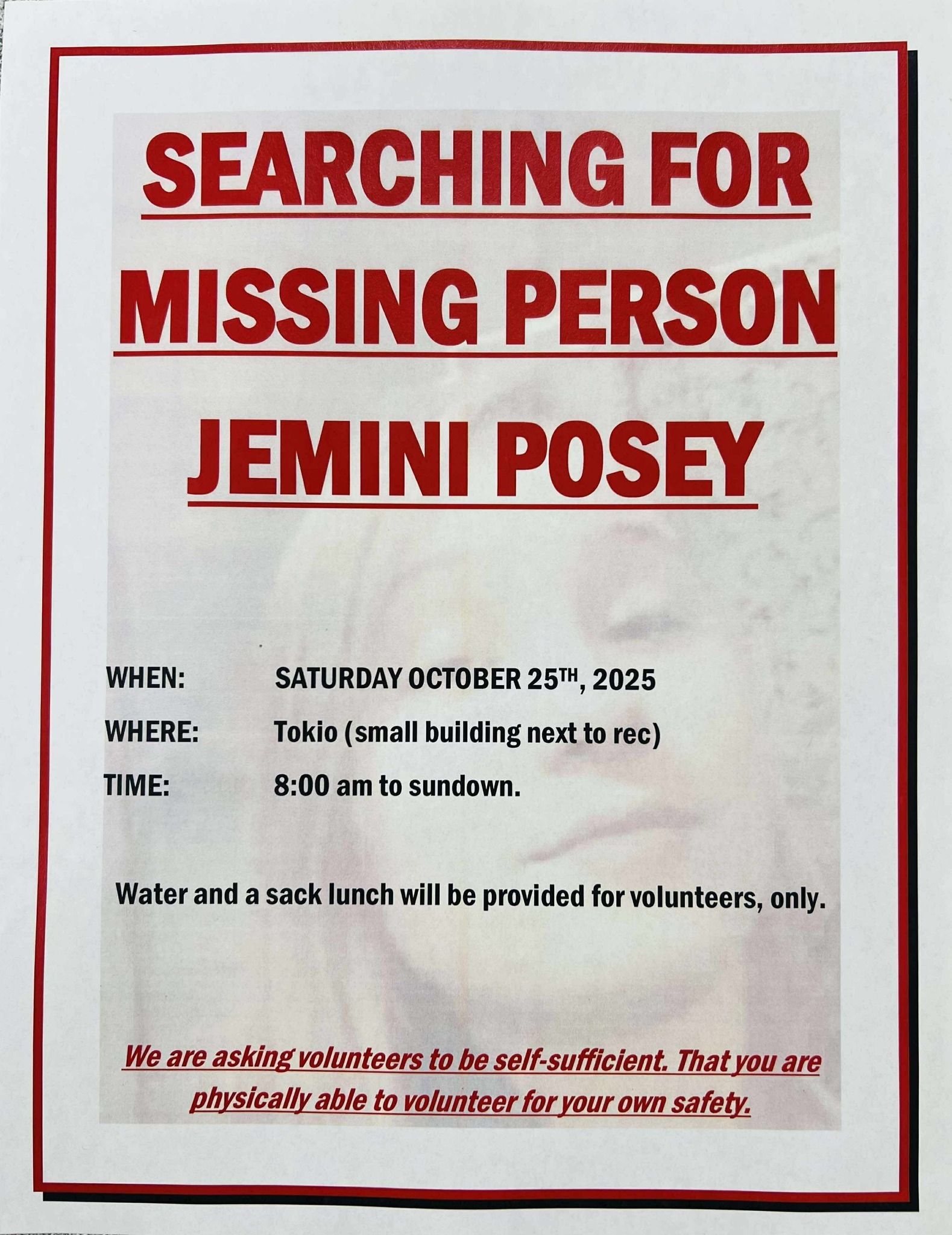
Search for Jemini Posey planned for Oct. 25
A search for 23-year-old missing Spirit Lake citizen Jemini Posey is scheduled for Saturday, Oct. 25. Posey’s sister, Jade Frier-Posey, encourages volunteers to show up in support. Posey was last seen by her boyfriend in January 2024. Her sister describes her as outgoing, cheerful and an incredible mother to her baby girl, now two years old. “She is missed by a lot of people and we aren’t going to give up until we have justice for her,” Frier-Posey said. A flyer with details for the search can be found on Facebook. A GoFundMe has been set up to help fund search efforts for Posey and care for her baby.
As federal government shutdown continues, Native education takes a hit in Idaho
Federal grants to reservation schools stop
With the federal government shutdown now in its third week, schools on Native reservations are already seeing grant money dry up, affecting a multitude of programs and services for students and their families.
IdahoEdNews.org reports that school districts on nontaxable federal land — which includes military bases — aren’t getting grants from the Impact Aid Program.
The National Association of Federally Impacted Schools says nine Idaho school districts and charters in fiscal year 2024 received roughly $9 million in Impact Aid basic support payments.
One affected district in Idaho, Lapwai, relies on the Impact Aid program for a third of its annual budget. Superintendent David Aiken told IdahoEdNews he’s worried about what a continued impasse in Congress could mean in the long term.
“What I’m really concerned about more than the government shutdown is the layoffs,” Aiken was quoted as saying. “The threatening of the layoffs at the U.S. Department of Education.”
Most federal money is still flowing in Idaho, including to the state’s Department of Education. But ImpactAid is one of the few federal programs that allocates funds directly to Idaho schools.
Adding to the frustration is the lack of communication during the shutdown. Impact Aid staff are employed through the U.S. Department of Education and not able to respond to messages while furloughed. Its website currently states that no emails or voicemails can be responded to while the shutdown continues.
Young Indigenous leaders direct $720K in grants to fight food insecurity
Panel backs 24 projects via Indigenous Tomorrows Fund
Young Indigenous leaders helped distribute $720,000 in grants to address food insecurity in tribal communities, according to the Associated Press. The funding came from Newman’s Own Foundation and Novo Nordisk and was organized by Native Americans in Philanthropy.
Twenty-one Indigenous youth, ages 16 to 24, designed the selection criteria, reviewed applications and chose two dozen recipients for the Indigenous Tomorrows Fund. “Funders can listen to Native youth to know where they should direct resources,” Savannah Baber, program manager at Native Americans in Philanthropy, was quoted as saying. The initiative aims to expand next year’s funding to $1 million to continue supporting projects promoting food sovereignty and wellness.
Indigenous Alaska villages face long recovery after Typhoon Halong
Kipnuk sees 90% destruction as 2,000 evacuate to Anchorage
The Indigenous villages of Kipnuk and Kwigillingok were among the hardest hit by the remnants of Typhoon Halong, which caused severe flooding and destruction across western Alaska, according to ICT. Alaska Gov. Mike Dunleavy requested a major disaster declaration, saying many displaced residents will not be able to return home for at least 18 months.
An estimated 90 percent of buildings in Kipnuk and 35 percent in Kwigillingok were destroyed, according to Alaska’s emergency management division. More than 2,000 people were evacuated to Anchorage. “My house drifted away,” Daryl John of the Native Village of Kipnuk was quoted as saying. “Everything is gone, our food supply, our clothes, everything.”
Eight tribes’ child welfare data added to federal AFCARS dashboard
New entries include Cherokee and Navajo
For the first time, data from eight tribal nations is included in the federal Adoption and Foster Care Analysis and Reporting System, according to The Imprint. The database tracks foster care and adoption information used by policymakers to shape child welfare programs.
The updated dashboard includes data from the Cherokee and Navajo nations, the Pascua Yaqui Tribe in Arizona, Port Gamble S’Klallam Tribe in Washington and the Keweenaw Bay Indian Community in Michigan. The tribes receive funding through Title IV-E of the Social Security Act.
Angelique Day, a Ho-Chunk descendant and associate professor at the University of Washington, said the inclusion “has the potential to enhance our understanding of American Indians’ and Alaska Natives’ child welfare needs” and could improve resources for tribes.
Catholic leaders in western South Dakota reject decision to uphold Wounded Knee medals
Rapid City bishop and De Smet Jesuit Community denounce Hegseth’s decision
Catholic leaders in western South Dakota have issued a statement rejecting the defense secretary’s decision to affirm Medals of Honor awarded for the 1890 Wounded Knee Massacre, according to reporting by South Dakota Searchlight.
The statement, released Oct. 20 by the Most Rev. Scott Bullock, bishop of Rapid City, and the De Smet Jesuit Community of West River, said the massacre “was not a battle” and that “those who died at Wounded Knee are sacred.” The leaders said the acts committed “were grave evils and cannot be honored.”
Defense Secretary Pete Hegseth announced last month that the medals would not be rescinded, calling the massacre a “battle.” The Defense Department has not released the review panel’s report or responded to requests for a copy, according to South Dakota Searchlight.
Family of Renzo Bullhead asks for volunteers in new search
The 20-year-old Standing Rock man went missing in March
The family of Renzo Bullhead (Standing Rock Sioux Tribe) is asking the community to come together to search for him along the Missouri River, according to reporting by KXNET. The United Tribes Technical College student went missing March 16. Badlands Search and Rescue, multiple tribes and law enforcement agencies will search the river, shorelines and sandbars on Oct. 30. The family is calling for volunteers to show up in support of finding Bullhead, especially those with watercraft for shallow areas and those with knowledge of the river between Fox Island and Beaver Bay. More information will be uploaded on the Facebook Renzo Bullhead search page and on the Badlands Search and Rescue website.
Hawaii settlement ends penalties for midwives
Traditional practices will be protected
Hawaii reached a legal settlement this week with midwives and students that ends criminal penalties for midwifery care, according to reporting by News From the States. The settlement resolves a lawsuit over restrictions that had threatened practitioners with jail. The Hawaii Legislature passed House Bill 1194 after the lawsuit was filed. State law now repeals many restrictions, removes criminal penalties, protects Native Hawaiian practices and allows students to train locally through apprenticeships. Licensing violations now bring civil fines instead of jail time. The settlement, finalized Oct 15, adds constitutional protections for traditional Native Hawaiian midwifery. Advocates say that ending the criminal law should expand access to midwifery in Hawaii, where rural residents often face travel and added costs to give birth in Honolulu. A KFF report says Native Hawaiian and Pacific Islander people have the highest risk for pregnancy-related deaths in the U.S. Maui-based midwife Ki‘inaniokalani Kaho‘ohanohano was quoted as saying, “We finally have a way forward to protect and pass down our sacred practices.”
Oglala Sioux Tribe sues U.S. over policing on Pine Ridge
The situation is ‘catastrophic’: Tribe seeks a court order to fully fund and staff law enforcement
The Oglala Sioux Tribe filed a federal lawsuit Oct. 17 in the U.S. District Court for the District of South Dakota, Western Division, alleging the U.S. has failed to meet treaty and statutory duties to provide adequate law enforcement on the Pine Ridge Indian Reservation. The defendants are the United States, Interior Secretary Doug Burgum and Bureau of Indian Affairs leaders. The tribe asks the court to order the government to provide sufficient law enforcement resources. “There is a complete lack of adequate and effective law enforcement within the Tribe's Reservation, and the impacts to the Tribe and its members have been and continue to be catastrophic,” the tribe said in its complaint. The complaint frames public safety as a treaty and trust obligation — not a discretionary program — rooted in the 1825 Treaty and the Fort Laramie Treaties of 1851 and 1868, and reinforced by later laws including the Snyder Act and the Indian Law Enforcement Reform Act of 1990. According to the filing, only 33 officers and eight investigators currently serve Pine Ridge, far below federal benchmarks that would require as many as 150 officers, depending on the population used. The tribe cites the BIA’s minimum of 2.8 officers per 1,000 residents and ties the shortfall to federal funding decisions.
New Mexico’s Yazzie/Martinez draft plan draws criticism from Indigenous education advocates
Indigenous education experts and advocates criticized New Mexico’s draft action plan to address the Yazzie/Martinez court ruling, saying it lacks detail and meaningful community input, according to ICT. Regis Pecos, former governor of Cochiti Pueblo and co-director of the Leadership Institute at Santa Fe Indian School, said during a five-hour gathering north of Albuquerque that “we may be stuck with something that is unconscionable” if the Public Education Department does not make changes before submitting the final plan to the court in early November.
The 2018 Yazzie/Martinez decision found the state was violating its constitutional duty to provide adequate education to Native American and low-income students, English language learners and students with disabilities. Advocates said the department has not fully incorporated public feedback collected over several years, including at statewide meetings held in August, according to ICT.
University of Kansas receives $1.5 million grant to train teachers for Native-serving schools
The University of Kansas received a $1.5 million grant from the Office of Indian Education in the U.S. Department of Education to collaborate with tribal nations and school districts in Kansas, Nebraska and Oklahoma, according to the Kansas Reflector. The five-year Southern Plains American Indian Teaching Pathways Project aims to prepare and mentor 15 teachers for Native-serving schools through a partnership that includes Haskell Indian Nations University.
Alex Red Corn, Osage, director of Indigenous studies at KU and lead principal investigator on the project, said the grant will provide a “funded pathway to full teacher licensure through KU and Haskell.” Students will receive financial support, including tuition, stipends and laptops, and will be required to work in Native-serving schools after graduation.