






The Daily Spark
Small sparks from Indian Country, built to catch fire
Tribal Broadband Bootcamps train Native communities to build their own networks
Tribal Broadband Bootcamps are helping Native communities gain hands-on experience building and maintaining broadband networks, according to reporting by ICT. Since 2021, nearly 20 bootcamps have trained more than 400 people from over 80 tribes across the United States.
Program co-founder Matt Rantanen, a Cree descendant, told ICT the bootcamps create a non-judgmental learning space where “everybody has something to learn, but everybody has something to contribute.” Instructor Davida Delmar, Navajo, said she encourages women to enter the male-dominated field, noting that more women are leading tribal internet service providers. The most recent bootcamp, hosted by the Sault Ste. Marie Tribe of Chippewa Indians in Michigan, trained participants in fiber and wireless technology. “Together, we are advancing digital sovereignty for our people, now and for generations to come,” Dan Doyle, the tribe’s chief executive officer of enterprise operations, was quoted as saying.
Standing Rock educator named to UNESCO global task force
Tipiziwin Tolman, a Standing Rock Sioux Tribe member and descendant of the Spirit Lake Dakota, has been appointed to the UNESCO Ad-hoc Group 2: Indigenous Language Transmission and Resilience Building of the Global Task Force for the International Decade of Indigenous Languages, according to a news release.
Tolman, a doctoral candidate at Washington State University, focuses her research on Lakota and Dakota language pedagogy and literacy. “I’m honored to contribute to this global effort,” Tolman was quoted as saying. “Our languages carry the wisdom, laws, and lifeways of our people as learned from the land and water.” Audrey-Maude Perreault, Secretariat of the International Decade of Indigenous Languages, said Tolman’s expertise and commitment will “enrich the collective efforts to safeguard, support, and promote Indigenous languages worldwide.”
Native All-American football game returns to Minneapolis in December
The Native All-American football game will return to U.S. Bank Stadium in Minneapolis on Dec. 14, according to ICT. The event, featuring Indigenous high school football players from across the country, marks the fourth year of partnership between the National Football League and the Native American Athletic Foundation.
Executive Director Michael Stopp said the foundation aims to use sports to develop future leaders in Indian Country and will also host a flag football clinic for Native girls on Dec. 13. Brett Taber, Minnesota Vikings vice president of social impact, said the team values its partnership with Native communities in Minnesota and surrounding states. Former NFL players Ahman Green and Levi Horn will serve as head coaches, and Randy Fine will act as athletic director.
Alaska airlifts residents from storm-hit coastal villages
Alaska officials are conducting one of the state’s largest airlifts to move hundreds of people from coastal villages devastated by the remnants of Typhoon Halong, according to the Associated Press. The storm brought record water levels to Kipnuk and Kwigillingok, washing away homes and killing at least one person. Two others remain missing, officials said.
Jeremy Zidek, spokesperson for the state emergency management office, said more than 1,000 residents from the two villages were being evacuated, with about 300 flown to Anchorage. Mark Roberts, the agency’s incident commander, said the focus is ensuring people are safe and warm while essential services are restored. State officials said some homes cannot be reoccupied, and local leaders have urged residents not to return due to safety concerns.
Citizen Potawatomi Nation offers free college advising to all applicants
According to reporting by KOSU, the Citizen Potawatomi Nation is providing no-cost college advising services to anyone pursuing higher education. The services include help with applications, scholarships, disability forms and essay reviews, said Rachel Watson, director of the Nation’s Education Department.
Watson said the department, which began in 2016, assists both recent high school graduates and adults seeking career changes or advanced degrees. The team of four advisers meets students through Zoom, phone or text, depending on need.
Most participants are Citizen Potawatomi Nation citizens, but the program is open to everyone, including noncitizens and those living out of state, Watson said. She added that the department’s funding primarily comes from the tribe’s gaming revenue, allowing the program to remain free for all users.
Minnesota tribes push clean energy plans amid federal funding cuts
Indigenous communities across Minnesota are expanding efforts toward energy sovereignty through clean power projects, according to the Minnesota Reformer. Prairie Island Indian Community has installed onsite solar arrays and geothermal systems, energy program manager Andrea Zimmerman told the Reformer. Meanwhile the White Earth Nation operates a tribal utility commission empowered to set rates and issue binding orders for utilities serving its territory, Nate Matthews, the commission’s executive director, said.
The Minnesota Reformer reports that the Trump administration’s reduction of $7 billion in Solar For All funding has stalled some initiatives, including a proposed tribal virtual utility on the Red Lake Reservation backed by Bob Blake of the Red Lake Band of Chippewa. Blake told the Reformer that up to $80 million in aid for the project is now in limbo.
Annual walk in Rapid City honors boarding school victims and survivors
More than 270 Indigenous community members and allies participated in the Remembering the Children walk on Oct. 13 in Rapid City, South Dakota, to honor victims and survivors of the former Rapid City Indian Boarding School, according to ICT.
The walk, led by the Sicangu Youth Council and Rapid City Student School Board, ended for the first time at the nearly completed boarding school memorial site. Four additional children’s deaths were recently confirmed by researchers and added to the memorial list, bringing the total number to 55, said Remembering the Children Executive Director Amy Sazue.
Elders and leaders, including American Indian Movement activist Leonard Peltier and Oglala Sioux Tribe President Frank Star Comes Out, attended the event, which organizers described as a step toward truth, remembrance and healing.
Western Alaska communities assess destruction after Typhoon Halong
Residents in western Alaska are sharing images and updates after the remnants of Typhoon Halong brought hurricane-force winds and severe flooding to coastal villages on Oct. 12, according to the Alaska Beacon. The storm, with gusts reaching up to 107 mph, caused extensive damage in the Kuskokwim Delta and Bering Sea communities, according to local residents.
“Several houses floated miles inland — some with people still inside,” Jacqui Lang of Kipnuk wrote on Facebook. The U.S. Coast Guard rescued 51 residents from Kwigillingok and Kipnuk, where one woman was killed, two people remain missing and more than 1,000 were displaced. Emergency crews are working to restore power, repair runways and evacuate residents to Bethel as floodwaters recede, according to the Alaska Beacon.
Bismarck Documenters to hold orientation
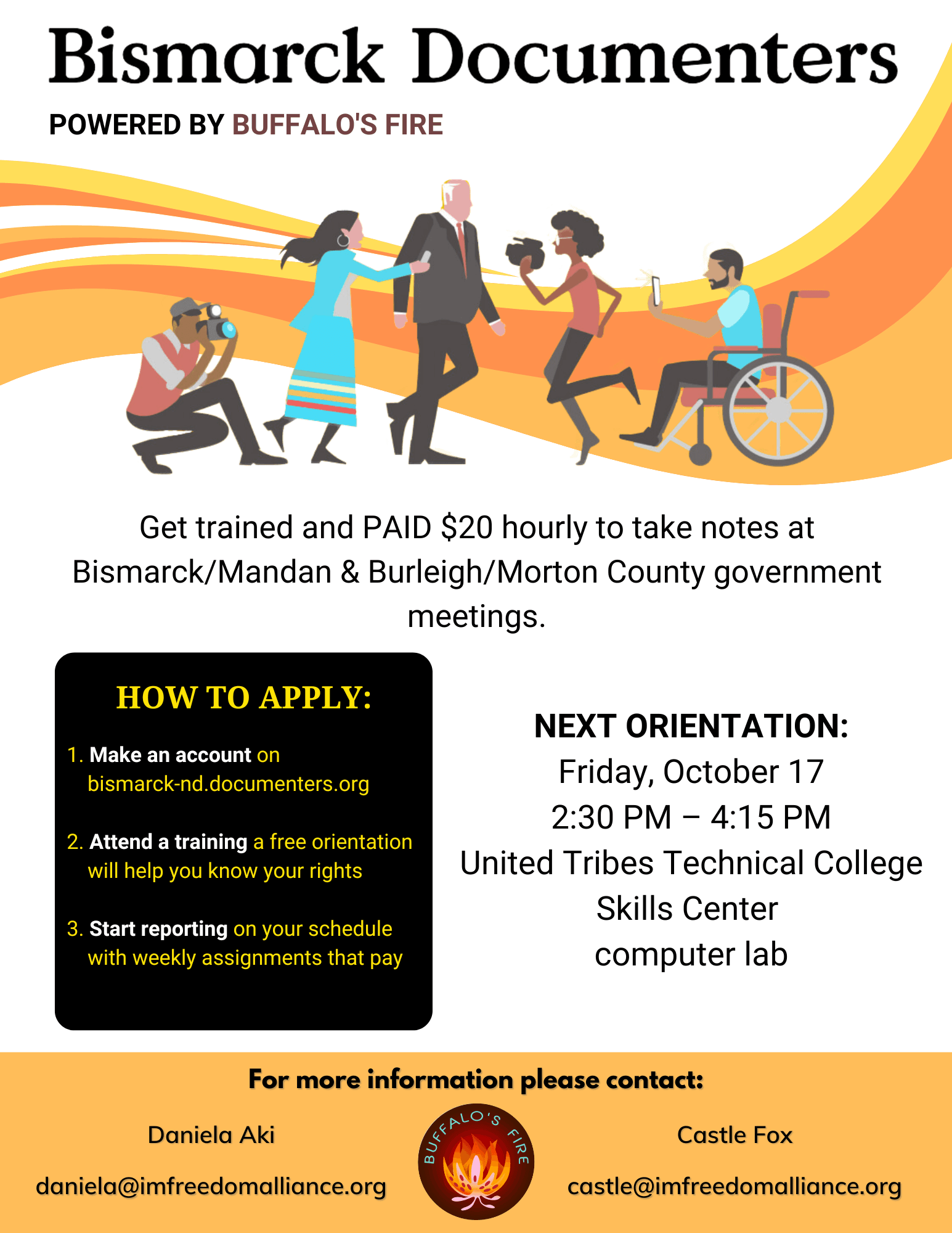
Bismarck Documenters will be holding an orientation at United Tribes Technical College on Friday, October 17, in the Skill Center computer lab from 2:30-4:15 p.m. The Documenters program trains and pays members of the public to take notes at public meetings. The orientation is free and can be attended in person or virtually. Attendees will learn about local government, as well as the value of information gathering and sharing to strengthen communities. Visit documenters.org to create a profile and click on the Bismarck Workshops tab to register for the virtual orientation option or just come to campus and register there.
Contact Daniela, daniela@imfreedomalliance.org, or Castle Fox, castle@imfreedomalliance.org, for more information.
Alaska expands cold case list amid MMIP calls for transparency
Alaska State Troopers have expanded the 2019 cold case list from 69 to 116 unsolved homicides following pressure from Missing and Murdered Indigenous People (MMIP) advocates and others who challenged the removal of certain cases, according to Alaska’s News Source. The increase represents a 68% jump.
Charlene Apok, director of Data for Indigenous Justice, said updates have included adding victims’ names and case numbers but that location data still needs improvement. Austin McDaniel, communications director for the Department of Public Safety, said names were restored after feedback and that his office is exploring ways to include more case details while preserving investigative focus.
Klamath River shows signs of recovery one year after dam removal
According to Underscore Native News, scientists monitoring the Klamath River say the ecosystem is rebounding a year after the final dams were removed. Chinook salmon have returned to spawning grounds, and wildlife such as eagles, bears and otters are appearing more frequently, said Damon Goodman, Mount Shasta-Klamath regional director for California Trout.
Goodman was quoted as saying that the river “came alive almost instantly after dam removal,” with more than 7,700 fish recorded passing the former Iron Gate Dam site between October and December 2024. Toz Soto, fisheries program manager for the Karuk Tribe, said water quality has improved as temperatures cool and harmful algae blooms disappear. However, Goodman said federal funding cuts, including the Department of the Interior’s termination of California Trout’s funding, pose challenges for continued monitoring of the river’s recovery.
Tariffs raise costs for Indigenous artisans making traditional regalia
New tariffs on imported materials are driving up the cost of making regalia for Indigenous artists and small businesses, according to reporting by ICT. Tin-plated jingle cones, fabric, beads and other supplies used in traditional designs are largely imported and now subject to tariffs imposed by the Trump administration.
Sharona Crane, Naongashiing First Nation Ojibwe and owner of Zazegaakwe in Ontario, said the increased costs have forced her to raise prices on her handmade jingle dresses and other Anishinaabe regalia. “I had a rough summer financially,” she told ICT. Beth Simmons, owner of Shipwreck Beads in Washington, said her company has also been affected by higher prices on imported beads from the Czech Republic, China and India.
Santa Rosa Band to open Creek Heritage Center in Florida
The Santa Rosa Band of the Lower Muscogee is establishing the Creek Heritage Center on 4.5 acres of the Jones Swamp Wetland Preserve in West Pensacola, Florida, according to the Pensacola News Journal. The center will feature a Learning Grove around a historic oak tree, offering outdoor educational programs, guided tours and hands-on experiences in nature. A greenhouse on site will grow spartina, a critical sea grass used in shoreline restoration projects, addressing local shortages of the plant.
Chief Dan “Sky Horse” Helms said the center will focus on environmental conservation and recreational opportunities, complementing the tribe’s 97-acre Cultural Center in Milton, which highlights history and culture. County support includes arborist services and integration with the Jones Creek Trail and Boardwalk. Grants from Impact 100 and the Pensacola and Perdido Bay Estuary Program are funding the project, which will also employ youth through the Oyster Corps conservation program.
Wabanaki women lead self-defense workshops amid violence crisis
Wabanaki women on the Houlton Band of Maliseet Indians reservation in Maine are participating in self-defense workshops organized by Wabanaki Public Health & Wellness, according to Maine Public. The classes, led by MiMi Tarshus and Clara Porter of Prevention, Action, Change, teach participants to recognize threats, de-escalate situations and strike attackers effectively. The program focuses on Indigenous women and two-spirit people, addressing the disproportionate rates of violence against Native women.
Crisis response manager Lena Newell said the workshops also provide support for families affected by missing and murdered Indigenous women. Tribal Chief Clarissa Sabattis noted that recent federal restrictions on diversity, equity and inclusion initiatives, as well as budget cuts to the Bureau of Indian Affairs, may hinder efforts to combat violence. Participants, including Barbara Haynes and her granddaughter, said the training empowers them to protect themselves and challenge cycles of violence in their communities.
University of Mary receives $1.74 million federal grant for Native graduate students
The University of Mary has received a $1.74 million federal grant to support Native American graduate students, according to a university statement. The funding, provided by the Department of Education’s Office of Indian Education, covers master’s degrees in school administration, special education and social work, as well as K-12 administration credentials, at no cost for eligible students.
The grant will provide $500,000 annually for the first three years and $120,000 annually for the final two years. Applicants must be tribal descendants or enrolled members of a tribe, meet admissions standards and commit to working in North Dakota schools where at least 11% of students are Native American. The University of Mary’s Native American Education Leadership Program has received five federal grants since 2016, totaling more than $7.1 million, and has supported over 120 Native American scholars, the university said.
North Dakota Native Vote to host online candidate training
North Dakota Native Vote will hold a candidate training online on Oct. 16 and 17, offering two half-day sessions from 12-4 p.m. The sessions will cover campaign strategy, public speaking, storytelling, understanding systems of power and ways to support other campaigns, according to an announcement by the organization.
The training aims to encourage more Native Americans to run for office and serve in elected roles in North Dakota and beyond. Robert Bird Horse, a Hunkpapa Lakota from Standing Rock, will lead the sessions. Nicole Donaghy, executive director of North Dakota Native Vote, said the program is designed to be accessible and to promote leadership and representation for the state’s Native communities. Registration is available online at bit.ly/NDNV2025.
South Dakota football unveils Native American Heritage helmet for Nov. 1
The University of South Dakota will celebrate Native Heritage Day on Nov. 1 as its football team hosts the University of North Dakota Fighting Hawks, according to USD Athletics. USD’s Coyotes will wear custom helmet decals designed by Sadie Red Wing (Spirit Lake Dakota) featuring the word Sungmanitu, Lakota for Coyote, and symbols representing the Oceti Sakowin, or Seven Council Fires.
Red Wing said the design highlights balance, abundance and strength, while John Little, director of Native Recruitment & Alumni Engagement, emphasized the importance of Native representation. Players, including defensive tackle Kainen White (Cherokee), said the helmet inspires pride and encourages recognition of Native culture. USD Native Student Services will also host a morning admissions program and honor Native alumni, students and staff during the game.