






The Daily Spark
Small sparks from Indian Country, built to catch fire
‘No Kings’ protests set for Oct. 18 in Bismarck and across the U.S.
A volunteer-organized “No Kings” rally will take place Oct. 18 from noon to 2 p.m. at the North Dakota State Capitol in Bismarck, according to event organizers. The demonstration is part of a nationwide movement that describes itself as peaceful and committed to nonviolent action.
Organizers said the “No Kings” events call attention to opposition against dictatorship and emphasize democratic values. Participants are encouraged to de-escalate potential confrontations and to act lawfully during the event. Weapons of any kind, including those legally permitted, are not allowed at the rally, organizers said.
Montana officially observes Indigenous Peoples Day for the first time
Montana marked its first official observance of Indigenous Peoples Day on Oct. 13, joining more than a dozen states and at least 200 cities that officially recognize the holiday, according to Montana Free Press.
The observance follows the passage of Senate Bill 224 earlier this year. Republican Gov. Greg Gianforte signed the bill into law in the spring, establishing the day as a state holiday alongside Columbus Day.
State Sen. Shane Morigeau, who sponsored the bill, told the Montana Free Press the holiday represents respect and empowerment for Indigenous youth. Marsha Small, cofounder of Indigenous Peoples Day Montana, said the day is meant to foster unity and healing. “This isn’t a political stunt,” Small was quoted as saying. “This is about communities working together for a better horizon.”
Indigenous Peoples’ Day honors Native cultures and histories across the U.S.
Indigenous Peoples’ Day is observed on the second Monday of October to honor the cultures and histories of Native American people. This year, the day falls on Oct. 13, according to National Today. The observance encourages reflection on tribal roots and the experiences that have shaped Indigenous communities.
The first recognition of Indigenous Peoples’ Day began in 1989 when South Dakota became the first state to adopt the holiday. Today, 14 states and the District of Columbia celebrate Indigenous Peoples’ Day instead of Columbus Day. More than 130 cities across the country also recognize the holiday, which highlights Indigenous contributions, resilience, and sustainable ways of life.
Five year anniversary of Savanna’s Act
Oct. 10 marks the five-year anniversary of Savanna’s Act. The act is named after Savanna LaFontaine-Greywind, the 22-year-old Fargo mother who was murdered by her neighbors in 2017.
Greywind was a citizen of Spirit Lake Nation. Her case caught national attention, with Native advocates calling out the need for awareness and policies to address MMIP.
The act was signed into law in 2020 with the goal of improving the federal response to MMIP. Both of North Dakota’s senators, John Hoeven and Kevin Cramer, co-sponsored the act. The act required the Department of Justice to establish new guidelines in MMIP training, engagement with tribal leaders and data entry. The bill also authorizes the Department of Justice to provide MMIP grants to tribal and state governments.
“Savanna’s Act was born out of heartbreak, but also out of strength,” Spirit Lake Nation Chairwoman Lonna Jackson-Street said in a press release. “Five years later, we continue to honor Savanna’s memory by putting action behind our words. “Here at Spirit Lake, her legacy is alive in the systems we’re building, the families we stand beside, and the voices we refuse to let fade into silence.”
Michigan State University, MiLEAP release updated Native American resource guide
Michigan State University’s Native American Institute partnered with the Michigan Department of Lifelong Education, Advancement and Potential to publish an updated Native American Resource Guide, according to MSU’s Office of University Outreach and Engagement. The guide is designed to improve access to tribal and Indigenous services and opportunities across Michigan.
Melissa Kiesewetter, Tribal liaison for MiLEAP, said the guide supports Native students and families by connecting them with educational resources, scholarships and community programs. Kevin Leonard, director of the Native American Institute, said the collaboration ensures tribal nations and community members can access needed supports. The 2025 edition of the guide, which was last published in 2016, is available both online and in print and includes updated information and artwork from Native artists in Michigan.
North Dakota Native Tourism Alliance earns global recognition
The North Dakota Native Tourism Alliance, founded in 2016, is gaining international attention for promoting Native-led tourism across the state, according to KXNET. The organization represents all five of North Dakota’s tribal nations and partners with North Dakota Tourism to coordinate cultural tours for domestic and international visitors.
The alliance’s unified support and funding from each tribal nation has helped it expand and serve as a national model for tribal tourism development. The alliance also plays a key role in hosting events such as the International Roundup, which brings tour companies from abroad to North Dakota.
Tribal nations lead transition to electric school buses
The Eastern Band of Cherokee Indians is on track to become the first tribal nation to fully transition its school bus fleet to electric by the end of 2025, according to the World Resources Institute. The move follows the deployment of the tribe’s first electric school bus in 2022 and is part of a growing effort among tribal nations and Native communities to reduce emissions and improve student health.
As of July, more than 400 electric school buses operate in 70 Native school districts nationwide. Communities including the Eastern Band of Cherokee Indians in North Carolina, the Passamaquoddy Tribe in Maine, Red Lake Nation in Minnesota and Shawnee Public Schools in Oklahoma have adopted the technology, citing cost savings, cleaner air and cultural integration as key benefits.
Children’s book honors LaDonna BraveBull Allard and the origins of Sacred Stone Camp
A new picture book, “The Sacred Stone Camp,” tells the story of LaDonna BraveBull Allard, tribal historian for the Standing Rock Sioux Tribe who founded the Sacred Stone Camp in 2016, according to The Seattle Times. Written by Seattle author Rae Rose and illustrated by Aly McKnight, the book recounts how Allard and her husband, Miles, organized the camp along the Cannonball River in North Dakota as part of the resistance to the Dakota Access Pipeline.
Rose said she wanted to highlight Allard’s legacy and her philosophy of generosity, protection of sacred lands and advocacy for her people. The book also explores Lakota prophecies, the meaning of “Mitákuye Oyás’iŋ” and the broader message of environmental stewardship and unity.
Standing Rock Sioux Tribe ushers in newly elected chair and council members
Inauguration attendees honor outgoing tribal leaders
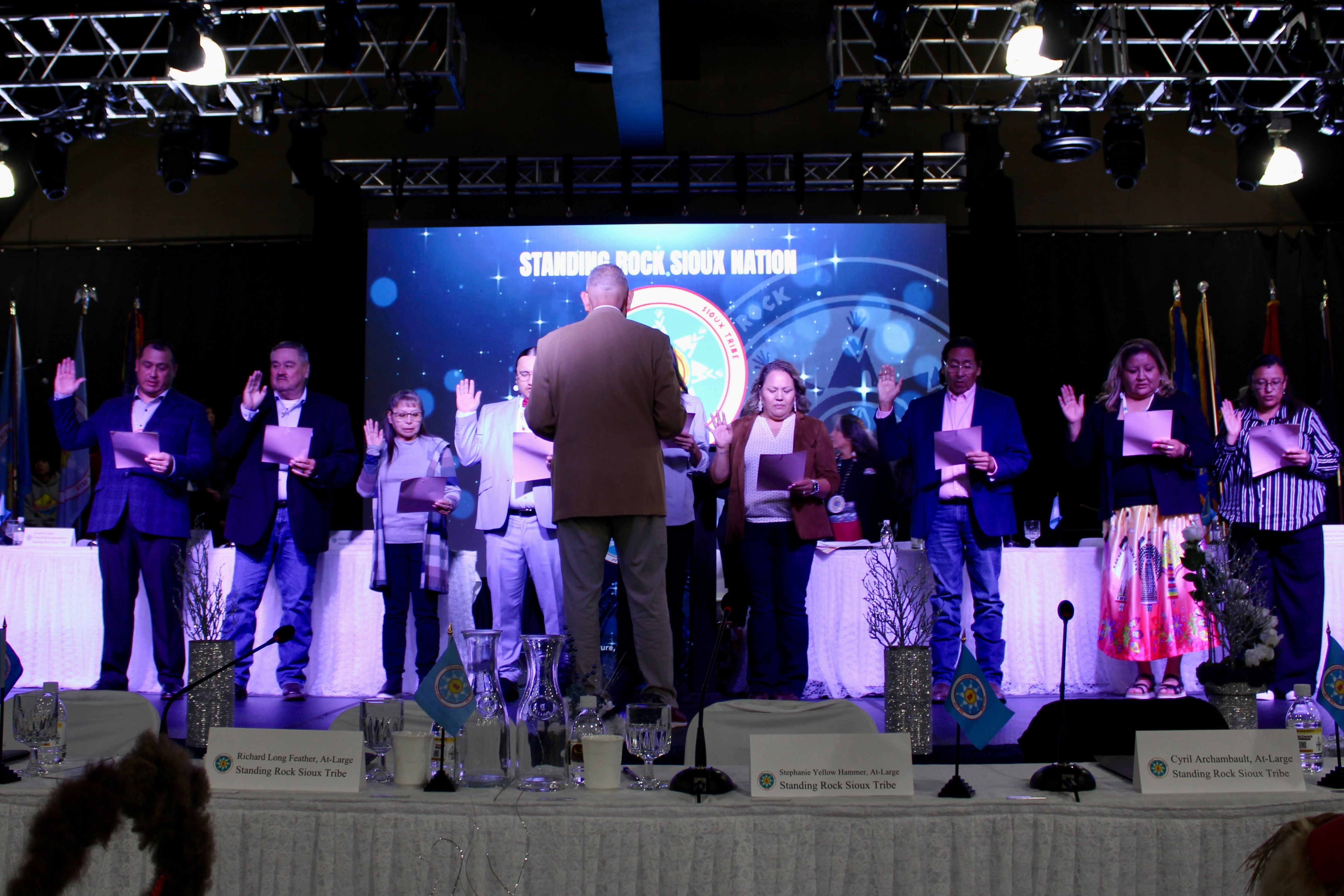
On Wednesday, Oct. 8, the Standing Rock Sioux Tribe held its 2025 Inauguration for newly elected Chairman Steve Sitting Bear and several council members at the Prairie Knights Casino & Resort in Cannon Ball, North Dakota. Friends, family, tribal members and government officials also honored retiring Chairwoman Janet Alkire, the tribe’s first enrolled woman to hold the position of chair, along with other outgoing council members and past tribal leaders.
Alkire told Buffalo’s Fire she never thought she’d step into the role of chairwoman four years ago, but “the Creator put her there” to serve with truth and compassion. She said she’s now ready to retire, and thinks the tribe’s future is in good hands with Chairman Sitting Bear.
MHA Nation receives grant for wildfire protection plan
The Mandan, Hidatsa and Arikara Nation received a $249,262 federal grant to develop a Community Wildfire Protection Plan for the Fort Berthold Indian Reservation, according to KXNET. The Nation is one of only two tribal nations selected for the 2025 USDA Community Wildfire Defense Grant.
The $200 million federal initiative supports 58 projects across 22 states and two tribal nations to improve wildfire preparedness, build capacity and strengthen fire management. The MHA Nation’s plan will focus on fuel management, community readiness and interagency coordination, led by the tribe’s Emergency Operations Center. A project coordinator and wildfire planning contractor will oversee the five-year effort, which follows the October 2024 Bear Den Fire that burned 13,000 acres in northwest North Dakota. The grant proposal was developed by retired Fire Management Officer Mare Baker.
Indigenous musical ‘Bear Grease’ draws sold-out crowds across Canada
The Indigenous musical “Bear Grease” is playing to sold-out audiences on a Canadian tour following a successful off-Broadway run in New York City, according to ICT. The show, created by Crystle Lightning and rapper MC RedCloud, reimagines the 1978 movie “Grease” with Indigenous music, humor and storytelling.
Lightning told the audience at Winnipeg’s Burton Cummings Theatre that the cast worked hard to bring Indigenous representation to the stage. “We’re the first Indigenous musical to have our own playbill,” Lightning was quoted as saying. “We had a dream, we had a goal, and we chased after it.” RedCloud said the all-Indigenous cast honors elders who “paved the way” and reflects how far Indigenous performers have come since the 1950s and 1960s.
Passamaquoddy artist Jeremy Frey named MacArthur Fellow for redefining traditional basketry
A member of the Passamaquoddy Tribe from Maine has received a 2025 MacArthur Fellowship. Artist Jeremy Frey is one of 22 fellows who will receive the $800,000 award commonly known as a “genius grant.” The “no-strings-attached” fellowship recognizes “extraordinarily talented and creative individuals as an investment in their potential,” according to the MacArthur Foundation.
In a video interview released by the foundation, Frey said his goal is to help redefine craft as fine art through his work in basketry, sculpture and weaving. He uses natural materials such as black ash and sweetgrass and said his family has practiced basketry for seven generations.
His work has been exhibited at the Portland Art Museum in Maine, the Art Institute of Chicago, the Bruce Museum in Connecticut, the Metropolitan Museum of Art in New York and the Smithsonian American Art Museum in Washington, D.C.
Wind River students take part in buffalo harvest to honor tradition, feed community
According to WyoFile, students from Arapahoe and Fort Washakie schools joined Northern Arapaho and Eastern Shoshone tribal members for a buffalo harvest this week on the Wind River Reservation. The event, organized by the Wind River Tribal Buffalo Initiative and the Food Bank of Wyoming, aimed to teach Native youth about cultural traditions and food sovereignty.
Jackie White, the Food Bank of Wyoming’s tribal relations specialist and a member of the Northern Arapaho Tribe, told WyoFile that the harvested buffalo will be processed and distributed in November food boxes for Wind River Reservation residents and elders. White said the effort connects generations and honors the buffalo as a sacred relative. “We have so much love and respect for our elders,” she said. “They are our knowledge keepers."
Cheyenne and Arapaho tribes reclaim remains of 16 children from Carlisle Cemetery
The Cheyenne and Arapaho tribes in Oklahoma have reclaimed the remains of 16 children from the Carlisle Indian School Cemetery, according to WGAL. The disinterments were part of this year’s program by the Office of Army Cemeteries, which oversees the return of remains from the former boarding school site.
The tribes had requested the return of 18 children who died while enrolled at the school in the late 1800s and early 1900s. Due to the federal government shutdown, the Army was limited in releasing information about the two children not yet accounted for. Since 2017, the Army has returned the remains of more than 50 children to their tribes.
North Dakota updates Native American textbooks with tribal input
Education leaders in North Dakota are completing an updated series of Native American history books for schools, according to KXNET. As Buffalo’s Fire previously reported, the project revises four textbooks first published between the 1990s and 2002 and adds a fifth volume featuring the Sisseton Wahpeton Oyate. United Tribes Technical College will print the books this fall for distribution to schools, libraries and tribal colleges across the state.
Hopi Tribe loses federal funding for solar project after program termination
The Hopi Tribe in Arizona lost $25 million in federal funding to connect 600 homes to electricity after the Trump administration ended the Solar for All program, according to NPR. The Environmental Protection Agency terminated the program in August, following the passage of the One Big Beautiful Bill Act, which eliminated tax credits for large-scale renewable energy projects.
Hopi Chairman Tim Nuvangyaoma said the tribe will now have to choose which families receive power through limited funding from the Tribal Electrification Program. The Hopi plan to join other tribes in suing the Trump administration to reinstate the Solar for All grants, which had been approved under the Inflation Reduction Act in 2022.
Seminole Tribe supports Florida State’s Chief Osceola and Renegade traditionSeminole Tribe supports Florida State’s Chief Osceola and Renegade tradition
Chief Osceola and Renegade have performed at Florida State University football games with the approval of the Seminole Tribe of Florida since 1978, according to the Associated Press. The ritual, featuring a student rider portraying Osceola planting a flaming spear at midfield, began after FSU student Bill Durham worked with tribal leaders to develop the regalia and ceremony.
The university and the Seminole Tribe continue to maintain the partnership that defines the tradition, which FSU identifies as a symbol rather than a mascot. The pregame performance remains a central part of Florida State’s football identity nearly 50 years after its debut.
Yankton Sioux citizen Valeriah Big Eagle announces Rapid City Council bid
Valeriah Big Eagle, an Ihaƞktoƞwaƞ Dakota and Nakota woman from the Yankton Sioux Tribe, announced her campaign for the Ward 4 seat on the Rapid City Council in South Dakota, according to ICT. If elected, she would be the only Native woman currently serving on the council and the second Native person overall, joining Rosebud Sioux Tribe citizen Lance Lehmann.
Big Eagle said she aims to improve access to affordable housing, mental health resources and food security. She lives in Ward 4, a predominately Native area and food desert, and serves on boards for He Sapa Otipi and Oaye Luta Okolakiciye, organizations focused on community healing and development. The election is scheduled for June 2026.
Three North Dakota schools receive federal grants to support Native education
Three North Dakota schools are receiving nearly $1 million through the Indian Children Program to improve education for Native American students, according to KFYR. The program supports development, testing and demonstration projects aimed at strengthening educational outcomes.
Devils Lake Public School District will receive more than $290,000, Turtle Mountain College will receive just over $360,000 and the University of North Dakota will be awarded nearly $300,000. The funding will also assist college students pursuing careers as teachers and administrators.