






The Daily Spark
Small sparks from Indian Country, built to catch fire
North Dakota launches October challenge to improve money management skills
The State of North Dakota is encouraging residents to take part in the October Money Personality Challenge through the Smart With My Money program, according to the Minot Daily News. Participants can create a free account to complete a financial checkup and take a Money Personality Quiz that provides personalized learning recommendations.
Bank of North Dakota President and CEO Don Morgan said the challenge aims to help residents improve financial literacy after North Dakotans received a C grade in a recent Financial Industry Regulatory Authority study. The Smart With My Money initiative, launched in April 2024, seeks to make North Dakota the most financially literate state by 2027, according to the Minot Daily News.
Federal shutdown disrupts tribal services, spurs concern over treaty obligations
Tribal nations across the United States are facing furloughs and service closures as the federal government shutdown continues, according to the Associated Press. Tribes with independent revenue sources said they can sustain operations for several months, while others dependent on federal funding have begun cutting staff. The Pyramid Lake Paiute Tribe in Nevada furloughed at least 25 employees and closed its museum, cultural center and education services.
Tribal leaders said they fear the Trump administration could use the shutdown to reduce the federal workforce responsible for upholding treaty and trust responsibilities. “I’m extremely nervous about that,” Liz Carr, vice president for intergovernmental relations for the Cedar Rock Alliance, was quoted as saying.
Standing Buffalo Dakota Nation advances Indigenous trade corridor across US-Canada border
The Standing Buffalo Dakota Nation in Saskatchewan plans to establish an Indigenous-governed trade corridor connecting Dakota territories in Canada and the United States, according to reporting by Mother Jones. The First Nation is expected to sign a memorandum of understanding with the Fort Peck Sioux Tribes in Montana to formalize the partnership. The initiative seeks to revive ancestral trade routes and operate under Indigenous law, with a proposed $2 billion infrastructure plan to develop a cross-border trade portal and renewable energy corridors.
Chief Rodger Redman told Mother Jones the project fulfills promises made to Indigenous peoples under the Jay Treaty of 1794, which recognizes cross-border trade rights. Spokesperson Solomon Cyr said the corridor would allow Indigenous nations to control the movement of resources and strengthen sovereignty.
Four states approve Medicaid coverage for tribal traditional healing
Traditional tribal healing practices are now eligible for Medicaid coverage in Arizona, California, New Mexico and Oregon under new federal waivers, according to Stateline. The programs allow tribal and urban Indian health facilities to bill for traditional healing services such as sweat lodge ceremonies, talking circles and plant medicine.
Virginia Hedrick, executive director of the California Consortium for Urban Indian Health, said each tribe and facility will decide which services to offer, noting they can take place at sacred sites rather than clinics. Dr. Naomi Young of the Fort Defiance Indian Hospital Board called the integration of traditional and Western medicine “exciting.” In Washington, state officials plan to apply for similar approval by the end of the year.
Homeownership helps strengthen Blackfeet community
When Brad Hall became president of Blackfeet Community College, finding housing near campus was one of his biggest challenges, according to Montana Free Press. Like many reservation residents, Hall faced barriers to buying a home because most land on the Blackfeet Reservation is held in trust by the federal government, limiting traditional mortgage options.
Hall eventually secured financing through NACDC Financial Services, a Native Community Development Financial Institution that offers flexible lending for Indigenous borrowers. Executive Director Angie Main said NACDC has closed more than 100 real estate loans in Montana since 2017 but lacks sufficient funding to meet demand. Hall said owning a home has deepened his connection to the community.
Report warns Northwest tribes could lose half of federal funding under new bill
Nearly half of federal funding allocated to Northwest tribal nations last year could be eliminated under President Donald Trump’s new spending bill, according to InvestigateWest. A report by Portland State University researchers found that about $530 million of the $1.19 billion in 2024 federal funds for tribes in the region is at risk.
Serina Fast Horse, co-director of the Northwest Environmental Justice Center, said tribes are deeply concerned about cuts affecting programs for clean water, housing, education and climate resilience. The report links potential reductions to the repeal of former President Joe Biden’s Executive Order 14008 and cuts across agencies including the Environmental Protection Agency and the Department of the Interior. William E. Ray Jr., chair of the Klamath Tribes, said the cuts threaten tribal culture and treaty-protected resources.
Panelist says focus on soldier conduct undermined Wounded Knee medals review
A former Department of the Interior official told South Dakota Searchlight that the panel reviewing Medals of Honor awarded for the 1890 Wounded Knee Massacre focused too narrowly on individual conduct instead of whether medals should exist for a massacre. Wizipan Little Elk Garriott, a member of the Rosebud Sioux Tribe and former principal deputy assistant secretary for Indian affairs, said that Department of Defense representatives dominated the review panel and ignored accounts from Lakota survivors. “They were looking for evidence that individuals committed war crimes, essentially,” Garriott was quoted as saying. “The broader question — that this was a massacre in which women and children were killed and therefore not deserving of medals — was simply not part of the conversation.”
Garriott said the panel voted 3-2 against rescinding the medals, with Defense officials in the majority. Former Defense Secretary Pete Hegseth cited the panel’s unreleased report last week in affirming that the medals will not be revoked. Garriott said the decision “chose not to make right a historical wrong.”
Native Forward Scholars Fund receives $50 million from MacKenzie Scott
Native Forward Scholars Fund, the largest direct provider of scholarships to Native students, received a $50 million gift from philanthropist MacKenzie Scott, the organization announced. The contribution marks Scott’s second major gift to the fund and is the largest single award to date in Indian Country.
The Albuquerque-based nonprofit has supported more than 22,000 scholars from over 500 tribes across all 50 states since 1969. According to Native Forward, scholarship requests increased 35% this year. CEO Angelique Albert, a member of the Confederated Salish and Kootenai Tribes, said the unrestricted funding will help the organization expand services and ensure students “not only enroll, but thrive and graduate.” Board Chair Lillian Sparks Robinson, a member of the Rosebud Sioux Tribe, said the award reflects growing recognition of Native Forward’s impact and will strengthen its ability to reach more scholars.
Spirit Lake tribe urges vigilance as suspect remains at large
Law enforcement is investigating a stolen vehicle incident that occurred on Oct. 2 near St. Michael, North Dakota, on the Spirit Lake Reservation, according to a news release from the Spirit Lake Tribe. The Bureau of Indian Affairs received a call about a stolen vehicle in Devils Lake just before 7 p.m., and minutes later a BIA officer arrived at the scene of a single-vehicle crash.
Authorities have made contact with one of the two suspects, who is cooperating with investigators. The second suspect, Winfield Chaske III, remains at large with active warrants in tribal and state courts. The tribe said there is no active threat to the community and urged residents to remain vigilant. Residents are asked not to approach Chaske and to contact Fort Totten Police at 701-766-4231.
Lower Sioux tribe invests in multipurpose hemp products
The Lower Sioux Indian Community is developing a “seed to wall” program that grows, processes and builds with industrial hemp, including the use of hempcrete, a concrete-like insulation, for housing on the reservation, according to reporting by ICT. The program combines tribal hemp farming with construction of affordable, energy-efficient homes, according to Brooklyn Lindsey, director of innovation at the nonprofit Ivory Innovations.
Danny Desjarlais, the tribe’s hempcrete project manager, said the program provides jobs and strengthens the community while addressing a housing shortage. Hempcrete is fire and mold resistant and provides natural insulation. The tribe is also hosting the 13th International Hemp Building Symposium on the reservation from Oct. 3-5.
Cheyenne River community honors missing and murdered relatives
The Cheyenne River Sioux Tribe held a “Paint the Town Red” event in September in Eagle Butte, South Dakota, to raise awareness of missing and murdered Indigenous people. According to reporting by South Dakota Searchlight, the event featured a display of red dresses and T-shirts along the main street, a commemorative walk and speakers sharing stories of lost loved ones.
Jolee Two Dogs Clark, a tribal citizen, displayed photographs of her 20-year-old daughter, Ahmyli Clark, who was killed in June, and her 23-year-old son, Miles Phillips, who was shot in July 2022. Jessica Grazier, domestic violence advocate for the Sacred Heart Center, said organizers could not hang shirts and dresses for all affected. The event offered a space for the community to pray, mourn, and access mental health and spiritual resources.
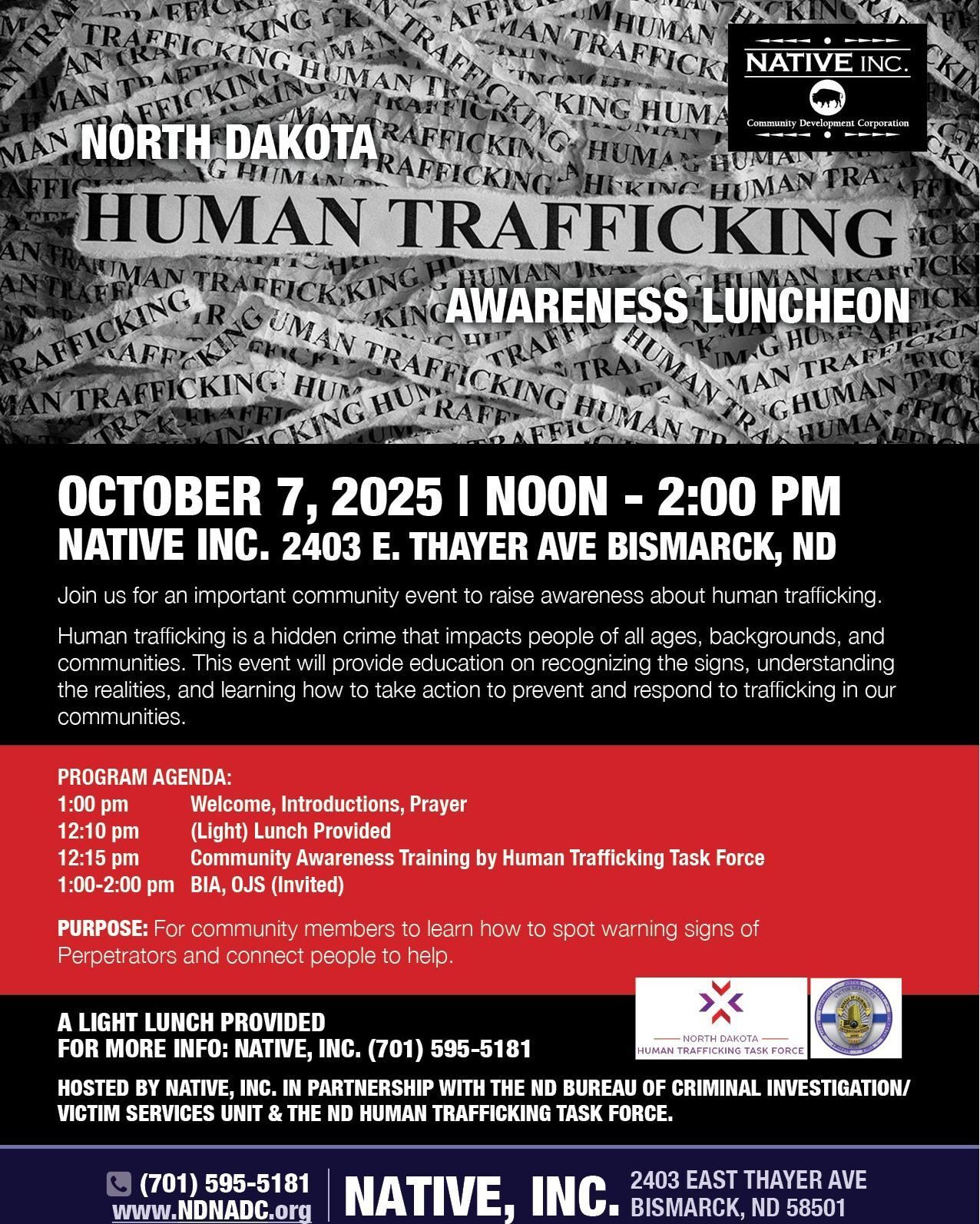
Bismarck community event raises awareness on human trafficking
Native, Inc. will host a community event on human trafficking on Oct. 7 from noon to 2 p.m. in Bismarck, in partnership with the North Dakota Bureau of Criminal Investigation Victim Services Unit and the North Dakota Human Trafficking Task Force. The event aims to educate community members on recognizing signs of trafficking and connecting people to resources. It includes participation from the Bureau of Indian Affairs and Office of Juvenile Services.
A light lunch at 12:10 p.m. will be followed by a community awareness training led by the Human Trafficking Task Force. Welcome, introductions and prayer are scheduled for 1 p.m.
The event takes place at 2403 E. Thayer Avenue. For more information, contact Native, Inc. at 701-595-5181.
Wendy Danicourt named CEO of Heartview Foundation
Wendy Danicourt has been named chief executive officer of Heartview Foundation, according to an Oct. 1 news release from the organization. She will assume the role Nov. 3, succeeding Kurt Snyder, who announced his retirement earlier this year after 23 years with the foundation.
Heartview Foundation, based in Bismarck with facilities in Dickinson and Cando, is North Dakota’s oldest private, nonprofit alcohol and drug treatment program. Danicourt brings more than 20 years of leadership in behavioral health and addiction treatment. She most recently served as CEO of Danicourt Group and has held senior roles at Walmart Inc., Brave Health, Riverside Recovery of Tampa and Operation PAR Inc.
Darrell Nitschke, board president, said in the release that Danicourt’s “experience and dedication to this field will be a tremendous asset to Heartview and the communities we serve.”
Alaska graphite mine advances without tribal consent
A proposed graphite mine in western Alaska is moving forward without legally required consultations with nearby Inupiaq communities, according to Grist and Alaska Public Media. Canadian company Graphite One plans to mine one of the world’s largest graphite deposits in the Kigluaik Mountains for batteries and strategic minerals, despite objections from the tribal governments of Teller, Brevig Mission and Mary’s Igloo.
The project, fast-tracked under the federal FAST-41 program, has accelerated permitting and environmental reviews. Tribal members say the process has marginalized their input, violating free, prior and informed consent under the U.N. Declaration on the Rights of Indigenous Peoples. Residents also raised concerns about infrastructure, environmental risks and impacts on hunting and fishing grounds. Federal and state officials have provided limited oversight, leaving communities responsible for monitoring potential violations.
Seneca artist Marie Watt to create work for Obama Presidential Center
Seneca artist Marie Watt has received the 2025 Heinz Award for the Arts and will create a site-specific work for the Obama Presidential Center, according to ICT. Watt, known for her blanket towers, sculptures, textiles and prints, is participating in a retrospective exhibit, “Storywork: The Prints of Marie Watt, From the Collections of Jordan D. Schnitzer and His Family Foundation,” at the Jordan Schnitzer Museum of Art at Portland State University through Dec. 6.
The Heinz Award includes a $250,000 unrestricted cash prize, which Watt said will support her studio operations and creative experimentation. She is collaborating with artist Nick Cave on a multimedia textile installation, “This Land, Shared Sky,” merging Indigenous and Black traditions for the presidential center. Watt described the project as a community-centered work and said the commission recognizes her multi-decade career exploring cultural intersections through art.
Sacramento State opens Wileety Native American College
Sacramento State celebrated the grand opening of the Wileety Native American College on Sept. 24, according to The State Hornet student newspaper. The college, the first of its kind in the California State University system, aims to support Native students through Native-based education, leadership training and community engagement.
Annette Reed, dean of WNAC and a citizen of the Tolowa Dee-ni’ Nation, canceled her retirement to lead the college. The first cohort of 34 students will study majors of their choosing while completing a minor in Native American studies with a focus on tribal leadership. Speakers, including President Luke Wood and tribal leaders, highlighted the importance of a campus space that affirms Native identity. Reed said the college provides a place for students to feel at home and build connections across the university community.
Indigenous activist Simone Senogles remembered for advocacy and heart
Simone Senogles, 54, a founding member of MMIW 218 and operations director for the Indigenous Environmental Network, died unexpectedly Sept. 20 in Bemidji, Minnesota, according to the Bemidji Pioneer. Born into the Migizi (Eagle) clan, Senogles carried the names Chinoodinikwé and Miskomakwakwe and had a long-standing connection to Red Lake Nation. Over 25 years, she led initiatives on food sovereignty, environmental justice and Indigenous women’s rights, including directing the documentary “Regaining Food Sovereignty.”
Senogles also helped create the first U.S. Indigenous Feminist Organizing school and served on the governing board of Grassroots Global Justice. Her wake was Sept. 25, with traditional services Sept. 26 in Red Lake led by spiritual leader Naabek Liberty.
Colleagues remembered Senogles for her mentorship and community presence. “It’s our responsibility to reciprocate that good energy that she put out into the Earth and into the communities that we work to uplift, to continue to embody all the positive things that Simone was like,” MMIW 218 organizer Audrianna Goodwin told the Bemidji Pioneer.
Spirit Lake Tribe says essential services will continue during shutdown
The Spirit Lake Tribal Council announced in a press release that essential services would continue despite the federal government shutdown, which began Oct. 1 after Congress failed to pass funding legislation. According to the council’s statement, BIA law enforcement, Indian Health Service clinical care at the Spirit Lake Health Center and Bureau of Indian Education schools will remain operational under federal contingency plans.
Chairwoman Lonna Jackson-Street said the Tribe has reviewed budgets and identified programs that may need supplemental tribal funding to keep services in place. “Our first priority is the safety and wellbeing of the Spirit Lake people,” Jackson-Street was quoted as saying. The council noted that some programs, such as grant reimbursements, new federal awards and communication with furloughed staff, may be delayed until funding is restored.
California legislation deepens inequity among tribes
California Assembly Bill 831 bars non-casino tribes and companies from offering online sweepstakes games, a move that critics say favors wealthy, mega-casino tribes and limits economic opportunities for smaller or rural tribes, according to Charlie Wright, chairman of the Kletsel Dehe Wintun Nation. Wright, writing in CalMatters, said his tribe and other non-gaming tribes are confined to a flat $1.1 million annual stipend from the revenue sharing trust fund, which has not increased in 25 years.
Wright argued Bill 831 extends inequity into digital gaming by blocking smaller tribes from participating while well-resourced tribes prepare to dominate the market. He cited Washington state as an example of a more equitable model, where tribes can lease unused gaming machine rights to each other, ensuring broader participation in gaming revenue streams. The legislation, he said, undermines the unity and opportunity voters intended when legalizing tribal gaming more than two decades ago.
Parshall ranch uses horses for therapeutic programs
Healing Horse Ranch, located near the Fort Berthold Reservation, offers therapeutic horse rides to help participants improve confidence, mental well-being and connection to Native traditions, according to KXNET. The nonprofit combines therapy with efforts to preserve and share Native horse culture across North Dakota.
MHA Nation Tribal Council Representative Mervin Packineau said the program helps riders overcome fear and build confidence. James Baker, ranch supervisor, added that horses are sensitive to riders’ physical and emotional states, allowing participants to connect with their bodies, minds and spirits. Horses also hold cultural significance for Native communities, representing strength, resilience and adaptability. The ranch will host its second team roping event on Oct. 14, continuing its therapeutic and cultural programming, according to KXNET.