






The Daily Spark
Small sparks from Indian Country, built to catch fire
Minnesota Indian Women’s Resource Center opens new supportive units
The Minnesota Indian Women’s Resource Center has begun welcoming residents into 24 newly constructed permanent supportive housing units, according to MPR News. The center’s CEO, Ruth Buffalo, said the housing will provide space and support services for unhoused Native community members. Residents will have access to cultural events, support groups and community meals.
Staff held a ceremonial cleansing with sage, singing and drumming to create a safe environment before residents began moving in. Corey Baesler, housing manager, said the program addresses the isolation and stigma of being unhoused while connecting residents to the larger MIWRC community. The center aims to fill all units by March 2026, with 20 units coordinated through Hennepin County and four accessible units filled directly by MIWRC.
Tribes brace for disruption as deadline looms
A federal government shutdown would cut off dozens of services to tribal nations, according to ICT. Tribal communities rely on federal programs for policing, health care, food, housing and other services.
“Government shutdowns affect Indian Country more quickly and more broadly than they do every day Americans because of our direct relationship with the federal government,” Holly Cook Macarro, Red Lake Ojibwe and a tribal advocate, was quoted as saying. The Indian Health Service will continue operating with prior year funds, but other programs, including tribal police departments and housing initiatives, face immediate impacts. “Indian Country can’t afford a shutdown,” said Liz Carr, Sault Ste. Marie Tribe of Chippewa Indians and vice president of intergovernmental affairs for the Cedar Rock Alliance, during a Sept. 29 National Congress of American Indians webinar.
South Dakota offers priority training to tribal officers, explores recognition legislation
South Dakota will offer one police certification course each summer that prioritizes tribal recruits, Division of Criminal Investigation Director Dan Satterlee told the State-Tribal Affairs Committee on Sept. 19, according to South Dakota Searchlight. This year’s class began in August with nine tribal agency officers enrolled, Satterlee said.
Committee members also voted to support drafting legislation for the 2026 session that would formally recognize tribal officers under state law, making assaults against them chargeable as felonies. The panel unanimously endorsed a resolution urging Congress to establish a federal tribal police academy in South Dakota.
During the meeting, Standing Rock Sioux Tribal Police Chief Derris Waukazoo reported 75 arrests and 817 incidents during a recent surge patrol with state troopers. Former Chairwoman Janet Alkire said the effort showed the value of cooperation while reiterating tribal concerns about past claims of cartel activity, according to South Dakota Searchlight.
UINO Chairperson calls for national investigation into boarding schools
This Orange Shirt Day, the United Indian Nations of Oklahoma is calling for the United States and Canada to honor Indian boarding school victims and survivors with “honesty and action” by launching an investigation into every boarding school.
“United Indian Nations of Oklahoma calls on everyone to take part in Orange Shirt Day to honor the survivors and remember the victims of residential Indian boarding schools,” Chief and UINO Chairperson Ben Barnes was quoted in a press release as saying. “Oklahoma had more of these schools than any other state, nearly 100, filled with Native children who were forcibly taken from their families and subjected to unimaginable trauma. Yet, to this day, there has been no true accountability.”
Orange Shirt Day began in Canada in 2013 to raise awareness and educate people about the trauma boarding school victims endured. It has been recognized every Sept. 30 in the U.S. and Canada since.
Ojibwe regain ancestral land in northern Wisconsin
The Lac du Flambeau Ojibwe Nation has regained about 2,500 acres of ancestral land in northern Wisconsin since 2019, according to the Milwaukee Journal Sentinel. The land includes areas in Oneida and Iron counties, expanding the tribe’s presence beyond its traditional Vilas County reservation.
“These accomplishments reflect the commitment of our land management team to both restoring our homelands and uplifting our people,” Jessie Peterson, the tribe’s land management director, was quoted as saying. Tribal officials are working to place the reclaimed land into federal trust to protect it from taxation and future seizure. The tribe is also assisting individual members in purchasing property, with more than 30 tribal members acquiring land or homes in the past six years, Peterson said.
Leonard Peltier honored on 81st birthday
The Indigenous Peoples Coalition commemorated the 81st birthday of activist Leonard Peltier on Saturday, Sept. 13, at the Unitarian Universalist Church of Nashville, according to People’s World. Peltier, a member of the Turtle Mountain Band of Chippewa Indians, was released from federal prison in February after serving 49 years and two months in prison. He is now under strict home confinement on the Turtle Mountain Reservation.
The celebration included updates from the International Leonard Peltier Defense Committee, noting Peltier had received cataract surgery and new dental work. Attendees discussed topics such as Tribal sovereignty and social justice issues. The event concluded with a birthday song, chants of “Happy Birthday, Leonard” and a cake reading “Happy 81st Birthday, Leonard Peltier,” according to People’s World.
Tribes awarded federal grants for veteran housing programs
Two North Dakota tribes will receive federal grants to support veteran housing, according to the Minot Daily News. Turtle Mountain Housing Authority will receive $348,194 and Standing Rock Housing Authority will receive $260,256 through the Tribal HUD-VA Supportive Housing grant program.
“Across North Dakota and across the entire nation, Native Americans serve at the highest rates of any demographic group in our country’s armed forces and their willingness to serve frankly deserves the highest thanks from a grateful nation,” U.S. Sen. Kevin Cramer was quoted as saying. Secretary of Housing and Urban Development Scott Turner said Sept. 26, “It is an honor to see how the Tribal HUD-VASH program is creating economic opportunity and pathways to self-sufficiency for Native American veterans. Today’s funding announcement will expand the impact of this program to more Native American veterans across the country.”
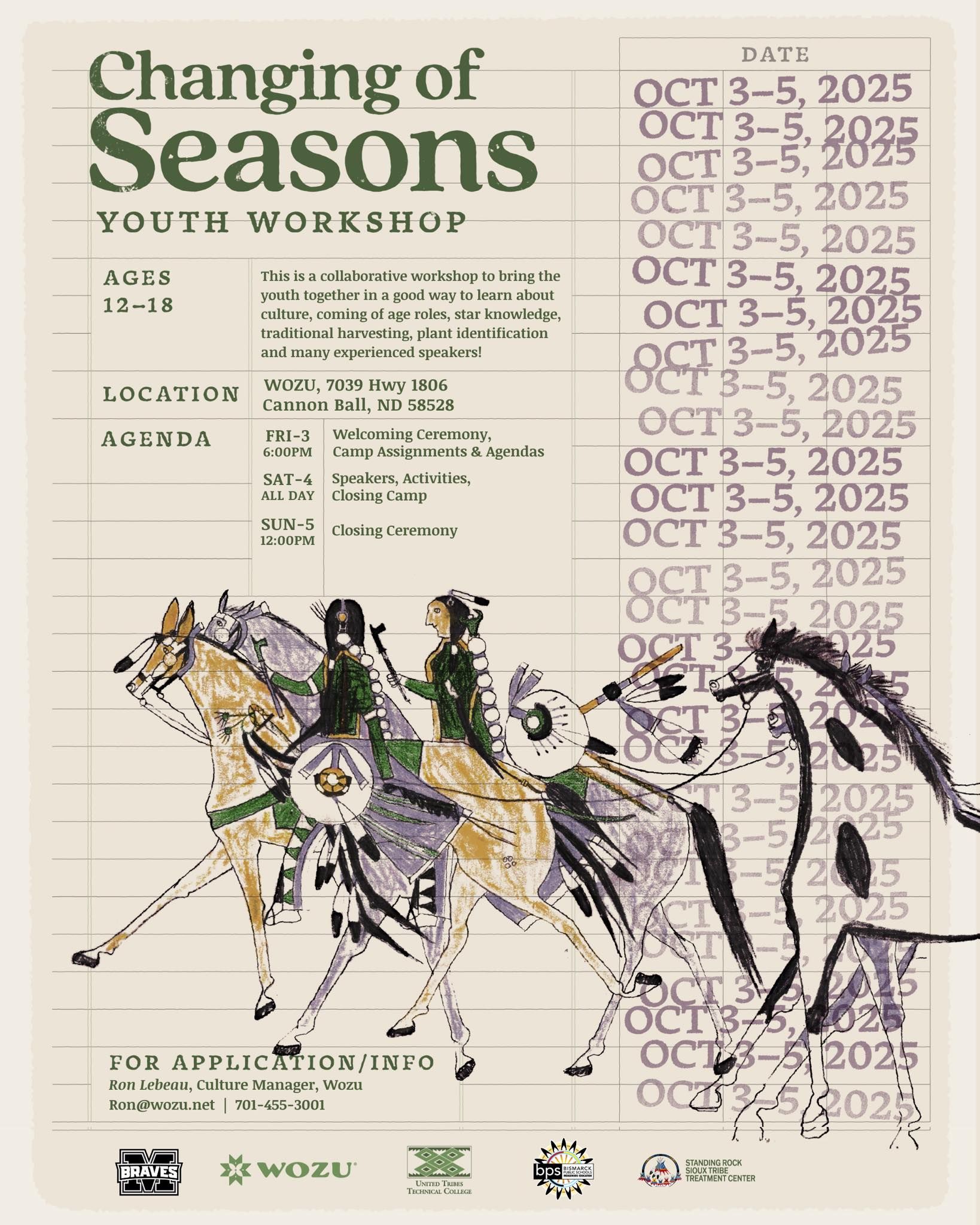
Youth workshop in Cannon Ball focuses on culture and tradition
The Changing of Seasons youth workshop will be held Oct. 3-5 at Wozu, 7039 Hwy 1806 in Cannon Ball, North Dakota. The event is open to those between the ages of 12 and 18 and aims to connect young people with cultural teachings.
The three-day agenda includes a welcoming ceremony, camp assignments and speakers on traditional knowledge, such as star teachings, harvesting practices and plant identification. The workshop closes with a ceremony at noon on Oct. 5. For more information or to apply, contact Ron Lebeau, culture manager at Wozu, at ron@wozu.net or 701-455-3001.
Indigenous families in Buffalo invited to join IPAC board elections
Buffalo Public Schools Indigenous Parent Advisory Council will hold elections for the 2025–2027 term on Monday, Sept. 29, 5-7 p.m. Open positions include president, vice president, secretary, two members at large, student representative, elder representative and teacher representative.
The meeting will take place rain or shine. Attendees must be present to nominate, run for or vote for candidates. A meal will be provided. Current board members available for questions include Billie Jo Beheler, Wind Spirit Spotted Bear, Valerie Siqueiros, Logan Anderson and Tamsen O’Berry. Additional details about each position will be shared in upcoming posts.
Audit finds Coushatta Tribe credit card purchases lacked receipts
An independent audit of the Coushatta Tribe of Louisiana found leadership failed to document more than $100,000 in credit card charges over a two-month period in 2024, according to Louisiana Illuminator. The review by the SJT Group of Albuquerque, New Mexico, reported 344 transactions without receipts, totaling $105,416, and noted 167 purchases with no business documentation to explain $100,254 in charges.
Tribal policy requires receipts for any purchase over $50 and expense reports for travel-related charges. In response, the tribal council said it has eliminated council credit cards and adopted new reimbursement policies. Tribal secretary and treasurer Kristian Poncho will complete a review of credit card policies by the end of September, according to the tribe’s statement. The findings follow the August 2024 resignation of former chairman Jonathan Cernek, who news outlets reported is under federal and state investigation.
Wind River Food Sovereignty Project unveils elder healing garden at Trout Creek Farm
The Wind River Food Sovereignty Project in Wyoming opened an elder healing garden at Trout Creek Farm near Fort Washakie on Sept. 20 with a ribbon cutting, prayer and community feast, according to WyoFile. The 30-acre farm, purchased in 2023, has been transformed with vegetable gardens, a high tunnel, transplanted native plants and circular paths designed for elders.
“This garden is a sanctuary, a place for healing, peace and connection with nature,” co-director Kelly Pingree was quoted as saying during the event. The project, founded in 2018 by Hank Herrera, is supported in part by a $36 million federal redevelopment grant awarded in 2024. Plans include expanding food production, education and access to healthy foods across the Wind River Reservation.
Indian Gaming Association chairman Ernie Stevens Jr. dies suddenly
The Indian Gaming Association has announced the sudden death of its longtime chairman, Ernest L. Stevens Jr. Stevens, who died on Sept. 26, led the organization for more than two decades, working to advance tribal government gaming and strengthen tribal sovereignty, according to an IGA statement.
Jason Giles, executive director of IGA, said in the statement that the IGA Board and staff “are stunned and saddened” by Stevens’s passing. “Out of respect for his wife Cheryl, his lovely family and the Oneida Nation,” the statement continued, “we will issue a full tribute at the appropriate time. Please send your prayers to the Stevens family.”
Under Stevens’s leadership, Indian gaming revenues grew from $11 billion in 2000 to $43.9 billion in 2024, which IGA described as a reflection of his strategic vision and advocacy alongside tribal leaders nationwide.
Hundreds of Native American remains in Louisiana still not returned
Hundreds of Native American remains taken from Louisiana gravesites remain in museums, universities and government collections nearly 35 years after the passage of the Native American Graves Protection and Repatriation Act, according to reporting by The Advocate.
In 1968, a prison guard looted a Tunica-Biloxi burial site in West Feliciana Parish, discarding the unearthed skeletons into the Mississippi River and keeping artifacts, Tribal Historic Preservation Officer Earl Barbry Jr. said. Although the Tunica-Biloxi later won a court case that set precedent for NAGPRA, repatriation has been slowed by lack of funding, inconsistent federal data and reluctance by some institutions to release remains. “It’s a sorrow in that it was taken out of the ground, but relief that it’s come back to be housed here and taken care of and honored,” Barbry said.
Film documents Alaska Native families’ search for justice
A new documentary, “In the Wake of Justice Delayed,” follows two Alaska Native families seeking justice for murdered loved ones, according to the Alaskan Beacon. The film tracks the Miller family of Teller, whose daughter Mingnuna Bobbi Jean Miller was killed in Palmer in 2019, and the Lane family of Point Hope, whose mother Harriet Lane was murdered in 1985.
The film, directed by Mary Katzke and produced by Affinityfilms, Inc., explores grief, barriers within the justice system and the broader crisis of missing and murdered Indigenous people in Alaska. It premieres in Anchorage on Sept. 21 and in Homer on Sept. 27, with a nationwide PBS broadcast set for Nov. 1, according to the Alaskan Beacon.
Alaskan Beacon
OU student becomes first female Native American Sooner Schooner driver
Brianna Howard, a University of Oklahoma junior and member of the Choctaw Nation, became the first female Native American to drive the Sooner Schooner during OU’s Sept. 20 home game against Auburn, according to Central Oklahoma Weeklies. Howard, a 2023 Tuttle High School graduate, was promoted from her role with the Ruf/Nek Lil’ Sis to driver trainee this fall.
Howard said her first official run felt “surreal” after months of training. “All of those practices don’t do the real run justice,” she told Central Oklahoma Weeklies. “Once I started driving, it was like everything went silent. All I could think about was the ponies and making that turn.” She said she takes pride in representing Native people and has received encouragement from community members who expressed excitement at seeing her in the driver’s seat.
Federal grant for Indian education in North Dakota
According to a press release from Senator Kevin Cramer, the U.S. Department of Education awarded $1,397,350 to three North Dakota colleges under the Indian Education Professional Development Grants. The funding aims to train Native students for careers as teachers and administrators and to support students at tribal colleges and universities.
The release says the University of Mary will receive $500,000; Sitting Bull College, $472,340; and Turtle Mountain College, $425,010.
Spirit Lake quilter keeps tradition alive
According to KXNET, Crystal Two Hearts of the Spirit Lake Nation has been sewing star quilts for 15 years and now runs Eternal Bloom Blankets in Bismarck full time. She said quilts are sacred gifts in Native culture, representing the embrace of ancestors during life events such as graduations, weddings and funerals.
Two Hearts learned the skill from her mother-in-law and now hopes to pass it on to her daughter, according to KXNET. Working with a vintage machine, she spends up to eight hours a day stitching and often a full week completing a quilt. She also sews handbags, keychains and skirts, donating items to Standing Rock to support fundraising efforts. Two Hearts said the work grounds her and connects her to her culture.
Justice Department expands Tribal Access Program
The U.S. Department of Justice has selected six federally recognized tribes to join the Tribal Access Program for National Crime Information, according to a press release by the U.S. Attorney’s Office for the District of Colorado. The program gives tribal governments access to national crime information systems maintained by the FBI Criminal Justice Information Services Division.
Deputy Attorney General Todd Blanche said the expansion arms tribal law enforcement with data to identify criminals, track predators and deliver justice for victims. The selected tribes are the Alabama-Coushatta Tribe of Texas; Cayuga Nation in New York; Duckwater Shoshone Tribe; Pueblo of Zia; Seneca-Cayuga Nation in Oklahoma; and Southern Ute Indian Tribe.
HHS funds national Native hotline
The U.S. Department of Health and Human Services awarded a projected $15 million, five-year grant to StrongHearts Native Helpline to operate as the first standalone National Indigenous Domestic Violence Hotline for American Indians and Alaska Natives, according to a Sept. 24 announcement. The grant, authorized by the Family Violence Prevention and Services Act, will fund culturally appropriate support and advocacy provided by trained staff with expertise in tribal cultures, sovereignty and jurisdictional complexities.
According to the Administration for Children and Families, the hotline will also serve as part of the FVPSA Training and Technical Assistance Resource Network, helping expand domestic violence programs nationwide. The service operates 24/7, offering confidential, toll-free support via call, text and online chat at 844-762-8483 and www.strongheartshelpline.org.