






The Daily Spark
Small sparks from Indian Country, built to catch fire
10th Circuit revives discrimination lawsuit against university
The U.S. Court of Appeals for the Tenth Circuit has reinstated a lawsuit filed by a Native American employee alleging race and sex discrimination by a university. The plaintiff claims she was terminated after reporting discriminatory treatment. The appellate court's decision overturns a lower court ruling that had dismissed the case, allowing the lawsuit to proceed.
This development underscores the ongoing challenges in addressing discrimination within academic institutions and highlights the importance of legal avenues for individuals seeking redress.
DOI approves $700M California tribe casino and housing project
The U.S. Department of the Interior has approved a $700 million casino and housing development project by the Pequot Tribe in California. The project will include a new casino, hotel, and residential units, aiming to create economic opportunities for the tribe and the surrounding community. The approval marks a significant step in the tribe’s efforts to expand its economic base and enhance self-sufficiency. The project is expected to provide job opportunities and bolster the region’s economy.
Washington city, tribe work to settle 24-hour ER shelter dispute
The city of Tacoma and the Puyallup Tribe are negotiating to resolve a dispute regarding a 24-hour emergency shelter for individuals in crisis. The shelter, operated by the tribe, was set to open in 2024 but has faced pushback over jurisdictional and safety concerns. Both parties are working towards a settlement that would balance tribal sovereignty with city regulations. The resolution aims to ensure the shelter’s success while providing essential services to the community.
Interior Department finalizes new tribal recognition rule
The U.S. Department of the Interior has finalized a new rule aimed at simplifying the federal recognition process for Native tribes. The updated rule is designed to reduce bureaucratic delays and make it easier for tribes to obtain recognition, which is important for gaining access to federal resources, services, and protections. The new policy outlines clearer criteria and establishes a more consistent, transparent process. Advocates view this change as a positive move for supporting tribal sovereignty and improving resources for unrecognized tribes.
Standing Rock Sioux Tribe resumes buffalo roundup after hiatus
The Standing Rock Sioux Tribe's Game and Fish Department has resumed its annual buffalo roundup after a year-long break, aimed at supporting the tribe's efforts to manage its bison population. The tribe had paused the roundup due to logistical challenges but is now moving forward with plans to gather and relocate buffalo to grazing lands. The roundup is an important cultural and ecological project, as the buffalo is central to the tribe’s heritage, providing food and materials. The tribe’s efforts are also contributing to ecological restoration and sustainability.
New exhibit at CWU highlights Indigenous knowledge
Central Washington University (CWU) has opened a new exhibit celebrating Indigenous knowledge and culture. The exhibit showcases the rich traditions, practices, and perspectives of Native communities, with a focus on how Indigenous knowledge has contributed to environmental sustainability and cultural preservation. It serves as an educational resource for students and visitors, fostering a deeper understanding of Indigenous contributions to modern society.
Biden administration and tribes finalize resource plan for Bears Ears National Monument
The Biden administration, in collaboration with five Native American tribes, has finalized a groundbreaking resource management plan for Bears Ears National Monument in Utah. This plan integrates Traditional Ecological Knowledge (TEK) and ensures that Tribal leadership plays a key role in the stewardship of the monument. The new framework marks a significant step in recognizing Indigenous knowledge and authority over cultural and natural resources.
Supreme Court upholds Native-majority districts in North Dakota
The U.S. Supreme Court has upheld North Dakota’s legislative redistricting plan, which includes two Native-majority subdistricts. These districts were designed to ensure fair representation for Native communities, particularly the Turtle Mountain Band of Chippewa Indians and the Spirit Lake Nation. The decision reinforces the importance of tribal voices in state governance and complies with the Voting Rights Act.
Tribal members push to join 8th Circuit appeal
Tribal members are seeking to join an 8th Circuit Court appeal over the Dakota Access Pipeline’s environmental review. They argue that the U.S. Army Corps of Engineers failed to consult adequately with tribes and properly assess risks to water resources, including the Missouri River, which serves as a critical water source. This legal battle builds on years of resistance against pipeline projects impacting Indigenous lands, with potential implications for federal consultation standards and tribal sovereignty.
New curriculum and film highlight the legacy of Billy Caldwell
A new Native American curriculum and documentary film explore the life and legacy of Billy Caldwell, a leader and diplomat of the Potawatomi Nation in the 19th century. The resources aim to educate students and the public about Caldwell’s efforts to secure land and protect his people amidst U.S. westward expansion. The project sheds light on an often-overlooked figure in Chicago’s history.
Deb Haaland reflects on her legacy as interior secretary
Deb Haaland, the first Native American to serve as a U.S. Cabinet secretary, is reflecting on her legacy as Secretary of the Interior. A member of the Laguna Pueblo tribe, Haaland has focused on climate action, advancing tribal sovereignty, and addressing the painful history of Indian boarding schools. Her leadership has brought critical Native issues to the forefront of federal policy.
Arizona launches MMIP database to track missing Indigenous people
A first-of-its-kind Missing and Murdered Indigenous People (MMIP) database and map has been launched for Arizona. This project, developed by Arizona Luminaria, focuses on tracking cases of missing and murdered Indigenous individuals, particularly women and girls. The database includes nearly 100 cases spanning decades, primarily involving the Navajo Nation. The initiative aims to raise awareness and provide valuable resources to families and communities affected by these crimes.
Family game night at Sacred Pipe Resource Center
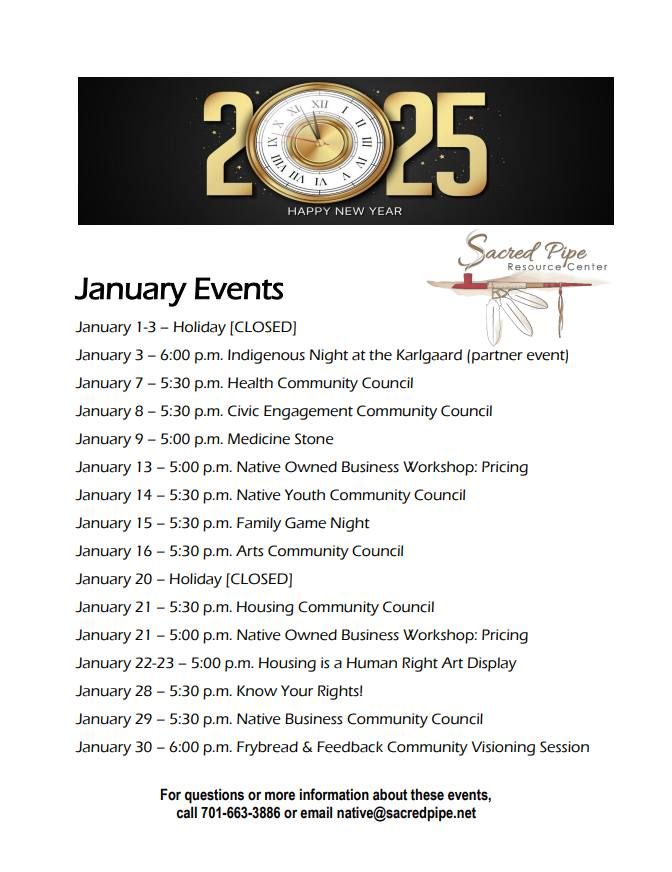
Sacred Pipe Resource Center will host Family Game Night tonight at 5:30 p.m. Participants are invited to join in working on puzzles and enjoy time with friends and family. The event aims to provide a safe space for community members to interact and meet new people.
2025 Mid-Winter Powwow at University of Mary
The University of Mary, in partnership with United Tribes Technical College, will host the 2025 Mid-Winter Powwow on Sunday, Jan. 19. The event will feature Mass, a buffalo feed and a contest powwow, celebrating Indigenous culture in North Dakota.
Cost of Attendance
- General Public: $5
- Mary, UTTC, and BSC Students/Faculty/Staff: Free with ID
- Under 5 or Over 65: Free
- Vendor Booth: $150
Tribal leaders advocate for clemency in Leonard Peltier case
More than 250 tribal leaders and Indigenous organizations have signed a letter urging President Joe Biden to grant clemency to Leonard Peltier, citing concerns over his health and fairness in his trial. Peltier, a member of the Turtle Mountain Band of Chippewa Indians, has been imprisoned for nearly 50 years in connection with the 1975 deaths of two FBI agents on the Pine Ridge Reservation. Advocates emphasize the need for justice and healing in Native communities.
Man arrested in 1983 murder of Sioux City woman
Authorities have arrested a suspect in the decades-old murder of Terri McCauley, a 22-year-old Native woman from Sioux City, Iowa. McCauley was found strangled in her apartment in September 1983. According to police, advancements in DNA technology led to the recent breakthrough, culminating in the arrest of 66-year-old Danny Ray Abshear. The case highlights ongoing efforts to bring justice to victims and their families, even after decades.
Hard Rock, Seminole Gaming expand human trafficking prevention efforts
Hard Rock International and Seminole Gaming have announced enhanced measures to fight human trafficking, including specialized training for employees to identify and respond to trafficking indicators. The initiative aligns with National Human Trafficking Prevention Month and underscores their commitment to protecting vulnerable populations, including Native communities. According to company officials, these efforts aim to foster safer environments across their properties.
Access to investigation documents on North Dakota tribal lands proves challenging
Accessing documents related to investigations on North Dakota's tribal lands has proven challenging, with delays and difficulty obtaining key materials. Tribes and advocates seeking transparency have expressed frustration, as the process impacts efforts to address unresolved issues on these lands. This lack of access raises concerns about accountability and tribal rights.
USACE and CTUIR partner to enhance fish passage on Umatilla River
The U.S. Army Corps of Engineers (USACE) is collaborating with the Confederated Tribes of the Umatilla Indian Reservation (CTUIR) to improve fish passage on the Umatilla River in Oregon. The project focuses on restoring habitat and migration routes for salmon and lamprey, species vital to the tribes’ cultural and ecological heritage. Tribal leaders emphasized the importance of this partnership in sustaining traditional fishing practices and environmental stewardship.
Chair resigns from Vermont Commission on Native American Affairs
Rich Holschuh has stepped down as chair of the Vermont Commission on Native American Affairs (VCNAA). Holschuh, who served since 2022, cited personal reasons for his resignation. His term was set to expire in February 2026. The VCNAA plays a crucial role in advising the governor and legislature on issues affecting Native American communities in Vermont.