






‘Our future does not hinge on the limbs of federal decision making,’ keynote speaker tells AIHEC crowd
Tribal college students travel through massive snowstorm to participate in annual education conference

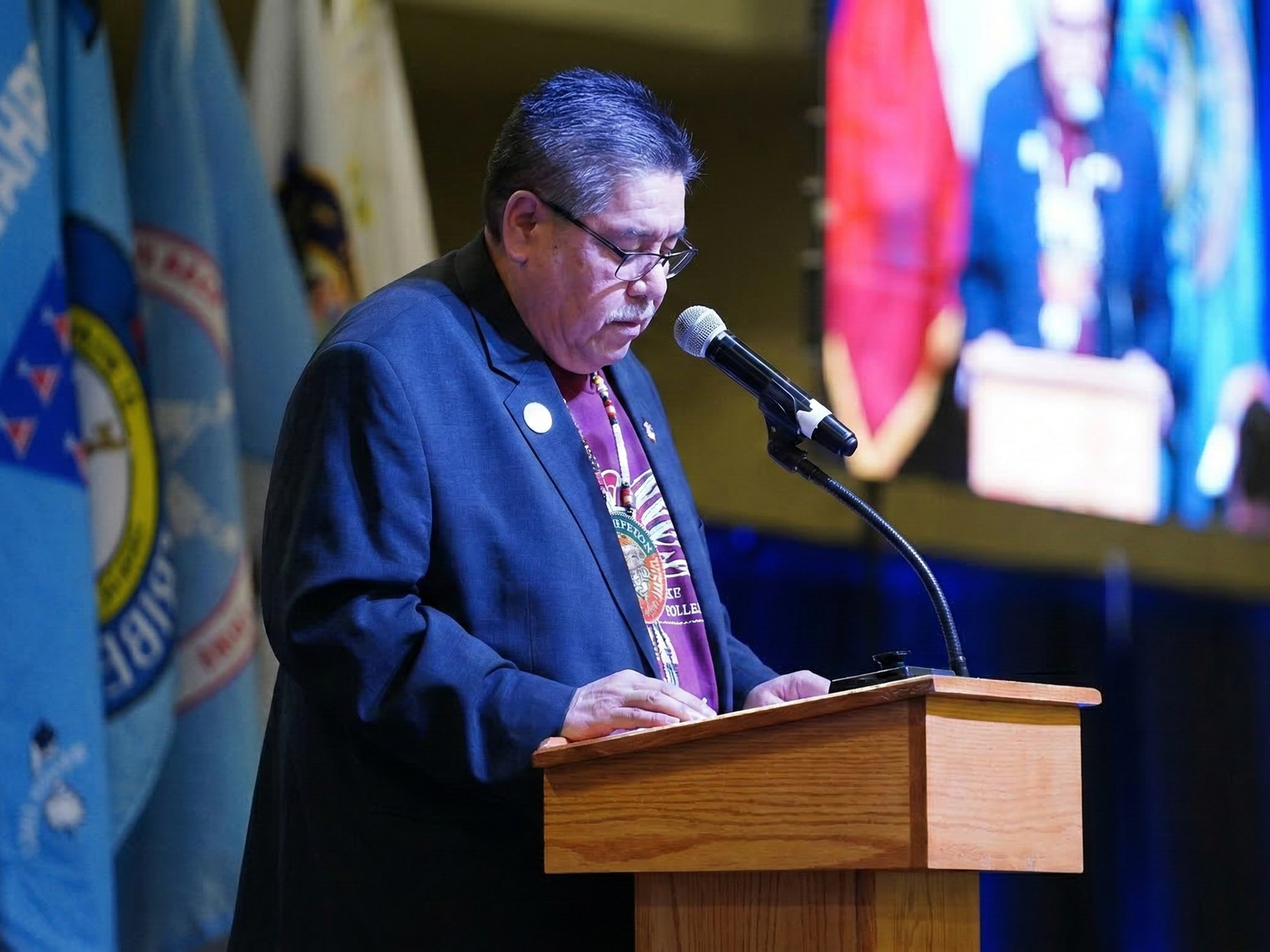
More than 1,100 people convened Monday for the American Indian Higher Education Consortium’s annual conference at the Bismarck Civic Center for four days of competition, learning and networking.
The annual conference began in 1980 and offers tribal college students the opportunity to compete in a variety of juried events, including knowledge bowls, traditional hand games, archery and art competitions. This year’s theme is “Our Stories, Our Strength, Our Future!”
The hosts of the conference were the five tribal colleges in North Dakota: Sitting Bull College, Cankdeska Cikana Community College, Nueta Hidatsa Sahnish College, Turtle Mountain College and United Tribes Technical College.
“What’s unique about this year’s conference is the North Dakota Tribal College System largely planned the event,” UTTC President Leander McDonald told Buffalo’s Fire. “We're the only formal organization among the tribal colleges that’s a consortium of Tribal Colleges and Universities. We work together, and it’s allowed us to apply successfully for some grants and partner with our university system in the state to help expand our programming at each of the colleges.”
UTTC, in Bismarck, is the first tribal college in the U.S. After it began instruction in September 1969, several tribal nations followed its lead and began establishing colleges to both serve people in their community and address their own workforce needs.
The first six American Indian tribally controlled colleges founded the nonprofit he American Indian Higher Education Consortium in 1973. The members of its board are presidents of accredited TCUs.
Today, 37 accredited TCUs operate in 16 states and serve more than 160,000 students from 250 federally recognized tribes. Each TCU is governed by a federally recognized tribe and is a nonprofit organization with the specific purpose of providing higher education opportunities to American Indians and Alaskan Natives. The TCU system uplifts regional economies. In fiscal year 2022-2023, it generated $3.8 billion in economic growth for the United States — supporting 40,700 jobs, according to a report published by the American Indian Higher Education Consortium.
Funding TCUs is too often political, said McDonald. “Federal support for Tribal Colleges and Universities upholds the government’s trust and treaty obligations,” he said.
“The trust and treaty obligation that defines our relationships with federal governments don't expire and they are not subject to political cycles. As tribal colleges, we are institutions of sovereign nations. We are equipping our people with the skills, knowledge and grounding necessary to govern effectively, to build economically and steward land responsibly.”
The Institute of American Indian Arts in Santa Fe, New Mexico, Haskell Indian Nations University in Lawrence, Kansas, and the Southwestern Indian Polytechnic Institute in Albuquerque, New Mexico, are congressionally funded institutions, whereas the remaining 34 TCUs are funded through the Tribally Controlled Colleges and Universities Assistance Act of 1978. The U.S. Department of the Interior’s Bureau of Indian Education manages funds for TCUs through federal grants. Funding is formula-based on how many students are attending and how many credits they take.
Since the Tribally Controlled Colleges and Universities Assistance Act was passed in 1978, tribal colleges have been underfunded. Last year the U.S. Department of Education aimed to end grant funding to hundreds of minority-serving institutions, including tribal institutions, but Congress did not approve the budget cut recommendations from the Bureau of Indian Education.
“I see firsthand how quickly political environments can change,” said American Indian Higher Education Consortium’s Executive Director Ahniwake Rose during her keynote presentation at the conference. “Policy becomes political battlegrounds, programs get reinterpreted, brands get changed and shifted based on whims, and it would be really easy to feel uncertain during this time, because it has been challenging.”
Recent contributions from philanthropist MacKenzie Scott have offered extra stability, providing many TCUs with the largest financial donations in their histories. In late 2025, she gave unrestricted grants to many tribal colleges, including $11 million to the Fort Peck Community College, $8 million to Blackfeet Community College, $10 million to the College of Menominee Nation.
“That's why coming to these gatherings and visiting TCUs and meeting you is so important,” Rose continued. “Because it reaffirms, for me, lessons that I have learned long ago, that our future does not hinge on the limbs of federal decision making, or administration. The trust and treaty obligation that defines our relationships with federal governments don't expire and they are not subject to political cycles. As tribal colleges, we are institutions of sovereign nations. We are equipping our people with the skills, knowledge and grounding necessary to govern effectively, to build economically and steward land responsibly.”
Students from several tribal colleges, including the Bay Mills Community College in northern Michigan, weren’t able to make the trip due a massive snow storm that canceled thousands of flights and closed highways in the upper Midwest.
Iḷisaġvik College students who made it all the way from Utqiaġvik, Alaska, to Minneapolis before their connecting flight was canceled rented a vehicle and drove through the storm that dumped at least 20 inches of snow in some places.
“The blizzard was nothing, we drive through winter weather every day,” Simon Aina, Iḷisaġvik College’s associate dean of students, told Buffalo’s Fire. “It was important for us to get our students here, to experience the conference for the first time. Many of them had no idea there were this many Tribal Colleges out there, and we’re all having a great time.”
Spotted an error? Suggest a correction.
Darren Thompson
(Lac du Flambeau Ojibwe)Former Reporter
Sharing Is Caring
This article is not included in our Story Share & Care selection.
The content may only be reproduced with permission from the Indigenous Media Freedom Alliance. Please see our content sharing guidelines.
© Buffalo's Fire. All rights reserved.
We provide independent Native-focused reporting that gives our communities the context and the facts they need to make informed decisions.
Respect The Fire
At Buffalo's Fire, we value constructive dialogue that builds an informed Indian Country. To keep this space healthy, moderators will remove:
- Personal attacks, harassment, or hate speech
- Spam, misinformation, or unsolicited promotion
- Off-topic rants and excessive shouting (All Caps)
Let’s keep the fire burning with respect.