






Legislation signed to protect Wounded Knee memorial site
South Dakota’s congressional delegation joins Wounded Knee descendants and supporters at site on 135th anniversary of the massacre

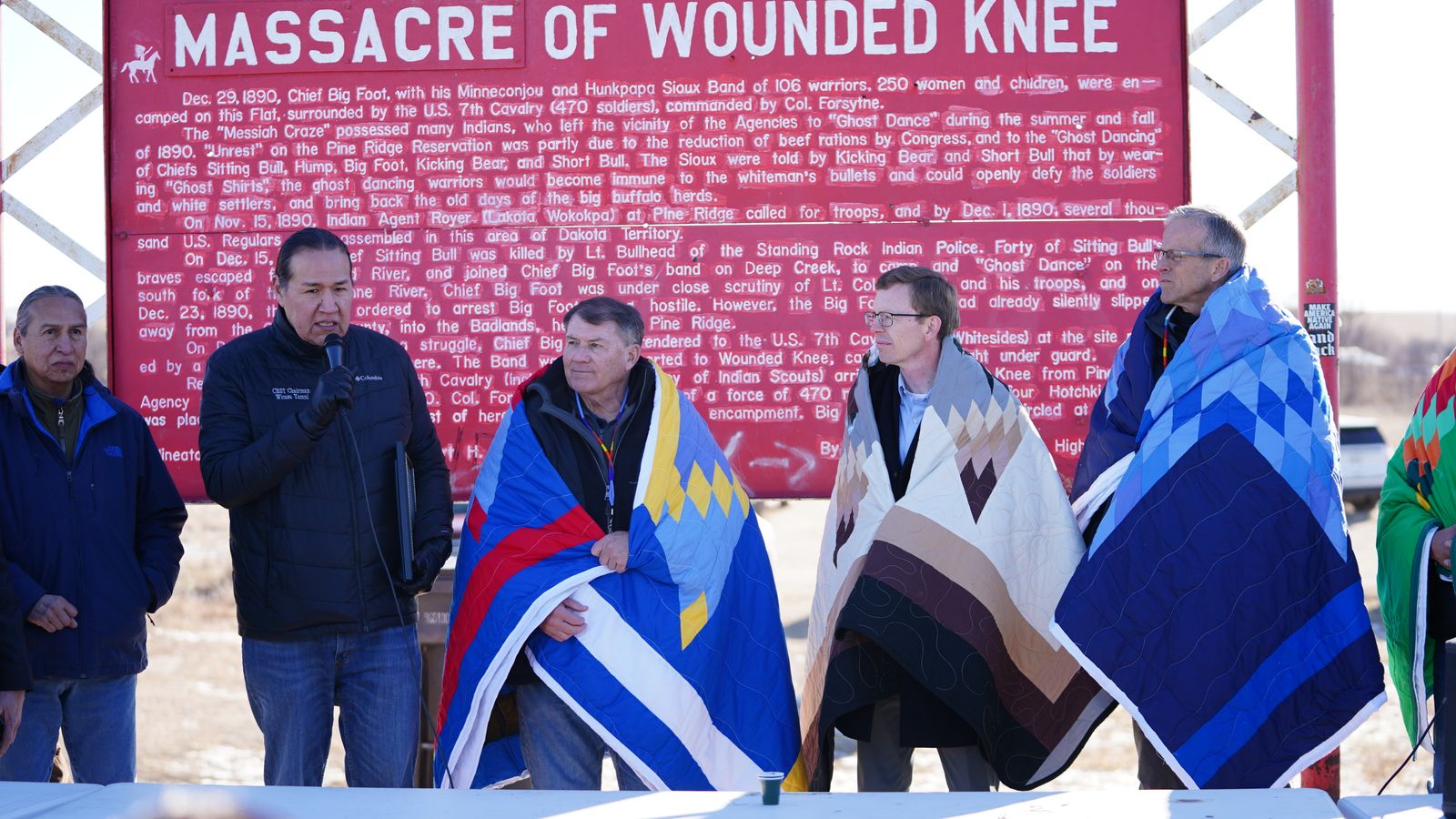
On Dec. 29, more than 100 people gathered near the Wounded Knee Massacre monument on the Pine Ridge Indian Reservation, about 500 feet from the site where, in 1890, more than 300 Lakota men, women and children were gunned down and buried. Many of their descendants and supporters prayed at the grave site to commemorate the 135th anniversary of the massacre, then moved to the highway to celebrate recent federal legislation that designates 40 acres at the memorial site as sacred.
Eleven days earlier, President Donald Trump had signed the Wounded Knee Sacred Site and Memorial Act, placing 40 acres adjacent to the Wounded Knee Memorial in restricted fee status. The Oglala Sioux Tribe (OST) and the Cheyenne River Sioux Tribe (CRST) bought the land in 2022. It was previously owned by a non-Native family, who ran a museum and tourist center on it for many years.
The legislation was sponsored in both the House of Representatives and the Senate by South Dakota’s congressional delegation and was supported by the OST and CRST.
“I want to say wopila to everyone for coming this morning,” said OST President Frank Star Comes Out during the celebration. “We decided to have it out here to pay respects to the families and not on the sacred site up there.”
CRST Chairman Ryman LeBeau spoke next, thanking U.S. Rep. Dusty Johnson and Senators John Thune and Mike Rounds for approving the bill. “We are happy that they are here for this dedication,” he said.
The bill passed the House of Representatives last January and was sponsored in the House by Johnson and co-sponsored in the Senate by Rounds and Thune, where it passed unanimously on Dec. 12.
After several Oglala citizens read the names of the deceased out loud and the crowd observed a moment of silence, Johnson, Rounds and Thune were invited to speak.
Johnson acknowledged the massacre by the 7th Cavalry and the efforts of the tribes “who worked so hard to get this done." He also thanked the survivors and their descendants “for being willing to work hard enough to bring some light into this space of darkness and shadow.”
The Wounded Knee Massacre was arguably the most violent assault on American Indians in recorded history. The tragedy is largely considered the “end of the Indian wars,” where many American Indians were confined to reservations and forced to adjust to a new lifestyle. The American Indian Movement occupied the site in 1973 for 71 days to protest tribal corruption and the violation of treaties signed between tribes and the federal government.
Senators Rounds and Thune both thanked the leadership of OST and CRST.
Rounds spoke of the book “Black Elk Speaks” and the impact it had on his understanding of life in South Dakota. “The thing that stood out to me the most was how Black Elk spoke of who he thought was the greatest of all the chiefs in his opinion, and that was Crazy Horse," he said. “Crazy Horse is remembered as saying, ‘My land is where my dead lie buried,’ and so, today, I want to say thank you to the tribes, the councils and the descendants of those who died here for staying persistent for protecting this land in perpetuity.”
Thune spoke of the site's future, saying, "What happened here 135 years ago will always be a blight on our state’s and nation's history, but it's important for those coming generations that this site be preserved to honor the victims, to honor the lost and to remind future generations on what happened here and how important it is that something like that never happens again.”
Scott Davis, the deputy assistant secretary of Indian Affairs at the Department of the Interior, also addressed the crowd. An enrolled Standing Rock Sioux Tribe citizen, he thanked the annual horse riders and runners who commit to trekking hundreds of miles to the Cheyenne River Reservation in the December cold to pay tribute to the victims and survivors of Wounded Knee.
“I remember when I was a young man, when former Governor George Mickelson declared the year of reconciliation," Davis said. “I didn't know about politics or government, I was just a teacher out of college.”
He added, “I began to read about the challenge that Tim Giago put out to him about reconciliation and fast forward that to now and I think we’ve all shared some type of formal reconciliation here and there within this state in our generation. Obviously, today, with this land issue being secured and preserved, and today we commemorate and congratulate leadership.”
Tim Giago was the founder and publisher of The Lakota Times, which later became Indian Country Today. He lobbied Mickelson to proclaim the Year of Reconciliation in 1990 to honor the 100th anniversary of the Wounded Knee Massacre and to change Columbus Day to Native American Day.
After Davis spoke, Junior Miss Oglala Lakota Nation Baylee Bravo then presented him and the congressional delegation with star quilts for their support in the legislation that preserves the massacre site from future development. Johnson presented a plaque recognizing the passage of the Wounded Knee Sacred Site and Memorial Act. Star Comes Out acknowledged other tribal leaders, including former OST President Kevin Killer, for their leadership in getting the legislation through Congress.
Star Comes Out also spoke of the continued effort to rescind the medals of honor given to 19 soldiers at Wounded Knee. “We’re not going to give up on asking to remove the medals," he said toward the conclusion of the day’s event.
Spotted an error? Suggest a correction.
Darren Thompson
(Lac du Flambeau Ojibwe)Former Reporter
Sharing Is Caring
This article is not included in our Story Share & Care selection.
The content may only be reproduced with permission from the Indigenous Media Freedom Alliance. Please see our content sharing guidelines.
© Buffalo's Fire. All rights reserved.
We provide independent Native-focused reporting that gives our communities the context and the facts they need to make informed decisions.
Respect The Fire
At Buffalo's Fire, we value constructive dialogue that builds an informed Indian Country. To keep this space healthy, moderators will remove:
- Personal attacks, harassment, or hate speech
- Spam, misinformation, or unsolicited promotion
- Off-topic rants and excessive shouting (All Caps)
Let’s keep the fire burning with respect.