






US Supreme Court sends North Dakota tribal redistricting case back for review
High court orders appeals court to reconsider tribal voting rights lawsuit after recent ruling changed standards for racial gerrymandering cases

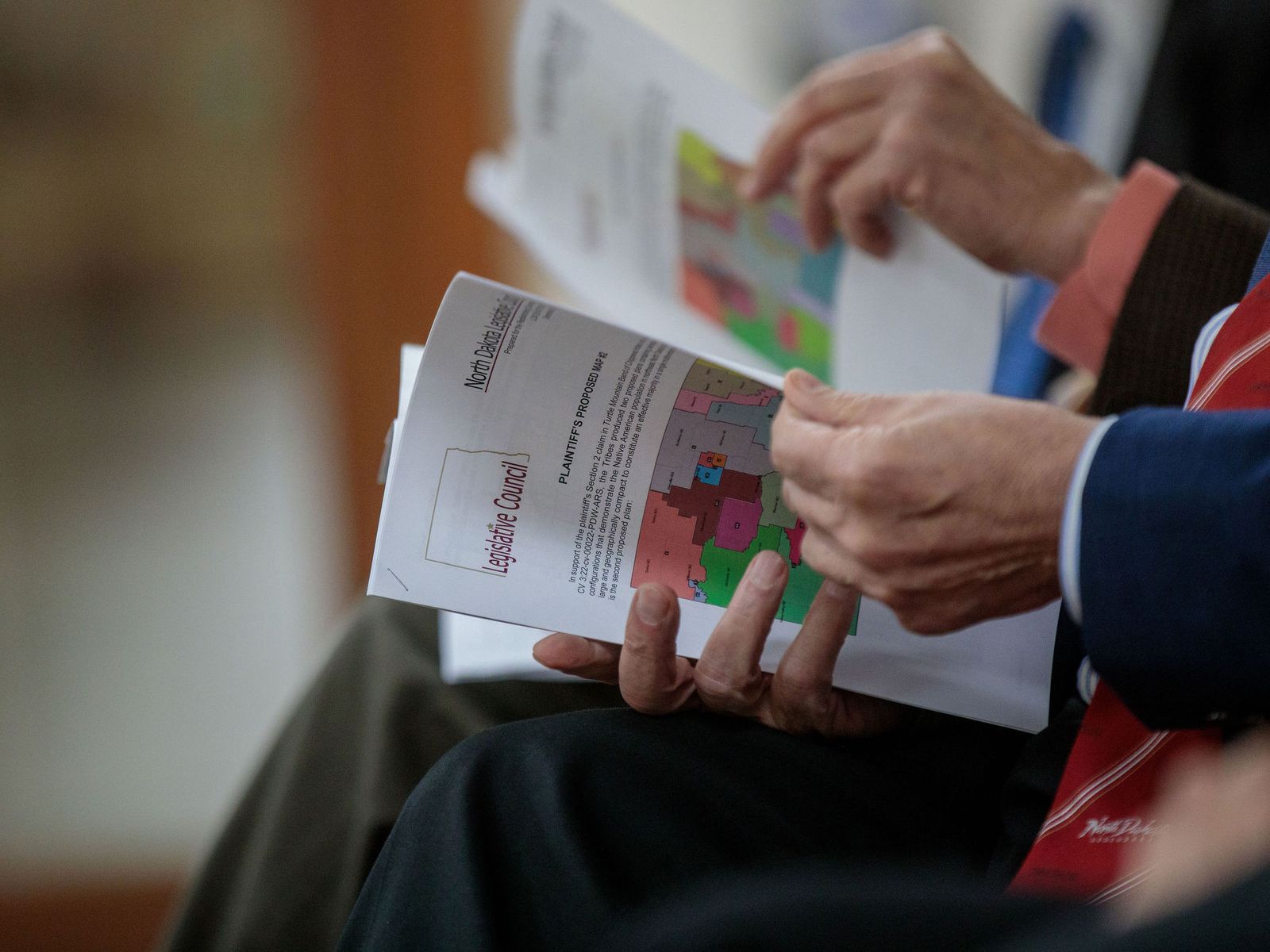

The U.S. Supreme Court on Monday ordered an appeals court to reconsider a North Dakota tribal redistricting case under new legal standards set in the high court’s recent Voting Rights Act ruling.
The Turtle Mountain Band of Chippewa, Spirit Lake Nation and three tribal citizens filed the lawsuit against the North Dakota Legislature in 2022, arguing that its new legislative map shifted district lines in a way that diluted tribal representation. The tribes filed the case under Section 2 of the federal Voting Rights Act, which outlaws racially discriminatory voting practices.
North Dakota U.S. District Court Judge Peter Welte in 2023 sided with the tribes and soon after ordered that a different map be put in place.
The 8th Circuit Court of Appeals last year came to a much different conclusion. It found that the tribes didn’t have the right to bring the lawsuit because compliance with Section 2 may only be enforced by the U.S. Department of Justice. The 8th Circuit is the only federal appeals court to make this finding.
The tribes in September officially asked the U.S. Supreme Court to weigh in on the 8th Circuit’s decision and answer whether private citizens can bring Section 2 cases.
The Supreme Court on Monday decided 8-1 to void the appeals court’s ruling, ordering the 8th Circuit to review the lawsuit again in light of its April decision in a separate racial gerrymandering case, Louisiana v. Callais.
The court did not issue an opinion explaining the reasoning behind its decision in the North Dakota case.
North Dakota Attorney General Drew Wrigley said the district map ordered by Welte will remain in place for this fall’s election.
Attorneys for the tribes applauded the court’s decision to vacate the 8th Circuit’s ruling.
“The Supreme Court was correct to vacate the Eighth Circuit’s decision, which wrongly prevented Native voters and Tribal Nations from vindicating their rights under the Voting Rights Act,” Lenny Powell, a staff attorney for the Native American Rights Fund, said in a statement.
Mark Gaber, senior director for redistricting at the Campaign Legal Center, said he believes the decision affirms private citizens’ ability to bring suits under Section 2.
“Today, the Supreme Court agreed that courts cannot slam the courthouse doors on plaintiffs seeking equal representation,” Gaber said in a statement.
Justice Ketanji Brown Jackson was the lone dissenting justice in Monday’s decision. In a note included with the decision, Jackson wrote she sees “no basis for vacating” the 8th Circuit’s ruling. Jackson said the high court’s decision in Louisiana v. Callais did not touch on the question central to the Turtle Mountain case — whether private citizens can file suit under Section 2 — so there are no new legal standards that would change how the 8th Circuit analyzes it.
Jackson wrote that she would instead reverse the 8th Circuit’s ruling.
Welte’s map remained in placewhile the tribe’s request was pending before the high court.
The North Dakota Secretary of State’s Office also must finalize maps by the December before an election year, according to legal documents the state filed in the lawsuit.
Attorneys for the state have previously said they agree with the 8th Circuit’s decision dismissing the tribes’ case, and have maintained that the Legislature’s 2021 map is not discriminatory.
The U.S. Supreme Court’s decision in Louisiana v. Callais makes it much harder to challenge district maps for alleged racial discrimination.
Previously, courts had interpreted Section 2 of the Voting Rights Act to forbid states from adopting any maps that reduce minority groups’ voting power, whether deliberate or accidental. The Supreme Court in Louisiana v. Callais found that in order to be found in violation of Section 2, there must be sufficient evidence that a state chose the map with the intent to discriminate based on race.
The Native American Rights Fund, Campaign Legal Center and other groups condemned the previous decision as a blow to voting rights.
North Dakota Attorney General Drew Wrigley told the North Dakota Monitor previously that he supports the ruling, saying it “strengthens North Dakota’s position that the Constitution is colorblind.”
Mary Steurer, North Dakota Monitor
Sharing Is Caring
This article is not included in our Story Share & Care selection.
The content may only be reproduced with permission from the Indigenous Media Freedom Alliance. Please see our content sharing guidelines.
© Buffalo's Fire. All rights reserved.
We provide independent Native-focused reporting that gives our communities the context and the facts they need to make informed decisions.
Respect The Fire
At Buffalo's Fire, we value constructive dialogue that builds an informed Indian Country. To keep this space healthy, moderators will remove:
- Personal attacks, harassment, or hate speech
- Spam, misinformation, or unsolicited promotion
- Off-topic rants and excessive shouting (All Caps)
Let’s keep the fire burning with respect.