






The Daily Spark
Small sparks from Indian Country, built to catch fire
Tribal leaders raise concerns over prediction markets at gaming convention
Leaders say platforms may evade gambling rules and threaten tribal revenue, as lawsuits from states and tribes challenge their legality
Tribal leaders raised concerns about the growth of prediction market platforms during the Indian Gaming Association’s annual convention in San Diego, according to the Associated Press. Chairman David Bean said platforms such as Kalshi and Polymarket may be misrepresenting their products to avoid federal, state and tribal gaming regulations. “This is unlawful gambling dressed up as finance,” Bean was quoted as saying during a news conference.
The association called on Congress to regulate prediction markets and announced a defense fund to support legal action. Platform operators say users are participating in futures trading, not gambling. According to the Associated Press, lawsuits filed by more than a dozen states and four tribal nations argue the platforms violate existing laws and tribal-state compacts, raising concerns about impacts to tribal gaming revenue that funds essential services.
Anishinaabemowin conference marks 32 years of language revitalization efforts
Participants from Canada and US Ojibwe communities met in London, Ontario, to share tools, teaching methods and ideas to expand language revitalization
Hundreds of speakers, learners and teachers gathered March 26-28 in London, Ontario, for the 32nd annual Anishinaabemowin Language Conference, according to ICT. The event, coordinated by Anishinaabemowin-Teg Inc., brought together participants from across Canada and Ojibwe-speaking communities in the United States to share resources, teaching strategies and cultural knowledge aimed at sustaining the Anishinaabe language.
Organizers said the conference has grown over three decades and remains largely self-funded through registration fees and donations. Workshops this year focused on immersion learning, online language tools and historical teachings. Speakers emphasized the role of community-based programs and youth engagement in preserving language, with participants sharing ideas to expand revitalization efforts in their home communities, according to ICT.
Second Black Hills mining proposal selected for fast-track federal permitting
Federal officials placed the Bear Lodge project on a faster permitting path, a move that could trim review time and revive a delayed rare earth effort
Federal officials have selected the Bear Lodge Rare Earth Mining Project in northeastern Wyoming for expedited permitting under the FAST-41 process, according to reporting by South Dakota Searchlight. The project, located on the Wyoming side of the Black Hills, is expected to produce rare earth elements used in alloys and magnets. The federal Permitting Council said the FAST-41 process is designed to improve coordination among agencies and could reduce review time by about 18 months.
The project has faced delays due to permitting challenges, market saturation from China and difficulty raising capital, according to the Cowboy State Daily. Wyoming U.S. Sen. Cynthia Lummis said in a news release the project could become a key domestic source of elements used in defense systems and high-tech manufacturing. A separate Black Hills mining proposal, the Dewey-Burdock uranium project in southwestern South Dakota, has drawn opposition from the Oglala Sioux Tribe, NDN Collective and the Black Hills Clean Water Alliance, according to South Dakota Searchlight.
Mni Wakan Oyate Wetu Wacipi set for May 2-3 in Devils Lake
The Mni Wakan Oyate Wetu Wacipi will be held May 2-3 in Devils Lake, featuring dance and singing contests and free admission
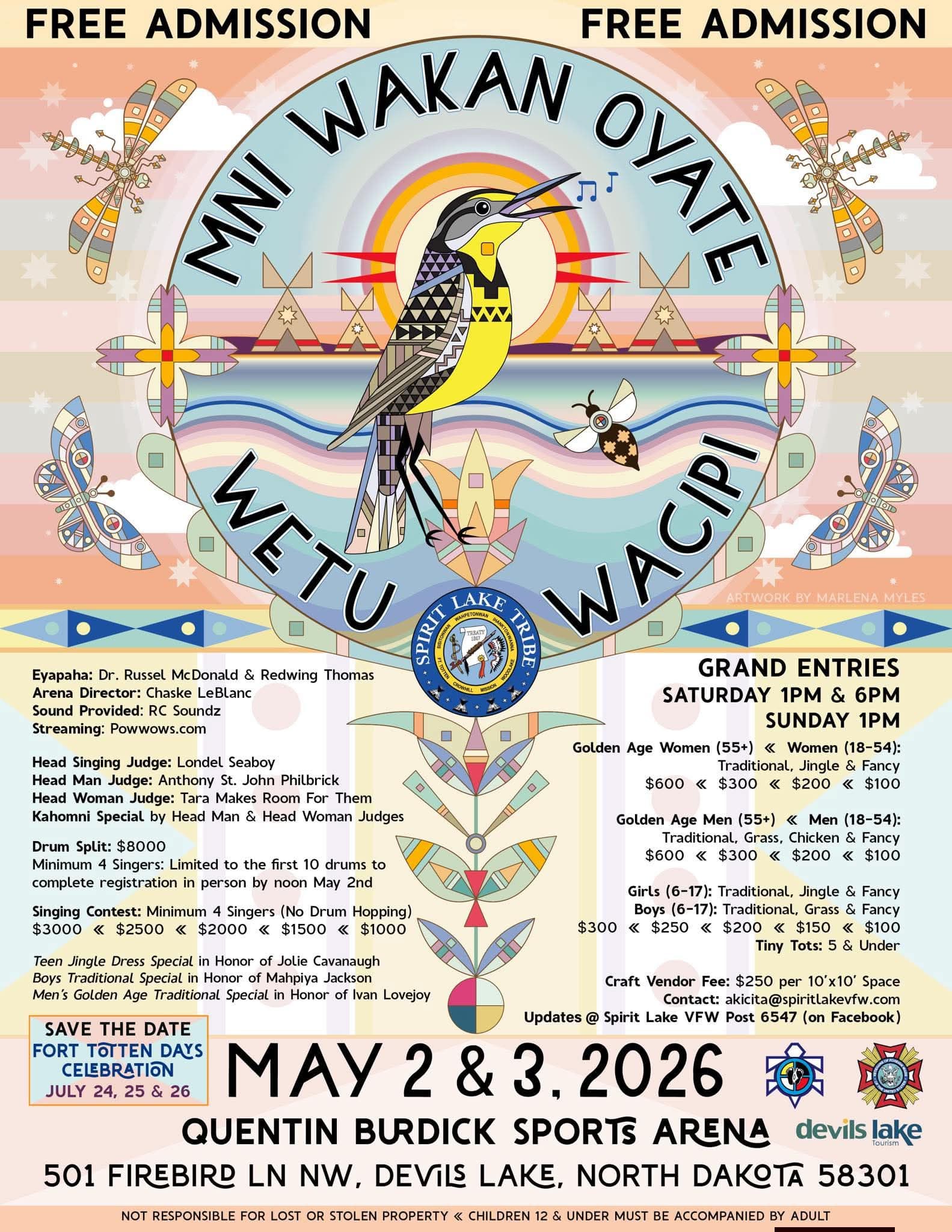
The Mni Wakan Oyate Wetu Wacipi will be held May 2 and 3 at Quentin Burdick Sports Arena in Devils Lake, North Dakota, according to the event flyer. Admission is free. Grand entries are scheduled for 1 p.m. and 6 p.m. Saturday and 1 p.m. Sunday.
According to the flyer, the event will include dance and singing contests, with categories for women, men, youth and tiny tots. The flyer lists Dr. Russel McDonald and Redwing Thomas as eyapaha, Chaske LeBlanc as arena director and RC Soundz as sound provider. It also names Londel Seaboy as head singing judge, Anthony St. John Philbrick as head man judge and Tara Makes Room For Them as head woman judge. Updates are posted through Spirit Lake VFW Post 6547 on Facebook.
Funding ends for Winnemem Wintu salmon restoration effort
Drought-linked funds are running out, ending support for a Winnemem Wintu effort to return Chinook to the McCloud River after more than 80 years
California is ending funding for a salmon restoration project led by the Winnemem Wintu Tribe, according to CalMatters. The project aimed to return endangered winter-run Chinook salmon to the McCloud River, where the fish had not been present for more than 80 years. State officials said the funding was tied to drought response efforts and has now been exhausted.
According to CalMatters, the tribe received more than $6 million since 2023, with funding expected to end by June. Tribal leaders said the loss of funding is leading to layoffs and could halt restoration work, including efforts to reintroduce salmon and restore genetic diversity. State officials said the pilot project established a foundation for future work, but no plans are in place to continue transporting fertilized eggs above dams this year.
Federal operation expands resources for Indian Country cases
Justice Department and FBI detail a fourth-year surge that sends rotating teams to 11 field offices to work unresolved violent crime cases in Indian Country
The U.S. Department of Justice and FBI announced April 2 a personnel surge under Operation Not Forgotten 2026 to support investigations in Indian Country. The initiative, now in its fourth year, focuses on unresolved violent crime cases, with priority on cases involving violence against women and children, including those who are missing or murdered.
According to a DOJ press release, the operation will deploy investigative, intelligence and victim-service personnel on rotating assignments across 11 FBI field offices, including Phoenix. The FBI is coordinating with U.S. Attorneys’ Offices, the Bureau of Indian Affairs Missing and Murdered Unit, the Bureau of Alcohol, Tobacco, Firearms and Explosives and tribal law enforcement. Officials said prior deployments supported more than 700 cases, resulting in recoveries of child victims, arrests and federal indictments.
U.S. attorney’s office marks Sexual Assault Awareness Month
A federal office in Wisconsin highlights Sexual Assault Awareness Month and cites more than $56 million in victim service grants for 2025
The U.S. Attorney’s Office for the Eastern District of Wisconsin is observing Sexual Assault Awareness Month in April alongside the U.S. Department of Justice, the Office on Violence Against Women and tribal nations, according to a statement released April 2.
According to the statement, the Office on Violence Against Women awarded more than $5.6 million to Wisconsin grantees in fiscal year 2025 through programs including the Tribal Sexual Assault Services Program, Legal Assistance for Victims Program and Transitional Housing Assistance Grants. The Department of Justice also funds victim services through the Office for Victims of Crime. Officials encouraged the public to learn the signs of abuse and connect victims to available resources, including national and Native-focused helplines.
Tribal colleges host Red Sand events across North Dakota
Tribal and state colleges will hold April 7 events using Red Sand displays, speakers and booths to spotlight trafficking and support affected communities
The five tribal colleges in North Dakota, along with participating state colleges, will host Red Sand Awareness events April 7, according to the First Nations Women’s Alliance. The events are part of the Red Sand Project, a visual campaign that raises awareness about human trafficking and exploitation by filling sidewalk cracks with red sand to symbolize people who fall through gaps in systems and communities.
Participating colleges include Turtle Mountain Community College, United Tribes Technical College, Nueta Hidatsa Sahnish College, Cankdeska Cikana Community College and Sitting Bull College. According to the announcement, each location will offer informational booths, a short video, a speaker and opportunities for attendees to take part in the Red Sand activity. Organizers said the events aim to bring communities together to increase awareness and support those affected.
Descendants of Choctaw code talkers honored with historical marker in Fort Worth
A Fort Worth marker recognizes Choctaw soldiers who sent coded World War I messages, highlighting 19 troops who trained at Camp Bowie
Descendants of Choctaw code talkers gathered April 1 in Fort Worth for the unveiling of a historical marker recognizing Native soldiers who used their language to transmit encrypted messages during World War I. The ceremony at Veterans Memorial Park was hosted by the Choctaw Nation, the Texas Historical Commission and the city’s parks and recreation department, according to the Fort Worth Report.
Nuchi Nashoba, president of the Choctaw Code Talkers Association, told the Fort Worth Report the marker helps preserve the group’s legacy. The code talkers were among 19 Native soldiers who served in northern France and were sworn to secrecy for decades. Officials said the men trained at Camp Bowie in Fort Worth and used their Choctaw language to send messages that enemy forces could not decipher, according to the Fort Worth Report.
USDA cancels tribal agriculture grants, projects face uncertainty
Cuts include nearly $9M for a Blackfeet Reservation institute; leaders say projects, jobs and training tied to a $300M program are at risk
The U.S. Department of Agriculture has terminated dozens of agricultural grants, including nearly $9 million awarded to the Piikani Lodge Health Institute on the Blackfeet Reservation, according to Montana Free Press.
The funding was part of the Increasing Land, Capital and Market Access Program, which distributed about $300 million to 50 grantees in 2023. USDA officials said the program involved “discriminatory preferences” tied to Diversity, Equity and Inclusion and “wasteful spending.” Tribal leaders and project organizers disputed that characterization, calling the cancellations “devastating,” according to Montana Free Press. The grants supported projects including land purchases, farmer training and food production infrastructure, and leaders said the loss of funding threatens jobs, training programs and economic development efforts.
Fort Totten man pleads guilty to assault and voluntary manslaughter in Spirit Lake cases
Kolby Jae McKay admitted to assault and a 2024 killing on the Spirit Lake Reservation; sentencing is set for July 22, 2026
A Fort Totten man pleaded guilty to multiple federal charges tied to two incidents on the Spirit Lake Reservation, according to a statement from the U.S. Attorney’s Office for the District of North Dakota. Kolby Jae McKay, also known as Kolby Woods, 33, pleaded guilty to assault with a dangerous weapon, assault of a spouse, intimate partner or dating partner by strangulation and voluntary manslaughter before Chief Judge Peter D. Welte. Sentencing is scheduled for July 22, 2026.
According to the statement, the assault charges stem from a March 13, 2024, incident involving a woman identified as “Jane Doe.” He also pleaded guilty to voluntary manslaughter in the April 3, 2024, killing of Monte Ray Herman Sr. McKay fled after the killing, prompting a curfew and reward notice by the Spirit Lake Tribal Council, according to the statement.
Warm Springs chief Delvis Heath Sr. dies at 87
Delvis Heath Sr, a hereditary chief since 1984, died March 29, the Confederated Tribes of Warm Springs said, marking the loss of a cultural leader
Warm Springs Chief Delvis Heath Sr. died March 29, according to a statement from the Confederated Tribes of the Warm Springs Reservation of Oregon. He served as the Warm Springs people’s hereditary chief for 42 years and took on the role in 1984.
Heath was a ceremonial leader, Sahaptin language speaker and longtime participant in Longhouse traditions, including dancing, drumming and singing, according to the statement. He also served as Board Member Emeritus for the Museum at Warm Springs and worked as a liaison with federal and state governments during his time on Tribal Council. Heath advocated for tribal sovereignty, treaty rights, natural resources, fishing rights and health issues. He was born Sept. 26, 1938, near Simnasho and married Shirley Stahi in 1960.
Lawsuit challenges Forest Service permit for graphite drilling at Pe’ Sla
Advocacy groups say the Forest Service bypassed full environmental review for a multiyear graphite project and seek a court order to stop it
NDN Collective, Black Hills Clean Water Alliance and Earthworks filed a lawsuit against the U.S. Forest Service over its February decision to approve exploratory drilling at Pe’ Sla, according to a statement from the groups. The lawsuit argues the agency improperly used a “categorical exclusion,” which allows projects to proceed without a full environmental review, despite the graphite project being expected to last at least three years.
The groups say the project could harm the site’s cultural and religious uses and impact water in the Rapid Creek watershed. According to the statement, a 2024 memorandum of understanding between the Forest Service and Oceti Sakowin tribal nations established a 2-mile buffer zone around Pe’ Sla and recognized its cultural importance. The lawsuit asks a federal court to reverse the permit and halt further activity.
South Dakota Board of Minerals and Environment to host 5-day hearing on proposed uranium drilling permit near sacred site in Black Hills
Hearing to be first in state history to accept Lakota language
The South Dakota Board of Minerals and Environment is hosting a five-day hearing, beginning April 13, at the Mueller Civic Center in Hot Springs, regarding an application for uranium drilling in the southern Black Hills. The Canadian firm Clean Nuclear Energy Corp. is seeking a permit to explore the area known as Craven Canyon for uranium deposits. The firm wants to drill up to 50, 700-foot-deep test holes adjacent to sites listed on the National Register of Historic Places.
Lakota elders, tribal nations, landowners and community members oppose the project, saying the location is a sacred site. Opponents plan to hold a five-day prayer vigil during the hearing, with a sunrise ceremony scheduled for April 13. The meeting was initially planned in Pierre but changed to Hot Springs at the request of Lakota organizers.
The meeting will be the first in the state's history to accept comments in the Lakota language. On March 9, Gov. Larry Rhoden signed legislation requiring the state to provide translator services in official hearings. The law was named after Helen Red Feather, a fluent Lakota speaker from Wounded Knee, South Dakota. She previously provided comments about the significance of Craven Canyon in the Lakota language and was told by the South Dakota Board of Minerals that it couldn't accept comments in a language other than English. Organizers then successfully lobbied to change the law, allowing state proceedings to accept verbal submissions in any language, including the Lakota language.
Federal tax credit program offers rare path to Native homeownership
A federal Housing Tax Credit lets residents buy after 15 years, with hundreds of homes across Native nations now eligible for transfer
The Low-Income Housing Tax Credit program has become a rare path to homeownership for Native nations, where trust land and lending barriers have long limited access to mortgages, according to Underscore Native News and ICT. The Washington State Housing Finance Commission said 17 of 25 eligible eventual tenant ownership homes at Spokane Tribal housing are in the process of being transferred, while 352 more homes across seven Native nations were eligible for ownership as of 2026.
The program allows residents to purchase homes after a 15-year compliance period. Advocates told Underscore Native News and ICT that the option helps preserve affordable housing and build generational wealth in Native communities.
Proposed BIA reorganization raises concerns over staffing cuts
A reported Bureau of Indian Affairs reorganization may reduce staff and slow funding delivery, tribal leaders told Congress, citing past delays
High Country News reports the Bureau of Indian Affairs could undergo a reorganization that includes additional staff cuts, citing testimony from tribal leaders during a congressional hearing on federal funding for Indigenous communities. Mark Macarro, president of the National Congress of American Indians, said the plan would reduce staff responsible for administering programs and distributing funding and was developed without consultation with tribal nations.
The proposed changes follow earlier workforce reductions within the Department of the Interior. Macarro said prior cuts have caused delays and left agencies with critical gaps, citing findings from the Government Accountability Office. Assistant Secretary for Indian Affairs Billy Kirkland said in a statement that the agency aims to improve efficiency and strengthen services, though details of the reorganization have not been released, according to High Country News.
Canadian astronaut’s Artemis II patch reflects Indigenous teachings
A Canadian Space Agency astronaut worked with Indigenous leaders to shape a mission patch that blends space imagery with cultural teachings
A mission patch created for Canadian Space Agency astronaut Jeremy Hansen incorporates Indigenous teachings and symbolism as part of the Artemis II mission, according to the Canadian Space Agency. The patch, designed by Anishinaabe artist Henry Guimond of Sagkeeng First Nation, includes references to the Seven Sacred Laws, represented through animal symbols and a heptagonal shape.
The design also features elements tied to space exploration and cultural meaning, including a bow representing Artemis, the Moon as “Grandmother Moon” and stars used for navigation. According to the Canadian Space Agency, Hansen worked with Indigenous leaders and Knowledge Keepers, including Dave Courchene III of Turtle Lodge, to reflect teachings shared with him. The agency said the design recognizes Indigenous knowledge and its role in understanding the natural world.
Antonia Gonzales steps down as National Native News host after more than 20 years
After more than two decades, host Antonia Gonzales departs March 27 as Jill Fratis steps in to lead ongoing coverage
Antonia Gonzales will step down as host of National Native News on March 27, ending more than two decades with the program, according to National Native News. Gonzales reported for 22 years and produced specials including the Climate Desk, Alaska’s Native Voice and election coverage, while also mentoring emerging journalists.
Jill Fratis, a journalist with KNBA 90.3 FM, will serve as interim host and continue the program without interruption, according to National Native News. Gonzales marked her departure during her final broadcast, thanking tribal and public radio stations, stringers and listeners for their support.
“As a longtime NNN stringer and fill-in host/producer, I wanted to give my gratitude to Antonia for her 20-plus years at the helm of this national program,” said Brian Bull, senior reporter at Buffalo’s Fire. “She delivered the latest headlines from across Indian Country with professionalism and care, and I wish her good fortune ahead as she explores new opportunities.”
Choctaw Nation purchases Durant facility amid opposition to ICE detention site
Purchase follows concerns the former Big Lots facility could house an ICE detention center; tribe now weighs uses for the property
The Choctaw Nation purchased a former Big Lots distribution facility and adjoining land in Durant after concerns the site could be used as an Immigration and Customs Enforcement detention center, according to KOSU. The Choctaw Nation Council approved the purchase March 14, and Chief Gary Batton confirmed the acquisition in a statement, calling it an opportunity to support long-term business strategy.
The facility, which closed in January 2025, previously employed more than 300 workers. Tribal leaders had raised concerns earlier this year about the potential detention site’s proximity to government headquarters and community services. The Durant City Council also passed an ordinance requiring a conditional use permit for detention centers. Batton said the tribe is evaluating future uses for the property that align with its strategic vision, according to KOSU.