






The Daily Spark
Small sparks from Indian Country, built to catch fire
Appeals court halts copper mine land swap in Arizona
A federal appeals court has temporarily blocked the transfer of Oak Flat, an Arizona site slated for copper mining, to Resolution Copper, a subsidiary of Rio Tinto and BHP, according to The Associated Press. The 9th U.S. Circuit Court of Appeals issued the injunction late Monday, halting the land exchange that was scheduled for Tuesday. The San Carlos Apache Tribe, Apache Stronghold and other plaintiffs argued the U.S. Forest Service did not fully review environmental risks, including dam breaches and pipeline failures.
Tribal leaders said Oak Flat, or Chí’chil Biłdagoteel, has been used for ceremonies and for gathering traditional plants for generations. Resolution Copper said the project underwent extensive federal review and would create thousands of jobs and generate $1 billion a year for Arizona’s economy.
MMIP task force for North Dakota in progress
An MMIP task force is currently in the works in North Dakota. House Bill 1199, requires the creation of a task force and is also responsible for the Feather Alert, which went live on May 1 after North Dakota Gov. Kelly Armstrong signed the bill into law.
Lonnie Grabowska, director of the North Dakota Bureau of Criminal Investigations, said the group is waiting for each North Dakota tribe to appoint members to the task force. The group can then meet to establish roles for the task force.
Their first meeting is likely to occur in early fall, Grabowska said.
Lumbee tribe urged to seek recognition through Congress
The Department of the Interior has told the Lumbee Tribe of North Carolina to continue pursuing federal recognition through Congress, according to The Assembly. Elizabeth Peace, a department spokesperson, was quoted as saying, “We anticipate the tribe will work with Congress on a path forward to be formally recognized.”
The Lumbee have been asking Congress for federal recognition for decades, according to The Assembly. The largest Native American tribe east of the Mississippi with 55,000 members, the Lumbee have had state recognition since 1885 and partial federal recognition since 1956, which does not provide financial benefits afforded to fully recognized tribes. Tribal Chairman John Lowery said legislative action is “the only clear and concise way to amend the Lumbee Act of 1956.”
Tulsa agreement excludes Freedmen descendants from Muscogee Nation jurisdiction
An agreement between the Muscogee Nation and the City of Tulsa will allow most tribal citizens facing municipal charges to have their cases heard in tribal court, but it does not apply to Freedmen descendants, according to The Frontier. The June deal requires citizens to present a certified degree of Indian blood for their cases to be transferred.
Jason Salsman, a spokesperson for the Muscogee Nation, said the exclusion follows a federal standard that “requires Indian blood to be considered an Indian.” Tribal citizenship cards for Freedmen list zero blood quantum, leaving them under state jurisdiction. Michelle Brooks, spokesperson for Tulsa Mayor Monroe Nichols, said the settlement “does not expressly include or exclude Freedmen” but follows federal court precedent. The provision affects cases like that of Marlon Drew, a Cherokee citizen of Freedmen descent, whose misdemeanor charges remain in Tulsa municipal court, according to The Frontier.
Army veterans plan 10,000-mile motorcycle challenge to support Native communities
Army veterans Randy Merrill and Brian Cassidy will ride nearly 10,000 miles in the 2026 Hoka Hey Motorcycle Challenge to raise $10,000 for the Association on American Indian Affairs, according to Native News Online. The pair are also fundraising another $10,000 to cover travel costs such as fuel, equipment and daily essentials.
Merrill and Cassidy said the journey is both a fundraiser and a path to healing. “PTSD and pain followed us home. But we refuse to be defined by the damage,” they wrote in a joint statement. Shannon O’Loughlin, CEO of the association and a citizen of the Choctaw Nation of Oklahoma, was quoted as saying the ride is “about healing, service, and standing in solidarity with Native Peoples.” Supporters can follow the riders and contribute at indian-affairs.org/hokaheymotorcyclechallenge, according to Native News Online.
SBA offers low interest loans to New Mexico nonprofits and Mescalero Apache Tribe
The U.S. Small Business Administration announced that private nonprofit organizations in Doña Ana, Lincoln and Otero counties, as well as the Mescalero Apache Tribe, are eligible for low interest federal disaster loans after severe storms, flooding and landslides beginning June 23.
Eligible nonprofits providing non-critical services, including community centers, schools, libraries and faith-based organizations, may apply for up to $2 million in loans to repair or replace damaged property and cover economic injury. “SBA loans help eligible private nonprofits cover both physical damage as well as economic injury after a disaster, which is crucial for their recovery,” Chris Stallings, associate administrator of the Office of Disaster Recovery and Resilience, said in an SBA news release. Applications for physical damage loans are due Oct. 15 and economic injury loan applications are due May 18, 2026.
Sisseton-Wahpeton Oyate host North Dakota officials for committee meeting
The Sisseton-Wahpeton Oyate hosted members of the North Dakota Tribal and State Relations Committee on Aug. 19 at Dakota Magic Casino near Hankinson, according to the North Dakota Monitor. Chair J. Garret Renville told legislators, “Your presence here today demonstrates respect for our people.”
The meeting marked the committee’s first session of the 2025-27 interim and its first held on the Lake Traverse Reservation, said Sen. Tim Mathern, D-Fargo, the committee’s vice chair. Rep. Dawson Holle, R-Mandan, who chairs the committee, said the group “is setting the tone that we want to be in conversation with our tribal leaders.” Officials discussed gambling, health care and tourism. Gov. Kelly Armstrong also met separately with tribal leaders. The committee plans to visit each of the state’s five tribal nations, with the next meeting scheduled in September at Fort Berthold with the Mandan, Hidatsa and Arikara Nation.
Snoqualmie Tribe opens Harvest Kitchen and Greenhouse
The Snoqualmie Indian Tribe held a ribbon-cutting ceremony for its new Harvest Kitchen and Greenhouse Classroom on the Tribal Administration Campus, according to Snoqualmie Valley Info. The facilities mark the second phase of the tribe’s childcare expansion project, following the 2023 opening of the Snoqualmie Child Development Center. Together, they will serve 54 children while advancing food sovereignty and cultural preservation. Treasurer Joshua Gabel said the project will help sustain Snoqualmie lifeways and practices for future generations.
U.S. Sen. Maria Cantwell, U.S. Rep. Kim Schrier, and King County Councilmember Sarah Perry were among the officials who attended. The facilities will host cultural programming, including cooking, weaving and nutrition classes, as well as Elder gatherings and seasonal events, according to Snoqualmie Valley Info.
Tribes expand sovereignty through health care self-governance
A growing number of tribes are taking control of health care systems previously operated by the Indian Health Service, according to The Daily Yonder. Jerilyn Church, chief executive officer of the Great Plains Tribal Leader’s Health Board, said the Oyate Health Center in Rapid City, South Dakota, has expanded access, generated more revenue and incorporated cultural practices since the board assumed management in 2019. “Nobody loves our community and our relatives like we do,” Church said.
The Choctaw Nation also reported benefits from self-governance, saying it has expanded clinics and specialty services while modernizing its health system. “Tribal health program oversight has allowed Choctaw Nation to strategically determine the best usage of funds in order to maximize health outcomes of our tribal members,” said Todd Hallmark, executive director of health for the Choctaw Nation, and Melanie Fourkiller, director of self-governance, in a joint statement to The Daily Yonder.
Native candidate announces run for Illinois congressional seat
Anthony Tamez, 25, announced his candidacy for Illinois’ Fifth Congressional District earlier this month, according to ICT. Tamez, who is Key First Nation Oji-Cree/Saulteaux and Sicangu Lakota, currently serves on the Chicago Police District Council for District 17, a seat he won in 2023. He was the second Native person elected to office in Illinois.
If elected, Tamez, a Democrat, would become the first Gen Z Afro-Indigenous member of Congress. He said his campaign will prioritize cannabis equity, data privacy legislation, health equity and protections of Native sovereignty and treaty rights. Tamez’s official campaign launch is scheduled for Aug. 22, with the Democratic primary set for March 17, 2026, according to ICT.
Tribal nations seek new funding as federal support for renewable projects wavers
Tribal nations across the U.S. are scrambling to maintain renewable energy projects after federal programs and incentives faced freezes or cuts, according to reporting by Grist. The Cheyenne River Sioux Tribe and other Indigenous communities have relied on federal grants and tax credits for solar projects powering clinics, schools and emergency services. With the passage of the Trump administration’s One Big Beautiful Bill, many projects now risk delays or cancellation.
Tribes and consulting organizations are pursuing alternative funding, including philanthropy, short-term loans and self-funded programs. “Some of these projects, at a minimum, have stalled, or they’re having to be reworked in some way to fit within the current parameters,” said Verrin Kewenvoyouma, a Hopi and Navajo managing partner at Kewenvoyouma Law.
New gold mining plans spark concern in South Dakota’s Black Hills
Rising gold prices have renewed interest in mining in South Dakota’s Black Hills, where companies are proposing open pit and underground mines near sacred sites, according to the Associated Press. The Black Hills, sacred to the Lakota Sioux people, encompass more than 1.2 million acres and are visited by millions of tourists each year.
Dakota Gold has proposed an open pit mine that could begin operating in 2029, with company officials estimating up to 250 jobs and $400 million in state taxes over the life of the project. Tribes and environmental groups oppose new mines, citing risks of chemical spills, water contamination and damage to sacred landscapes. “Our enjoyment of the Black Hills as a peaceful place, a sacred place, is disturbed,” said Lilias Jarding, executive director of the Black Hills Clean Water Alliance.
Santa Ana Pueblo investigates recovery of stolen cultural items
Santa Ana Pueblo is working to recover nearly 150 cultural items stolen during burglaries in the 1980s, including a century-old bowl used for breadmaking, according to the Associated Press. Federal authorities prosecuted those responsible decades ago, but many of the items were never returned. Pueblo leaders and preservation experts are now tracing artifacts through auction catalogs, sales ledgers and online postings.
Pueblo Gov. Myron Armijo said the thefts “really hurt the pueblo,” noting items such as war shields, drums and pottery were taken. One bowl was recently returned after researchers tracked it through gallery records. Investigators are also searching for a buffalo hide war shield misidentified as coming from another pueblo. “We’re not giving up,” Armijo said.
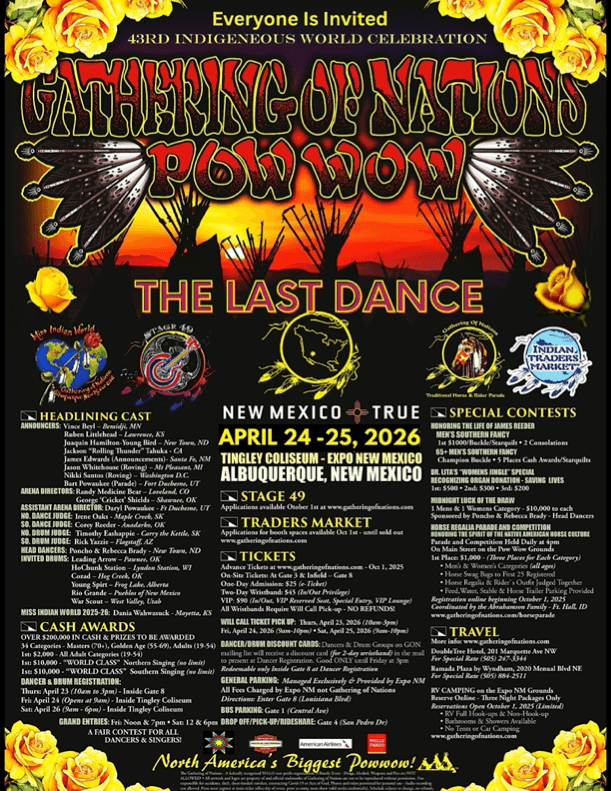
Gathering of Nations Powwow to end in 2026 after 43 years
Organizers of the Gathering of Nations announced that the 2026 event will be the final year of what is billed as North America’s largest powwow, according to the Associated Press. The Albuquerque-based celebration has drawn tens of thousands of participants and spectators for more than four decades, showcasing Indigenous dancers, musicians and artisans from around the world.
In a statement shared by email and social media, Gathering of Nations Ltd. said, “There comes a time,” without providing further explanation for ending the event. The official 2026 poster carries the words “The Last Dance.” The powwow has been held at New Mexico’s state fairgrounds since 2017, but organizers did not immediately respond to requests for comment on the announcement.
Chippewa Cree Tribe sues Chouteau County over election system
The Chippewa Cree Tribe and two Native American voters filed a lawsuit Thursday against Chouteau County and its board of commissioners, alleging the county’s at-large election system violates the Voting Rights Act and undermines Native voters’ political power, according to Montana Free Press. Located in north central Montana, Chouteau County overlaps with the Rocky Boy’s Reservation and has a population that is about 16% Native American, census data shows.
The complaint argues the at-large system allows the white majority to control commissioner elections and prevents Native voters from electing candidates of their choice. Plaintiffs are asking the U.S. District Court in Great Falls to order a redistricting plan that includes at least one majority-Native district. Chouteau County Commissioner Chair Clay Riehl did not immediately respond to a request for comment Friday. One plaintiff, Tanya Schmockel, said in a statement that without representation, Native Americans “remain invisible in decisions that affect every part of our lives.”
Cherokee governments clash over proposed land-in-trust change
The United Keetoowah Band of Cherokee Indians says a proposed federal appropriations provision would make its people “invisible,” while Cherokee Nation leaders support the measure, according to reporting by Cherokee Phoenix.
Drafted by Sen. Markwayne Mullin (Cherokee Nation), the proposal would require Cherokee Nation consent for trust land within its reservation, reversing a 1999 change that required only consultation.
UKB leaders call the move an assault on their sovereignty and legal status, but Cherokee Nation officials say it restores language first adopted in 1992 with then-Principal Chief Wilma Mankiller’s support. Cherokee Nation Principal Chief Chuck Hoskin Jr. said in a statement that the UKB has long made “fabricated claims” to treaty rights, while the UKB is urging Congress and other tribes to oppose the measure.
The dispute comes amid stalled UKB plans to re-enter the gaming market and ongoing legal disagreements over jurisdiction and treaty rights.
Report details crisis of missing and stolen Indigenous people in Canada
A Thomson Reuters Foundation report finds that Indigenous people in Canada face disproportionate rates of violence, trafficking and disappearance, fueled by systemic racism and gaps in services. Women, girls and 2SLGBTQI+ people are particularly targeted, with many cases linked to human trafficking, resource extraction projects and urban migration.
The report notes that the crisis of missing and murdered Indigenous people is deeply rooted not only in rural and remote communities but also in urban centers across the country. It cites a lack of consistent data collection, underreporting due to mistrust of authorities and insufficient culturally appropriate support for survivors.
Recommendations include improving national data systems, expanding Indigenous-led prevention and victim services and addressing root causes, such as poverty and housing insecurity.
Indigenous leaders urge AI safeguards, assert data sovereignty
At a U.N. forum, speakers highlighted artificial intelligence's dual role as a tool for cultural preservation and a threat of digital exploitation
Artificial intelligence is creating new opportunities and risks for Indigenous communities, according to Grist. Speakers at the Aug. 9 United Nations International Day of the World’s Indigenous Peoples said AI models are trained on large datasets — often including cultural knowledge, histories and languages — without consent, raising concerns about erasure and distortion. They called for “data sovereignty” and the use of free, prior and informed consent in AI development.
Panelists highlighted AI’s potential for language revitalization and climate forecasting. Examples include PolArctic, cofounded by Yup’ik Alaska Natives Leslie Canavera and Lauren Decker, which combines AI with Indigenous knowledge for Arctic sea ice and fish forecasts, and Te Heku Media in New Zealand, which developed Māori language transcription and storage tools. Leaders compared AI’s rise to historic resource extraction and urged tribes to secure protections before further exploitation occurs.
Legislative panel to hear proposals to ease tribal homeownership barriers
Citing the first public home sale on Navajo trust land, advocates will push a New Mexico committee for solutions to a housing crisis requiring 30,000 new homes
The interim legislative Indian Affairs Committee will meet Aug. 14 in Taos to discuss removing obstacles to tribal homeownership, according to Source NM. Christopher Billey, executive director of the Tribal Homeownership Coalition of the Southwest, and program manager Melinda Williams will present a case study on the first public sale of a home on Navajo Nation trust land, completed in January in LeChee, Arizona.
Billey said the sale sets a precedent for future housing market development in reservation communities. The coalition estimates the Navajo Nation needs 30,000 new homes, with thousands of families on waiting lists. Discussion topics are expected to include cultural views on selling homes, training tribal members to build housing and possible legislation to allow real estate disputes to be resolved in state or tribal courts.