






The Daily Spark
Small sparks from Indian Country, built to catch fire
Advocate calls for national Red Dress Alert to prevent future landfill searches
Hilda Anderson-Pyrz, chair of the National Family and Survivors Circle, is calling for full implementation of the Red Dress Alert system across Canada, according to CBC. The alert, now in a pilot phase in Manitoba, would notify the public when an Indigenous woman, girl, two-spirit or gender-diverse person goes missing.
Anderson-Pyrz, a member of Nisichawayasihk Cree Nation, said long delays in searches, such as those at Prairie Green and Brady Road landfills, highlight systemic racism in policing and public institutions. “If we hold these systems to account, we wouldn't be having to fight on the front lines,” she was quoted as saying. She urged governments to adopt a prevention-based approach and ensure policies and accountability mechanisms are in place. “There cannot be a two-tier system in Canada,” Anderson-Pyrz said.
Wabanaki voices shape new welcome center at Maine national monument
The National Park Service opened a new $35 million welcome center at Katahdin Woods and Waters National Monument that centers Wabanaki tribal history and perspectives, according to the Associated Press. The center, Tekαkαpimək — meaning “as far as the eye can see” in Penobscot — sits atop Lookout Mountain and offers views of Katahdin, a sacred site to the Penobscot Nation.
Developed through collaboration with the Maliseet, Mi’kmaq, Passamaquoddy and Penobscot tribes, the center features an amphitheater and eastward lookout for sunrise ceremonies. It also displays exhibits and art that reflect Wabanaki culture, stewardship and language. Jennifer Neptune, a Penobscot artist and contributor, said the site honors the mountain’s sacredness. The project was funded by philanthropic donors including the Quimby family, Burt’s Bees, L.L. Bean and the National Park Foundation. Tribal representatives shaped the design after rejecting an earlier version seen as colonial. Penobscot historian James Francis said the project’s strength lies in giving Wabanaki people a voice.
Storytelling supports Native culture and learning, educators say
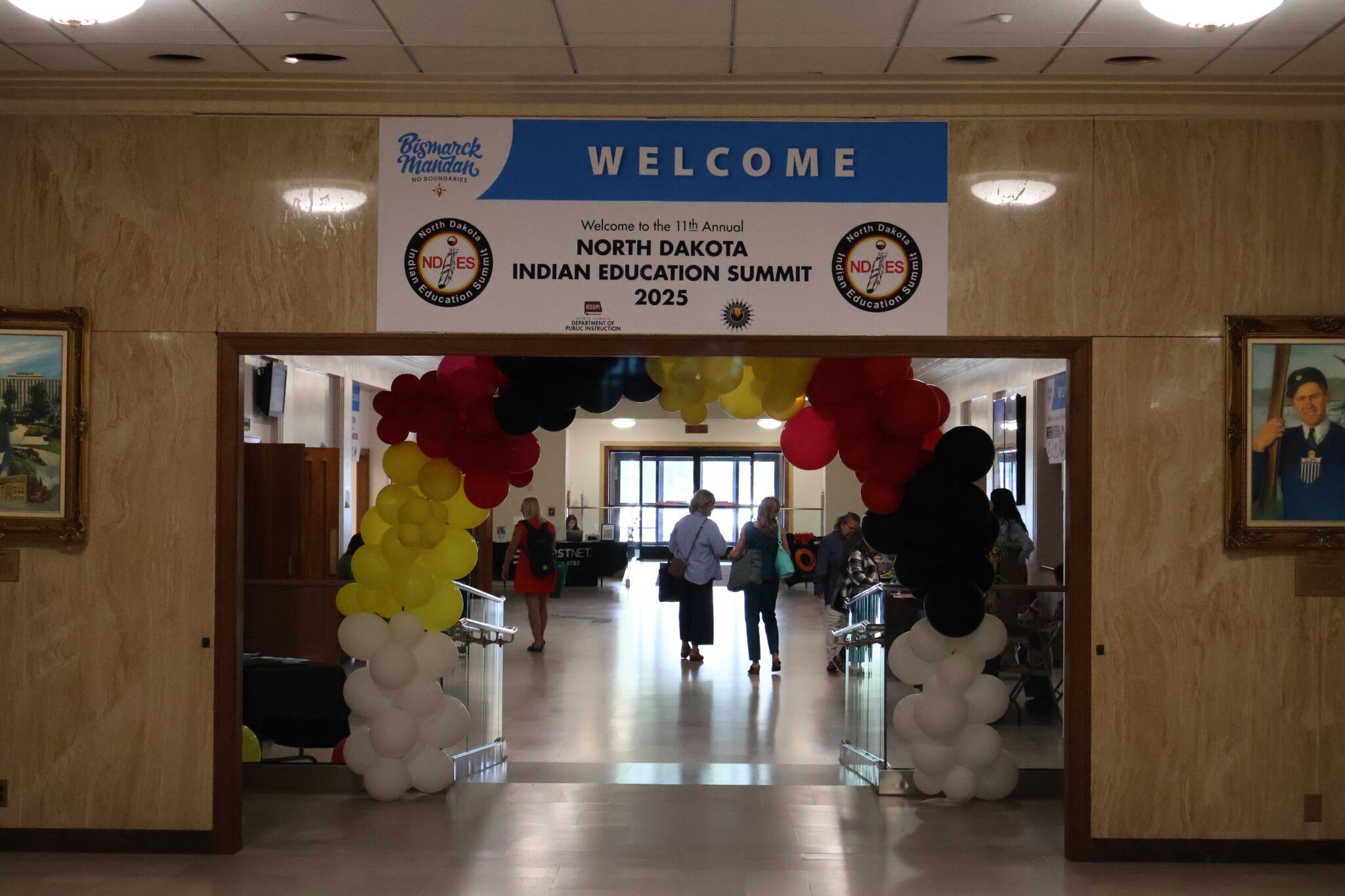
Educators gathered in Bismarck last week for the North Dakota Department of Public Instruction’s Indian Education Summit, according to the North Dakota Monitor. Speakers highlighted storytelling as a key method for teaching Native culture and values. In a video shown Friday, Standing Rock Sioux citizen Gladys Hawk described how childhood stories from her grandmother in Lakota helped teach life lessons. “We have to listen to what our elders have to say, because usually they’re teaching us something important,” Hawk was quoted as saying.
Sharla Steever and Scott Simpson presented the video as part of the Teachings of Our Elders project, which now features more than 350 interviews with tribal elders. Steever said storytelling fosters connection and memory in classrooms. The project supports North Dakota’s 2021 law requiring K‑12 schools to teach Native history. Youth speaker Haiden Person of the Standing Rock Sioux Tribe emphasized that education is key to addressing anti‑Indigenous racism.
Chicago advances Native American-inspired housing project
Chicago’s first Native American-inspired affordable housing project is moving forward on the city’s Northwest Side, according to WGN. The city council approved funding for Jigzibik, a seven-story building with 45 rental units. The name Jigzibik, meaning “at the river’s edge” in Potawatomi, reflects the project’s cultural design, which includes a symbolic representation of the river.
The development will include a mix of studios, one-bedroom, two-bedroom and three-bedroom apartments. Organizers held a land blessing instead of a traditional groundbreaking. “We decided we would do it with an Indigenous method and prepare the ground like we would traditionally if communities were gathering,” one organizer said. The project, six years in the making, is a collaboration between city agencies and Native American organizations.
Supreme Court halts changes to North Dakota district map amid tribal voting rights case
The U.S. Supreme Court on Wednesday temporarily paused changes to North Dakota’s legislative district map while a tribal voting rights case continues, according to North Dakota Monitor. The decision came a day before the 8th Circuit Court of Appeals was expected to finalize a reversal of a lower court ruling that ordered the state to adopt a new map.
The Turtle Mountain Band of Chippewa, Spirit Lake Nation and three tribal members filed the lawsuit in 2022, alleging the 2021 map diluted Indigenous voting power. U.S. District Court Judge Peter Welte sided with the plaintiffs in 2023, but the 8th Circuit reversed that ruling in May, finding private citizens cannot sue under Section 2 of the Voting Rights Act. Plaintiffs are preparing to petition the Supreme Court and asked the court to let Welte’s map remain during the case. The justices agreed to a temporary stay and requested the state’s response by July 22.
Indigenous youth complete 310-mile Klamath River journey after dam removals
On July 11, more than 120 Indigenous youth kayakers completed a 310-mile descent of the newly undammed Klamath River, according to Underscore Native News. Youth from the Klamath, Yurok, Karuk, Quartz Valley, Hoopa Valley, Warm Springs and Tohono O’odham Nations were welcomed at the river’s mouth below Requa Village on the Yurok Reservation after a 30-day journey.
Former Yurok Tribal Chair Susan Masten called the event a historic moment, saying, “The river remembers.” The descent marked the culmination of the largest dam removal project in history. Two Redwood dugout canoes led the youth to the landing, where elders, family and community gathered to celebrate. “It’s not just a river trip,” said Danielle Frank, Hupa tribal member and Yurok descendant. Frank called it “ a letter of love” and “a letter of promise.”
Standing Rock declares public safety emergency amid rising violence, drug use
The Standing Rock Sioux Tribe declared a public safety state of emergency on July 8, citing a surge in youth delinquency, gun violence, drug trafficking and delayed emergency response across its 2.3 million-acre reservation. In a resolution passed by the tribal council, Chairwoman Janet Alkire called on the U.S. Department of Justice and the Department of the Interior, through the Bureau of Indian Affairs, to fulfill trust obligations by deploying additional law enforcement resources and halting the reassignment of officers to other tribes. The resolution also directs tribal and federal prosecutors to vigorously pursue criminal activity on the reservation and urges community cooperation with BIA officers.
Project revives Sitting Bull songs long absent from historic collections
The Densmore/Lakota Songs Repatriation Project has added 18 audio recordings of songs attributed to Sitting Bull to the Lakota Songs website, aiming to restore his musical legacy, according to InForum. The effort emerged after ethnomusicologist Frances Densmore omitted Sitting Bull’s contributions, reportedly influenced by Standing Rock Indian agent Maj. James McLaughlin.
Courtney Yellow Fat, lead singer of Lakota Thunder and project co-producer, said Densmore was influenced to “steer clear of anything to do with Sitting Bull, his songs or ideas.” The site now includes lyrics, translations and performances by Yellow Fat, who also serves as the Standing Rock Tribal Historic Preservation Officer and descends from figures close to Sitting Bull.
Native radio stations shielded in Senate funding deal amid NPR‑PBS cuts
A deal secured by South Dakota Republican Sen. Mike Rounds and White House budget director Russ Vought will redirect $9.4 million from the Interior Department to support at least two dozen Native American radio stations in multiple states, according to the North Dakota Monitor.
Funding for public broadcasting is under threat as the U.S. Senate debates a bill to rescind $9 billion in previously approved spending. Prairie Public CEO John Harris said the state’s PBS station could lose about $2 million over two years if federal funding is cut. Stations such as KEYA, which serves the Turtle Mountain Band of Chippewa, rely heavily on federal grants and would struggle to survive without them.
North Dakota Monitor
AIANTA and Destinations International launch partnership to expand Indigenous tourism
The American Indian Alaska Native Tourism Association and Destinations International have signed a two-year strategic partnership to promote U.S. Indigenous tourism globally, according to AIANTA. The agreement was finalized at the Destinations International 2025 Annual Convention in Chicago.
AIANTA CEO Sherry Rupert said the collaboration will elevate Indigenous perspectives in global tourism and provide tools for respectful engagement with Native communities. Destinations International, which represents over 9,000 professionals in 23 countries, brings a network of destination organizations and convention bureaus to the effort. According to the Economic Impact of U.S. Indigenous Tourism Businesses Report, Indigenous-owned hospitality businesses contribute $11.6 billion annually to the U.S. tourism sector.
Omaha Tribe legalizes medical and recreational cannabis on reservation lands
The Omaha Tribe of Nebraska has passed regulations legalizing medical and recreational cannabis use on its reservation, making it the first in the state to do so, according to Nebraska Public Media News. The rules allow retail cannabis sales to adults 21 and older, including non-tribal visitors on tribal land.
Tribal Attorney General John Cartier said the move is expected to boost the tribe’s economy and help offset anticipated federal funding cuts. “Now more than ever, it's important for tribes to capture as much revenue as we can,” Cartier was quoted as saying. The new policy includes licensing requirements, an oversight commission and pathways for tribal and non-tribal business partnerships. Omaha Tribal Chairman Jason Sheridan said the decision is about opportunity, sovereignty and leadership. The new regulations are expected to be implemented by the end of 2025.
Canada commits $2.2 million to support families of missing and murdered Indigenous people in Nova Scotia
The Government of Canada will invest $2.2 million over five years to support families of missing and murdered Indigenous people in Nova Scotia, according to a July 16 news release from the Department of Justice Canada.
The funding will enhance the province’s Family Information Liaison Unit and expand community outreach through the Nova Scotia Native Women’s Association. According to the announcement, made by Parliament Member Jaime Battiste on behalf of Minister Sean Fraser, the funds will allow the province to hire a full-time case coordinator for Victim Services. The Native Women’s Association will also hire a community outreach worker to help connect families with culturally grounded support.
Lawmakers urge DOJ to restore Not Invisible Act Commission report
Thirteen Democratic members of Congress are urging the U.S. Department of Justice to reinstate the Not Invisible Act Commission report, which was removed from the department’s website following a February 2025 executive order, according to Native News Online. “Not One More,” the 212-page report, outlined findings and recommendations to address the Missing and Murdered Indigenous Peoples crisis and included testimony from more than 260 individuals, including survivors and family members.
In a letter to the DOJ, lawmakers led by Rep. Sharice Davids of Kansas and Rep. Gwen Moore of Wisconsin said the report’s removal undermines efforts to address violence against Indigenous people. They emphasized that the commission’s work does not conflict with the executive order and called for immediate public access to the report, which they described as a vital resource for identifying patterns, improving response and guiding policy.
North Dakota tribes ask Supreme Court to keep redistricting map in place
The Turtle Mountain Band of Chippewa, Spirit Lake Nation and three tribal citizens have asked the U.S. Supreme Court to keep North Dakota’s court-ordered legislative map in place while they seek review of a voting rights lawsuit, according to reporting by the North Dakota Monitor. The plaintiffs argue that reverting to the 2021 map would cause lasting harm and weaken Native voting power.
U.S. District Judge Peter Welte had previously ruled the 2021 map violated the Voting Rights Act, but the 8th Circuit Court reversed that decision in May. The appellate court ruled private citizens cannot bring Section 2 claims. The plaintiffs dispute this, calling the ruling a threat to Native voting rights and pointing to the 2024 election of three Native lawmakers in District 9 under the Welte map. The Supreme Court has asked the state to respond by July 22. North Dakota continues to agree with the 8th Circuit’s findings.
Crawford sworn in as assistant secretary for tribal affairs at USDOT
James Crawford, a citizen of the Forest County Potawatomi Community of Wisconsin, was sworn in on July 11 as the U.S. Department of Transportation’s assistant secretary for tribal affairs, according to a news release from USDOT. Crawford joined the department in May as deputy assistant secretary and previously served as chairman, vice chairman, council member and secretary of his tribal government.
Crawford said he will work to strengthen tribal sovereignty through the department’s Tribal Transportation Self‑Governance Program. As chairman of the Forest County Potawatomi Community, he signed the tribe’s compact and funding agreement with USDOT for self‑governance in August 2024.
Lawmakers introduce bill to expand clean water access in tribal communities
U.S. Senators Michael Bennet, John Hickenlooper and Martin Heinrich, along with U.S. Representatives Joe Neguse and Gwen Moore, introduced the Tribal Access to Clean Water Act on July 14 to expand water infrastructure in tribal communities, according to a press release from Sen. Bennet’s office. The bill would increase funding for the Indian Health Service, U.S. Department of Agriculture and Bureau of Reclamation to support projects that improve access to clean drinking water and sanitation.
“An estimated 48 percent of homes on tribal lands lack access to clean drinking water or sanitation services,” Moore was quoted as saying. Ute Mountain Ute Chairman Manuel Heart said the bill’s investment in technical assistance and operations is essential for tribal water governance. The National Tribal Water Council and Native American Rights Fund also expressed support for the legislation.
Native voices won’t wait — here’s what’s burning this week
From prayers at Bear Butte to tribal judges shaking up courts, these stories show Indian Country pushing for change. Plus, a look at the federal government's inaction on food security recommendations
Indigenous Milk Medicine Week 2025 celebrates seventh year
The seventh celebration of Indigenous Milk Medicine Week will be held August 8-14, according to organizers. The event will feature a virtual conference with educational sessions focused on knowledge sharing.
This year’s theme, “Unapologetically Indigenous: Love, Landback and Liberation,” aims to celebrate strength, connection and healing through community care. The event will honor Indigenous breastfeeding and maternal health practices, according to event materials.

California Indian Nations College to host third annual Fire Gala in September
California Indian Nations College has announced that it will host its third annual Fire Gala on Friday, Sept. 19, at 6 p.m. in the Cahuilla Ballroom at Agua Caliente in Rancho Mirage. The event will celebrate Native excellence and the role of higher education in fostering leadership, sovereignty and academic achievement, according to event materials.
The evening will include dinner, entertainment and a silent auction. Native comedian Jim Ruel, a citizen of the Bay Mills Band of Ojibwe, is scheduled to perform. The gala raises funds for scholarships, academic programs, student services and cultural initiatives through sponsorship table packages, ticket purchases and auction participation.