






The Daily Spark
Small sparks from Indian Country, built to catch fire
House extends Alaska Native veterans’ land allotment and expands Miccosukee land
The U.S. House of Representatives has passed two bills related to Native land rights. The Alaska Native Vietnam Era Veterans Land Allotment Extension Act of 2025 extends the deadline for eligible Alaska Native veterans or their heirs to apply for up to 160 acres of federal land. The new deadline is December 29, 2030, according to congress.gov.
The House also passed the Miccosukee Reserved Area Amendments Act, which expands the Miccosukee Reserved Area to include Osceola Camp within Everglades National Park. According to the bill summary, the Department of the Interior must consult with the Miccosukee Tribe of Indians and take steps to protect Osceola Camp structures from flooding. Both bills were agreed to in the House on July 14, without objection.
Bacone College closes after 145 years
Bacone College, Oklahoma’s oldest continuously operating college, has closed after 145 years due to financial collapse and mounting governance issues. The private, nonprofit institution in Muskogee filed for Chapter 11 bankruptcy in June 2025 and was later forced into liquidation after a federal judge converted the case to Chapter 7, according to Higher Ed Dive.
The Higher Learning Commission revoked Bacone’s accreditation in July, citing the absence of dedicated faculty, insufficient funds and the suspension of new enrollment. A U.S. bankruptcy trustee accused college leadership of “gross mismanagement,” including a $16,500 payment on a loan allegedly taken out in the president’s name. The institution, originally chartered by the Muscogee-Creek Nation in 1880, had long struggled to retain Native students and meet federal requirements for tribal college status, according to Higher Ed Dive.
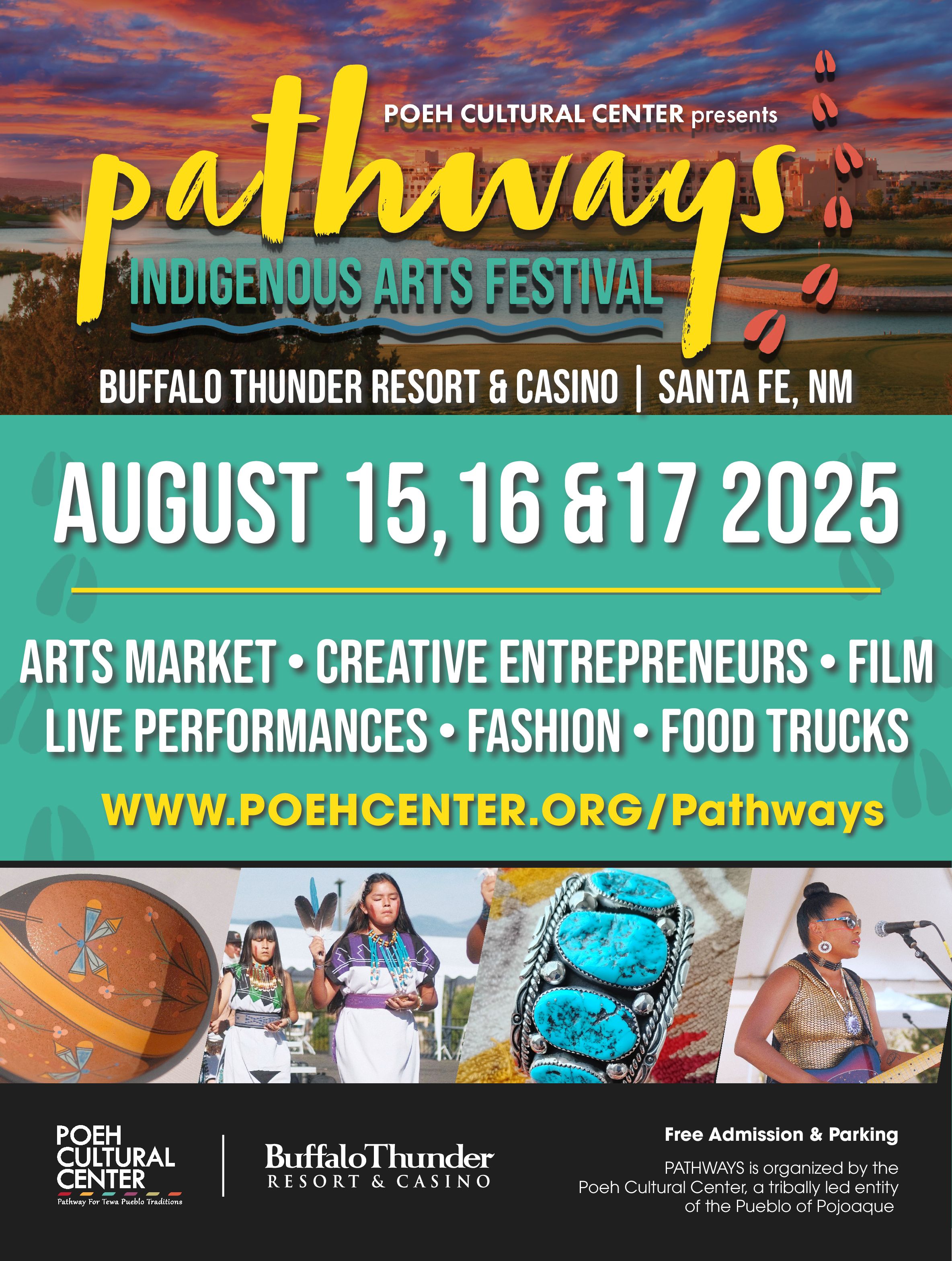
Pathways Indigenous Arts Festival returns to Santa Fe in August
The Pathways Indigenous Arts Festival will take place August 15-17 at Buffalo Thunder Resort & Casino on the Pueblo of Pojoaque, New Mexico. The three-day event showcases a wide range of Indigenous artwork from traditional Pueblo potters to contemporary emerging artists.
Organized by Indigenous people for Indigenous people on Indigenous land, Pathways is described on the Poeh Cultural Center’s website as Santa Fe’s fastest-growing Native art market. The festival offers visitors and collectors an opportunity to explore vibrant, top-quality art across diverse genres.
Ojibwe communities face climate threats to traditional spearfishing
Warming waters, erratic seasonal patterns and lakeshore development are threatening walleye populations and the Ojibwe practice of spring spearfishing, according to the Associated Press. On the Lac Courte Oreilles Reservation in northern Wisconsin, tribal members are seeing firsthand the changes affecting fish reproduction and survival.
Brian Bisonette, director of The Lac Courte Oreilles Conservation Department, indicated that recent ecological shifts raise questions about what future generations will experience. Efforts to keep traditions alive include stocking lakes, limiting permits and documenting fish data. Tribal reliance on nature for food has inspired members to take action and continue fighting for spearfishing traditions. “That’s one thing for all Indigenous populations, they want to adapt,” Bisonette was quoted as saying.
North Dakota governor meets with Turtle Mountain leaders in Belcourt
North Dakota Gov. Kelly Armstrong and representatives from more than a dozen state agencies met with Turtle Mountain Band of Chippewa Indians leaders on July 10 to identify shared priorities and strengthen partnerships. According to Knox Radio, the meeting at Sky Dancer Event Center included TMBCI Chairman Jamie Azure, tribal council members, legislators and other stakeholders. Discussions covered health care, education, workforce development, public safety, emergency management, transportation, gaming, natural resources and the need for natural gas service on the reservation. The visit is part of Armstrong’s plan to meet with all five tribal nations in North Dakota during his first year in office.
Native communities celebrate bald eagle’s new status as U.S. national bird
The bald eagle’s designation as the official national bird of the United States brings renewed pride and hope to many Native communities, including members of the Prairie Island Indian Community in Minnesota, according to the Associated Press. At a recent graduation ceremony by Prairie Island’s riverbank, high school graduates received eagle feathers — symbols of achievement and reverence — as drummers and singers honored them.
Jim Thunder Hawk, Dakota culture and language manager for the Prairie Island Indian Community, said he hopes the nation will be less divided now that the eagle is respected. The bill, sponsored by Minnesota legislators, was signed into law in December 2024. It acknowledges the eagle’s spiritual significance to Indigenous peoples.
NCAI welcomes Meghan Bishop as policy director
The National Congress of American Indians has named Meghan Bishop (Sugpiat/Native Village of Afognak) as its new policy director. Bishop has nearly 20 years of experience in law and public policy, focusing on justice reform, tribal self-governance and child and family welfare, according to NCAI.
Bishop previously served as senior counselor to the assistant secretary of Indian Affairs at the U.S. Department of the Interior, managing public safety portfolios, social services, education, Tiwahe, the PROGRESS Act and Missing and Murdered Indigenous Women initiatives. She also acted as associate director for Tribal Justice Support at the Office of Justice Services, overseeing a $65 million budget and providing technical assistance to tribal justice systems nationwide.
“Meghan’s expertise, leadership, and unwavering dedication to tribal sovereignty make her an outstanding addition to our policy team,” NCAI Executive Director Larry Wright Jr. said in a press release. Bishop holds a law degree from Willamette University School of Law and a master’s degree from George Washington University.
Tribal media at risk under proposed federal funding cuts
A House-passed bill that would rescind $9.4 billion in federal funds could eliminate funding for the Corporation for Public Broadcasting, threatening the future of tribally licensed radio and media stations, according to ICT. The Rescissions Act of 2025, approved by a 214-212 vote, has not yet reached the Senate. Among those affected would be 36 tribally licensed radio stations and Native-led media nonprofits like Vision Maker Media, Koahnic Broadcast Corporation and Native Public Media.
In a letter to Congress, National Congress of American Indians President Larry Wright Jr. said CPB funding is essential to maintaining tribal voices in media and providing critical services such as emergency information, public health messaging and culturally relevant content. Francene Blythe-Lewis, president and CEO of Vision Maker Media, said losing CPB support would “almost virtually eliminate” the organization. Oklahoma Sen. Markwayne Mullin, Cherokee, said on X that he plans to vote ‘yes’ when the bill reaches the Senate.
North Dakota tribes push Supreme Court review in voting rights case
Two North Dakota tribes and three tribal citizens plan to petition the U.S. Supreme Court to review an 8th Circuit Court of Appeals ruling that found they lacked standing to sue the state over alleged voter discrimination, according to the North Dakota Monitor. The case involves the Turtle Mountain Band of Chippewa, Spirit Lake Nation and a 2021 redistricting map the plaintiffs argue illegally diluted Native voting power.
The 8th Circuit reversed a lower court decision favoring the plaintiffs and reaffirmed its position that only the U.S. attorney general can enforce Section 2 of the Voting Rights Act. In a brief filed Wednesday, the plaintiffs asked to maintain the lower court decision. The request was denied on Thursday.
Las Vegas man indicted for allegedly selling fake Native art
A Las Vegas resident has been indicted for allegedly misrepresenting goods as Native American-made in violation of the Indian Arts and Crafts Act of 1990. According to a press release from the U.S. Attorney's Office for the District of Nevada, Jose Skywolf Martinez, 61, made his initial court appearance Tuesday. He is charged with one count of violating the federal law. A jury trial is scheduled to begin Sept. 8.
Prosecutors allege Martinez sold goods he falsely suggested were produced by a Native person or tribe. The director of the Interior Department’s Indian Arts and Crafts Board, Meridith Stanton, was quoted as saying that the counterfeit art allegedly sold by Martinez harms Native “economies, culture, and traditions.” If convicted, Martinez faces up to five years in prison, a $250,000 fine or both.
Muscogee Nation sues Henryetta over McGirt jurisdiction violations
The Muscogee Nation filed a lawsuit Tuesday against the City of Henryetta and its attorney, John Insabella, for prosecuting Native citizens within reservation boundaries in violation of McGirt v. Oklahoma, according to KOSU. The tribe initially contacted Insabella in September 2024 after learning of the prosecutions but received no response. The tribe later discovered the city's police chief had instructed officers not to involve Muscogee Lighthorse Police in traffic stops involving tribal citizens. Insabella later stated the city would continue prosecuting tribal members.
The lawsuit, filed in the Eastern District court, seeks a declaration that Henryetta lacks criminal jurisdiction over Native defendants. The filing comes amid similar disputes, including a recent Tulsa settlement and a January lawsuit against two district attorneys.
Study highlights Native health data gaps, equity efforts in North Carolina
Native Americans are frequently misidentified in public health records, leading to undercounts in disease and mortality data, according to reporting by WUNC that cites a JAMA study. The study found that death certificates more often misclassify Native identity in cases involving cancer or heart disease than in deaths caused by drugs, alcohol or violence.
The data gaps impact public health responses, according to Lumbee citizen Ryan Dial, a program manager at University of North Carolina’s American Indian Health Center and Lineberger Cancer Center. “Public health action is driven by data,” Dial told WUNC. “People look at incidence rates and mortality rates of Native communities and assume, ‘Oh, there's not a disparity there. There's not a problem. We can move on.’”
APSU students engage with Native artists and communities during New Mexico study away program
Austin Peay State University students recently traveled through New Mexico as part of a summer study away program exploring Native American art and literature, according to Clarksville Now. The group from the Tennessee university visited Bandelier National Monument, Acoma Pueblo and other cultural sites while meeting with Indigenous artists and writers, including Diné painter Ryan Singer and Diné author Brendan Shay Basham.
Crystal Bridges and Art Bridges acquire 90 works of contemporary Native art
ARTnews reports that 90 works of contemporary Native art from the John and Susan Horseman Collection have been acquired by the Crystal Bridges Museum of American Art and the Art Bridges Foundation. The acquisition includes pieces by Kent Monkman, George Morrison, Jaune Quick-to-See Smith, Rose B. Simpson and T.C. Cannon. Crystal Bridges will receive nine works; the remaining 81 will go to Art Bridges.
The acquisition expands both institutions’ collections and exhibition offerings. Jordan Poorman Cocker, curator of Indigenous art at Crystal Bridges, was quoted as saying that the artists in the collection “tell stories about collective history that predates America.” Ashley Holland, director of curatorial initiatives for Art Bridges, said Native perspectives are foundational to American art.
Caddo Nation and OSUIT sign workforce partnership for energy and construction careers
The Caddo Nation Economic Development Authority (CNEDA) and Oklahoma State University Institute of Technology (OSUIT) have signed a Memorandum of Understanding to launch customized training programs in renewable energy, construction and infrastructure, according to a July 3 press release. The agreement supports the Caddo Nation’s economic development plans by preparing citizens for careers aligned with tribally owned enterprises.
Under the partnership, OSUIT will provide non-credit training, credentialing, faculty expertise and access to facilities, while CNEDA will coordinate recruitment and ensure alignment with tribal priorities. According to Caddo Nation Chairman Bobby Gonzalez, the collaboration marks “a transformative moment” for the Nation’s long-term economic growth. The first programs are expected to launch in fall 2025.
CDC data shows Native and Black males have highest fentanyl death rates
The Centers for Disease Control and Prevention data shows Native American males and Black males had the highest death rates from illicit fentanyl in 2023, according to EIN Presswire. University of Oklahoma chemistry professor Donna Nelson presented the data at the InspireOK 25 Conference on June 27, with Oklahoma Secretary of State Ryan Walters in attendance.
While the CDC’s overall data for 2015 through 2023 revealed a leveling and slight decline in overall fentanyl-related death rates in 2023, the rates for Black males continued to rise. For Native American males, rates declined slightly but remained higher than those for white males.
Youth learn cultural and ecological stewardship at Rolette County day camp
Students gathered June 25 at the Anishinabe Learning, Cultural & Wellness Center in Belcourt, North Dakota, for a day camp focused on conservation, according to the North Dakota office of the U.S. Department of Agriculture’s Natural Resources Conservation Service (NRCS). The Rolette County Soil Conservation District and the Anishinabe Center hosted the camp with support from NRCS.
The event featured six rotating learning stations covering soils, wetlands, engineering, rangeland, wildlife and tree identification. Presenters included NRCS staff and professionals such as Adam Flaagan, tribal liaison for Spirit Lake Nation, and Beth Miller, of the North Dakota Forest Service.
Muscogee Nation commemorates McGirt ruling’s anniversary with Sovereignty Day event
The Muscogee Nation held a Sovereignty Day celebration to mark the fifth anniversary of the U.S. Supreme Court’s McGirt v. Oklahoma decision, according to Native News Online. The event took place at the College of the Muscogee Nation’s STEM Building Lecture Hall and included tribal leadership, citizens and special guests.
Principal Chief David Hill said the ruling confirmed the nation’s longstanding self-governance. A panel titled “Sovereignty in Action” highlighted efforts in justice, health, language revitalization and economic development. Riyaz Kanji, lead counsel in the McGirt case, spoke at the event. A time capsule filled with items from the Muscogee Nation will remain on display until 2050.
NCAI condemns Ann Coulter’s comment as hate speech
The National Congress of American Indians issued a statement condemning Ann Coulter’s July 6 post on X in which she stated, “We didn’t kill enough Indians.” The organization called the comment “a violent attack on Native people and Tribal Nations” and demanded an immediate retraction, public apology and platform ban.
“These words are not provocative social commentary; they are a violent attack,” said NCAI President Mark Macarro. NCAI Executive Director Larry Wright Jr. added that the statement “fuels harassment, hate crimes, and political violence.” The organization called on elected officials, media and X to denounce the comment and take action. NCAI urged the public to uplift Native contributions and voices, noting it will continue to confront rhetoric that threatens Native communities.