






The Daily Spark
Small sparks from Indian Country, built to catch fire
Prayer gathering called for missing loved one Renzo Bullhead
A prayer gathering for Renzo Bullhead and his family will be held at 7 p.m. on May 21 at the Bismarck train bridge in North Dakota. Bullhead went missing from the bridge in March. Mothers are asked to bring medicines, rattles, drums and songs to join in prayer.
For those unable to attend, organizers encourage lighting sage or sweet grass and offering a prayer at 7 p.m. to unite the community in support.

Failures in missing person response raised after San Carlos Apache teen’s death
San Carlos Apache teen Emily Pike, who went missing from a Mesa, Arizona, group home in January, was found murdered near Globe on Feb. 14, according to the Arizona Mirror. Her mother, Stephanie Dosela, learned of her daughter’s death after seeing photos of human remains on social media, highlighting communication failures among tribal, county and state agencies.
During a May 14 Arizona legislative hearing, officials and family members discussed gaps in sexual assault response, missing person protocols and jurisdictional challenges tied to tribal sovereignty. The San Carlos Apache Tribe is calling for improved information sharing and immediate missing child status for group home runaways. A new state law, dubbed “Emily’s Law,” creates a Turquoise Alert for missing Native people.
White Earth Tribal and Community College finalizes plans for Earth Summit 2025
White Earth Tribal and Community College is finalizing plans for Earth Summit 2025, set for May 28-29 on its campus, according to a May 19 report by Lakes Area Radio. The summit expands on the 2024 White Earth Water Summit blending of Ojibwe culture with contemporary science.
Speakers include Peg Furshong from CURE, who will discuss the impact of AI and cryptocurrency on water, and James Vukelich, Turtle Mountain Ojibwe author, who will talk about The Seven Grandfather Teachings and the relationship to Earth. Researchers from the University of Minnesota will present recent data on the White Earth Indian Reservation’s watersheds. The Nature Conservancy will highlight regional initiatives. Attendees can participate in Ojibwe lacrosse or “Yogachigede,” yoga with an Ojibwe twist.
National Indian Health Board hosting training to improve access to Medicare, Medicaid, Health Insurance Marketplace
The National Indian Health Board, in partnership with the Centers for Medicare & Medicaid Services, will hold an Indian Health Service, Tribal and Urban Indian program training June 3-4 in Rapid City, South Dakota. The training helps programs improve access to Medicare, Medicaid and the Health Insurance Marketplace, according to an announcement by the National Indian Health Board. It is recommended for benefits coordinators, billing and coding professionals, business office staff and patient registration staff. Trainings are also scheduled for July 9-10 in Flagstaff, Arizona, with virtual options planned later. Questions can be directed to Kristen Bitsuie at kbitsuie@nihb.org.
VA partners with Televeda to expand suicide prevention for Indigenous veterans
The U.S. Department of Veterans Affairs awarded a contract to Televeda, a community engagement platform, to pilot and expand the Hero’s Story Project, according to a Business Wire release. The culturally tailored suicide prevention program targets American Indian and Alaska Native veterans in Arizona and New Mexico, focusing on rural frontier communities.
The program combines traditional healing practices like talking circles and storytelling with evidence-based peer support. Special attention will support women veterans and survivors of military sexual trauma. Televeda plans to formalize partnerships with tribal governments and veteran service organizations while expanding program evaluation to improve effectiveness.
“We are deeply grateful to the VA, our tribal and community partners, and the veterans who have helped shape this important work,” said Mayank Mishra, co-founder of Televeda. The project is part of the VA’s Mission Daybreak initiative.
North Dakota establishes aerospace medicine center at UND
Gov. Kelly Armstrong has signed House Bill 1612, establishing the North Dakota Center for Aerospace Medicine at the University of North Dakota. According to UND, the John D. Odegard School of Aerospace Sciences will establish the center in partnership with its School of Medicine & Health Sciences, Student Health Services and University Counseling Center.
The center is mandated to support mental health and assist with Federal Aviation Administration medical certification for pilots and aviation professionals across the state. The legislation includes up to $250,000 in one-time funding. More than two dozen individuals, including UND administrators and industry experts, testified in support of the bill. UND officials say the center will expand access to specialized medical care and address barriers that discourage pilots from seeking mental health support.
Tribal IDs remain valid for airport security, TSA confirms
Tribal identification cards are still accepted by airport security officials under the new Real ID requirements, according to reporting by ICT. The federal rule took effect May 7 and requires travelers to present a Real ID or alternative form of identification to pass through security.
The tribal photo identification must be issued by a federally-recognized tribe. According to the TSA website, IDs that cannot be scanned will be checked manually and cross-referenced with the Federal Register, which matches the Bureau of Indian Affairs’ list of tribal entities.
Kristi Noem, secretary of the U.S. Department of Homeland Security, told a congressional panel May 6 that those using tribal IDs may face an extra step or be diverted to a different line.
Tribal regalia protections expand ahead of 2025 graduations
More Native students will wear tribal regalia at their 2025 graduation ceremonies as 20 states now have laws protecting the right to cultural expression during commencements, according to reporting by ICT.
New Mexico became the latest state to adopt such protections with the passage of Senate Bill 163, signed March 19 by Gov. Michelle Lujan Grisham. The law prohibits schools from barring Native students from wearing traditional clothing, accessories or objects during graduation. It took effect immediately.
“This legislation represents our commitment to honoring and respecting the rich cultural heritage of New Mexico’s Native communities,” Grisham said at the signing.
Regalia bills are also pending in Wisconsin, and incidents of denied regalia in 2024 continue to prompt legal action and policy change across the U.S.
Native veterans to be honored at Memorial Day event in Washington
The National Museum of the American Indian (NMAI) will host an event on Memorial Day to honor Native veterans. The event, Service and Sacrifice, takes place May 26 at the museum in Washington, D.C.
Attendees will hear from Native veterans, create prayer ties in remembrance of loved ones and witness a wreath-laying ceremony at the National Native American Veterans Memorial, according to the museum’s website. The museum will also feature “Why We Serve: Native Americans in the United States Armed Forces,” an ongoing exhibition on Native military service. NMAI will livestream the event at AmericanIndian.si.edu/livestream for those unable to attend in person.
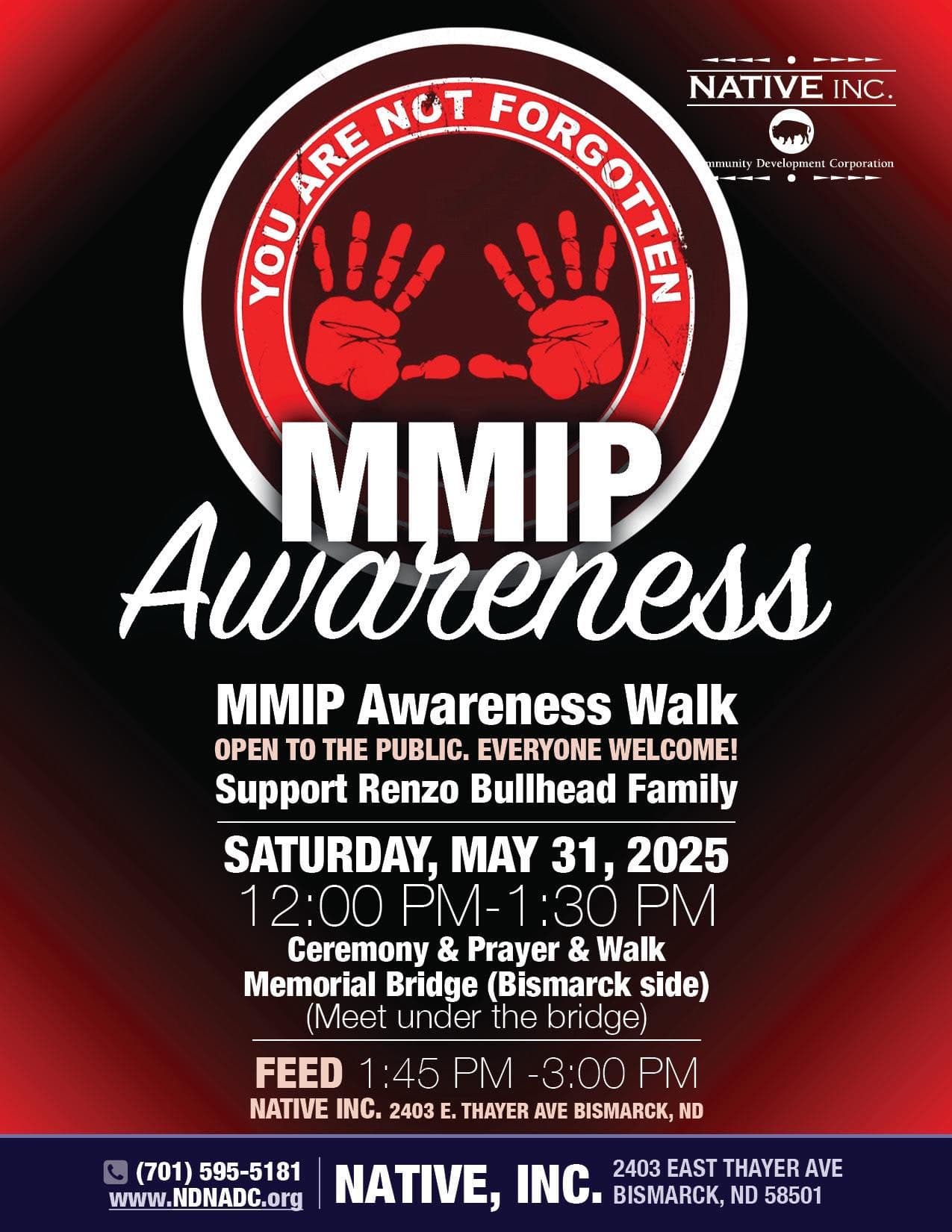
MMIP awareness walk honoring Renzo Bullhead planned in Bismarck
A Missing and Murdered Indigenous Persons (MMIP) awareness walk honoring Renzo Bullhead will take place Saturday, May 31, from 12 to 1:30 p.m. at Memorial Bridge in Bismarck, according to Native, Inc. Community Development Corporation.The event is open to the public and invites community members to support Bullhead’s family and raise awareness for MMIP cases.
The schedule includes a ceremony and prayer with drum groups under the Bismarck side of the bridge at noon and a walk across the bridge at 12:30 p.m., followed by a second ceremony on the Mandan side at 1 p.m. A community feed will follow from 1:45 to 3 p.m. at Native, Inc., 2403 East Thayer Ave., Bismarck.
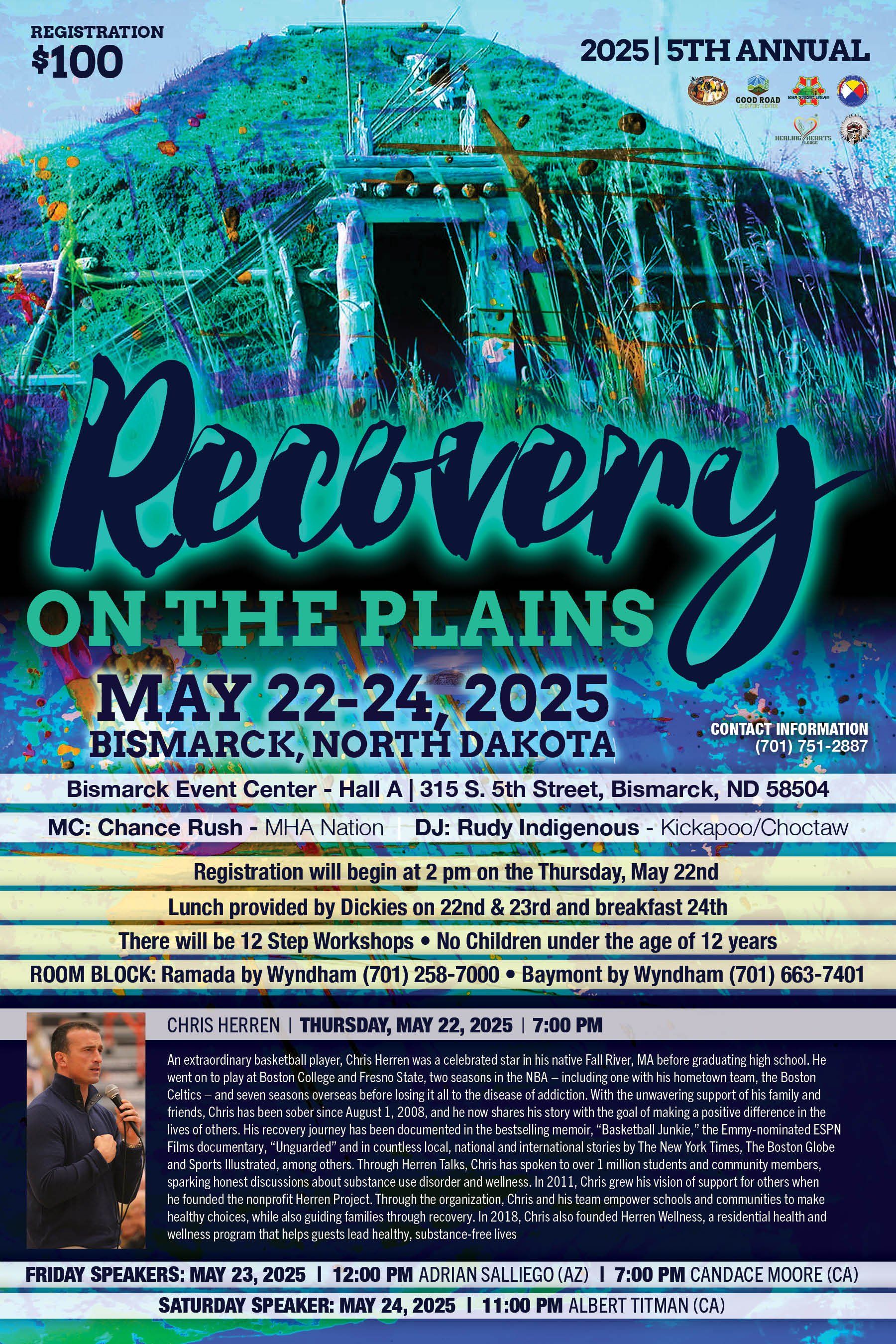
Recovery on the Plains event planned in Bismarck
The Mandan, Hidatsa and Arikara Nation will host its 5th annual Recovery on the Plains event from May 22 to 24, at the Bismarck Event Center in Bismarck, North Dakota. Registration opens at 2 p.m. on May 22. The event features keynote speaker Chris Herren, a former NBA player who has been sober since 2008 and shares his story to raise awareness about addiction. Workshops, speakers and meals are included.
Speakers include Adrian Salliego, Candace Moore and Albert Titman. Children under 12 are not permitted. Room blocks are available at nearby hotels. Registration costs $100. For details, contact (701) 751-2887.
Grand Ronde to host MMIP awareness event
The Confederated Tribes of Grand Ronde will host a Missing and Murdered Indigenous People awareness event on Friday, May 30, from 11 a.m. to 2 p.m. at the new health building located at 9615 Grand Ronde Rd in Grand Ronde, Oregon. The event, organized by Warriors of Hope, will include food, drinks and front door raffles at 1:30 p.m.
The gathering will feature elk and bison burgers, hot dogs and chips as part of the community gathering focused on MMIP awareness. The notice directs attendees to contact 503-879-1660 for more information.

Missoula Art Museum to open MMIP portrait exhibit in June
The Missoula Art Museum has announced the launch of Outrage: Missing and Murdered Indigenous People in Montana. The exhibition, by Irish artist Brian Maguire, includes portraits created in collaboration with Native families and MMIP advocates across Montana. A public reception will be held Friday, June 6, from 5 to 8 p.m., followed by a panel discussion on Saturday, June 7, from 11 a.m. to 1 p.m.
According to the Missoula Art Museum, Maguire’s work is based on meetings with impacted families and reflects themes of remembrance and resistance. The June 7 panel will include Maguire, Native leaders and advocates discussing the role of art in justice and healing.
Greenpeace seeks reduction of $667 million jury award in pipeline case
Greenpeace is asking a North Dakota judge to reduce a $667 million jury award it was ordered to pay Energy Transfer, the developer of the Dakota Access Pipeline, calling the amount excessive and inconsistent with state law, according to the North Dakota Monitor. Greenpeace attorney Steven Caplow argued the damages exceed legal caps and include costs not directly tied to the organization’s actions during the 2016 and 2017 protests. Caplow also said the jury form failed to allow jurors to distinguish Greenpeace’s responsibility from that of other groups. Energy Transfer attorney Trey Cox said the award reflects the evidence and should stand. Judge James Gion took the motion under advisement. A hearing is scheduled for May 27, and Greenpeace USA has announced plans to appeal to the North Dakota Supreme Court.
Black Hills foundations launch fund to aid groups losing federal funding
Two Rapid City foundations have partnered to help nonprofits facing funding cuts due to federal changes. The Black Hills Area Community Foundation and the John T. Vucurevich Foundation created the Sustaining Black Hills Nonprofits Fund to provide short-term bridge funding. The Bush Foundation in Minnesota also supports the effort, which aims to help nonprofits adjust while encouraging community support.
John T. Vucurevich Foundation CEO Jacqui Dietrich said nonprofits face rising costs and declining federal aid. Black Hills Area Community Foundation president Chris Huber added that without these services, community needs go unmet. The fund has supported groups including Seventh Circuit Court Appointed Special Advocates, Feeding South Dakota and Working Against Violence Inc., which lost federal grants or face funding gaps, according to South Dakota Searchlight.
Arizona signs ‘Emily’s Law’ for Native American alert system
Arizona Gov. Katie Hobbs signed legislation May 13 establishing a rapid alert system for missing Native Americans under age 65, known as the “turquoise alert.” The law follows similar systems in Washington, Colorado, California, North Dakota and New Mexico, and was named “Emily’s Law” to honor Emily Pike, a San Carlos Apache teen whose remains were found in February after she disappeared from a group home in Mesa.
The law allows alerts when a person is missing under suspicious circumstances or may be in danger, according to lawmakers. Rep. Teresa Martinez, sponsor of the bill, said on the House floor, “We cannot let children go missing without somebody being alerted.” The FBI recently announced a $75,000 reward for information on Pike’s disappearance and death, adding to a $75,000 offer by the San Carlos Apache Tribe, according to the Associated Press.
Appeals court overturns voting rights win for North Dakota tribes
The 8th U.S. Circuit Court of Appeals ruled Wednesday that the Turtle Mountain Band of Chippewa and Spirit Lake Nation lack standing to sue North Dakota over a legislative redistricting plan they argued diluted Native voting power, according to the North Dakota Monitor. The 8th Circuit Court of Appeals reversed a 2023 decision by U.S. District Judge Peter Welte that had ordered the state to adopt a new map.
The appellate panel found that voters cannot use Section 1983 to challenge racial discrimination under the Voting Rights Act, affirming its earlier position that only the U.S. attorney general may file such claims. The ruling sends the case back to district court with instructions to dismiss. According to Secretary of State Michael Howe, the state will now proceed with using the 2021 redistricting plan for the 2026 election cycle, pending further legal action.
Colville Tribes respond to reported bans on graduation regalia
The Confederated Tribes of the Colville Reservation issued a press release May 12 responding to reports that some central Washington school districts are refusing to allow tribal students to wear traditional regalia during graduation ceremonies. The tribe stated that any prohibition of culturally significant items, such as beaded caps or eagle feathers, violates Washington state law and disrespects tribal heritage.
Citing RCW 28A.600.500 and Washington Office of Superintendent of Public Instruction bulletin #028-25, the tribe emphasized that public schools may not prevent Native students from wearing regalia or other culturally significant objects. Chairman Jarred-Michael Erickson called on schools to respect Colville students’ right to express their heritage and asked families to alert the Colville Business Council if any student is denied that right.
$26.4 million awarded to Yurok Tribe for wellness center
The Yurok Tribe will receive $26.4 million from the California Behavioral Health Continuum Infrastructure Program to build the Yurok Tribal Health and Wellness Center, according to a Yurok Tribe press release. The 24,000-square-foot facility will offer inpatient and outpatient services, including primary care, behavioral health and mental health treatment, to tribal members and nearby communities.
The funding is part of a larger $3.3 billion investment in 124 projects statewide. “By improving the health of the most vulnerable members of our community, the Yurok Tribal Health and Wellness Center will help us prevent future MMIP cases,” said Yurok Chairman Joseph L. James. The center will be built near Martin’s Ferry Bridge on the Yurok Reservation and is expected to open in three to five years.