






The Daily Spark
Small sparks from Indian Country, built to catch fire
Standing Rock leaders raise concerns about federal funding in meeting with ND, SD governors
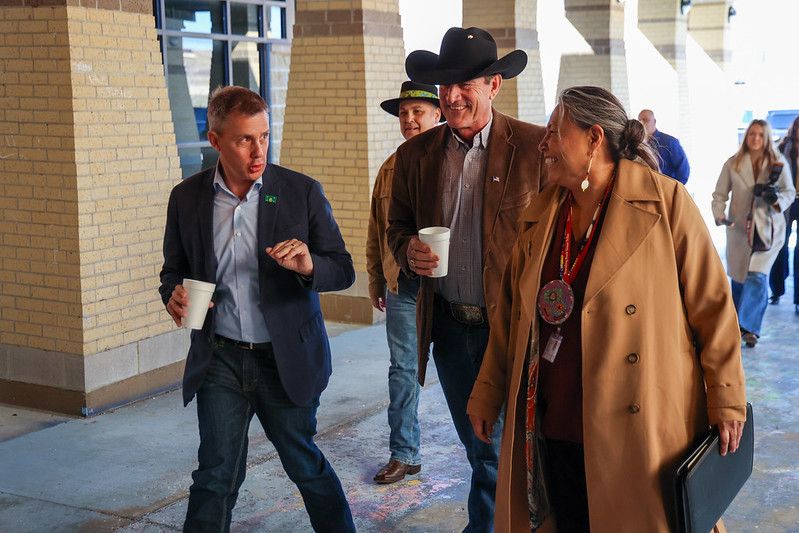
Leaders of the Standing Rock Sioux Tribe met with North Dakota Governor Kelly Armstrong and South Dakota Governor Larry Rhoden on April 7, 2025, at the tribe’s administrative center in Fort Yates, North Dakota. The meeting was prompted by concerns that federal funding cuts could affect education, healthcare and law enforcement services in Indian Country. Tribal Chairwoman Janet Alkire told the governors that Standing Rock is counting on them to help make sure the federal government is meeting its responsibility to Native communities. Both governors committed to supporting the tribe's needs.
Powwow for the Planet to raise awareness of sacred national monuments in Nevada
The Powwow for the Planet will be held on Saturday and Sunday at the University of Nevada, Las Vegas. The event will highlight the cultural and spiritual significance of national monuments on tribal lands, such as Avi Kwa Ame and Gold Butte. The powwow will feature traditional dances, a new drumming contest, and public intertribals. Organizers also want to raise awareness of sacred sites that tribal nations are proposing as monuments, such as Bahsahwahbee and East Las Vegas.
Tribal groups challenge use of boarding schools in SCOTUS case
Three national Native organizations filed an amicus brief on April 7 in two Oklahoma education cases now before the U.S. Supreme Court. Represented by the Native American Rights Fund, the organizations are pushing back against claims that federal Indian boarding schools set a precedent for public funding of religious education. The groups say this misrepresents a system rooted in cultural genocide.
USDA consults with Tribal Nations on food program improvements
U.S. Department of Agriculture officials met with tribal leaders in Chandler, Arizona, on April 7 to discuss the Food Distribution Program on Indian Reservations (FDPIR), a continuing effort to improve food access in Native communities. The consultation, held during the Tribal Self Governance Conference, included Acting Deputy Under Secretary John Walk. FDPIR provides food and nutrition education to roughly 53,000 income-eligible Native American households and is administered by 107 Indian Tribal Organizations and three state agencies.
Summer pollinator workshop offered at United Tribes Technical College
The North Dakota Game and Fish Department will host Pollinators in the Classroom, a professional development workshop for K-12 educators, June 10–11, at United Tribes Technical College in Bismarck. Participants will explore pollinators’ roles, habitats and life cycles through hands-on lessons and field activities. Attendees will receive the Urban Pollinator Program Curriculum and all course materials. The event costs $50 and includes walking field trips.
For details, contact Sherry Niesar at 701-527-3714 or sniesar@nd.gov.
Register here: https://gf.nd.gov/education/educator-workshops/schedule
Larissa FastHorse brings satire to D.C. stage
Playwright Larissa FastHorse’s latest production, “Fake It Until You Make It,” is now showing at Arena Stage in Washington, D.C. The farce, which premiered in California, satirizes the nonprofit world through the rivalry of two leaders—one Indigenous, one not—highlighting racial and political disparities in funding and representation. FastHorse, a Sicangu Lakota Nation citizen, explores the themes of identity, sovereignty and Two-Spirit visibility.
UC San Diego study evaluates culturally tailored anti-tobacco efforts in tribal communities
A study led by the University of California, San Diego, has found that culturally tailored efforts to reduce commercial tobacco use in Native American communities are showing promising results. The California Native American Tobacco Initiative, launched in 2019 by the state’s Department of Public Health, funded 13 tribes and four tribal-serving organizations, aiming to reduce tobacco-related health disparities in Native American communities by focusing on tobacco cessation programming, community engagement and policy changes. Researchers prioritized cultural humility and respected the sacred role of traditional tobacco.
Trump defends tariffs despite market fallout, vows to press ahead
Former President Donald Trump said he will not retreat from broad new tariffs set to begin Wednesday, calling them “medicine” to fix global trade. The announcement has roiled financial markets worldwide, with U.S. futures and Asian stocks experiencing a sharp decline. Trump said more than 50 nations have reached out to negotiate, but no agreements have been made. Some Republican lawmakers are pushing a bill to limit presidential tariff powers.
IGA Chairman Ernie Stevens remains calm amid threats to tribal gaming
Ernie Stevens Jr., chair of the Indian Gaming Association (IGA), expressed calm resolve in an interview with CDC Gaming in which he discussed the challenges facing tribal gaming, including obstacles from the Trump administration, sweepstakes operators and online gaming markets. Despite these threats, Stevens emphasized the importance of tribal sovereignty and lobbying efforts to protect Indian Country’s interests. Under his leadership, tribal gaming revenues have grown significantly, from $11 billion in 2000 to over $49 billion in 2024. Stevens stressed the importance of unity and education, urging tribal leaders to engage with lawmakers to defend tribal rights.
Oregon Fish and Wildlife Commission repeals Siletz Tribe Consent Decree
The Oregon Fish and Wildlife Commission recently rescinded a 1980 agreement between the Oregon Department of Fish and Wildlife (ODFW) and the Confederated Tribes of Siletz Indians, completing the process to restore the tribe’s full hunting and fishing rights. This action follows federal law and a court ruling to vacate the Siletz Tribe Consent Decree, which had severely limited the tribe’s rights. The move recognizes the tribe’s sovereignty, strengthens collaboration between the state and the tribe and, ODFW Director Debbie Colbert said, “rights a historic wrong.”
Governments urged to enable Indigenous trade through inclusive policies
Governments can play a critical role in advancing Indigenous entrepreneurship through targeted trade and investment policies, according to a new report from the World Economic Forum. The report outlines six key strategies: including Indigenous rights in trade agreements, enabling culturally informed trade promotion, ensuring access to financing, and adopting inclusive procurement laws. The report also highlights the importance of protecting Indigenous intellectual property and traditional knowledge.
Cottonwood log transformed into 18th-century-style canoe
Communal project involved Indigenous youth
A unique canoe-building project, sponsored by Wakan Tipi Awanyankapi and Great Lakes Lifeways Institute, took place at the Minneapolis American Indian Center, where a 38-foot cottonwood log was transformed into an 18th-century-style dugout canoe. The Prairie Island Indian Community will receive the canoe as a symbol of gratitude for protecting the sacred Wakan Tipi site. Over three weeks, 263 volunteers, including local Indigenous youth and recovery groups, participated in shaping the canoe using traditional tools. The completed vessel will serve as a cultural and educational resource for future generations.
Anti-Trump protesters turn out in force
Tens of thousands of demonstrators gathered in Washington, D.C., and across all 50 states on April 5, 2025, to protest President Donald Trump’s policies. Known as the “Hands Off!” rallies, participants expressed discontent with the administration's handling of issues such as federal worker layoffs, immigration policies, due process and LGBTQ+ rights. Organizers reported over 1,200 rallies nationwide.
Spirit Lake Tribe reaches agreement with BIA
The Spirit Lake Tribe's police force is operating with just four officers and sometimes responds to 200 calls in a week. The tribe’s chairperson, Lonna Jackson-Street, describes the need for more officers as urgent. To address the officer shortage, the tribe has established a Memorandum of Agreement with the Bureau of Indian Affairs, allowing for direct recruitment of officers under tribal authority while ensuring the recruits meet BIA Police Academy credentials.
Lawmakers hear Native leaders at Oklahoma field hearing
The House Committee on Natural Resources held its first field hearing of the 119th Congress at the First Americans Museum in Oklahoma City on April 4. Twelve members of Congress and eight tribal witnesses participated in discussions focused on strengthening federal policy under the Indian Self-Determination and Education Assistance Act. Lawmakers highlighted the need to adapt federal programs in partnership with tribes. The hearing marked record attendance for a field event hosted by the committee.
Native education programs must remain a federal priority
U.S. Sen. Lisa Murkowski, R-Alaska, emphasized the importance of Native education programs during a Senate Committee on Indian Affairs oversight hearing. Murkowski, the committee’s chair, said she wanted to explore the possible impact to Native students if programs like the Alaska Native Education Program and Impact Aid are moved out of the Department of Education. Witnesses, including Sealaska Heritage Institute President Rosita Worl, said such changes could damage long-standing relationships with Native communities. Written testimony is being accepted through April 16 at testimony@indian.senate.gov.
Mohawk Nation withdraws from NY land settlement talks
The Mohawk Nation Council of Chiefs has officially withdrawn from a federal land dispute case in New York, citing lack of full internal consensus on a proposed settlement. A judge dismissed their claims without prejudice, allowing other parties — including the Mohawk Council of Akwesasne and the Saint Regis Mohawk Tribe — to continue negotiations over 2,000 acres tied to an 18th-century treaty.
Nansemond Nation sues Virginia over Medicaid changes
The Nansemond Indian Nation and its healthcare arm, Fishing Point Healthcare, have filed a federal lawsuit against Virginia, alleging unlawful changes to the state’s Medicaid program that undermine tribal sovereignty. The complaint says the state bypassed federal consultation requirements and withheld reimbursements, disrupting services to both Native and non-Native patients. Virginia officials claim the tribe overbilled Medicaid, a charge the Nation disputes.
Alaska youth ask high court to halt LNG project transfer
Eight young Alaskans have asked the Alaska Supreme Court to block a deal transferring ownership of the Alaska LNG project to Glenfarne Alaska LNG, LLC. The plaintiffs, aged 11 to 22, argue the transfer threatens lands and resources essential to their health and cultures. According to court documents, the project would cross 800 miles and could triple the state’s climate emissions. State officials argue the motion is procedurally improper and that the project has already received environmental approvals.