






The Daily Spark
Small sparks from Indian Country, built to catch fire
Cara Romero’s photography explores environmental racism
Native American photographer Cara Romero uses her art to spark a conversation about environmental racism and its impact on Indigenous communities. Her latest solo exhibition, Panûpünüwügai (Living Light), currently on display at Dartmouth’s Hood Museum, includes over 60 powerful photographs addressing issues like land loss and the environmental exploitation of tribal lands. Romero’s work blends tradition with environmental development, aiming to open a dialogue about the connection between Indigenous cultures and the fight for environmental justice.
Film explores Indigenous fight to protect Oklahoma river
Indigenous communities have long faced displacement and environmental threats from natural resource extraction. A new documentary, Drowned Land, by Choctaw filmmaker Colleen Thurston, highlights the ongoing fight to protect Oklahoma’s Kiamichi River. The film, which premiered in select theaters on March 23, explores the deep connections between land, water, and Indigenous storytelling.
Trump order threatens Native student funding
President Donald Trump signed an executive order to dismantle the U.S. Education Department, a move that could significantly impact Native students. U.S. Sen. Brian Schatz (D-HI) called the order a “betrayal of a sacred federal promise,” warning it could cut funding for special education, Native language programs, and tribal colleges. Advocates say Native students, most of whom attend public schools, would be left vulnerable to state budget decisions.
Michigan tribes withdraw from Line 5 review
Six Michigan tribes have withdrawn from the U.S. Army Corps of Engineers' review of Enbridge Energy’s Line 5 tunnel project, citing concerns that a Trump-era executive order will fast-track approval. The tribes accuse the Corps of disregarding its obligations under the National Environmental Policy Act and failing to engage in meaningful consultation. The proposed tunnel would relocate part of the pipeline under the Straits of Mackinac, raising environmental and sovereignty concerns.
Oregon tribes clash over Willamette Falls land dispute
The Confederated Tribes of Siletz Indians is supporting Portland General Electric’s bid to condemn five acres of public land at Willamette Falls for hydroelectric operations. The Confederated Tribes of the Grand Ronde Community opposes the move, arguing it threatens their ceremonial fishing platform. A federal judge will hear arguments on April 21. The case highlights complex intertribal disputes over land use and treaty rights.
Supreme Court rejects youth-led climate lawsuit
The U.S. Supreme Court on Monday declined to hear a lawsuit filed by 21 young plaintiffs, including Native Americans, who argued that federal energy policies violate their constitutional rights by worsening climate change. The case, first filed in 2015, was dismissed by the Ninth Circuit for lack of standing. Despite the ruling, attorneys say the case has fueled a growing youth-led climate movement.
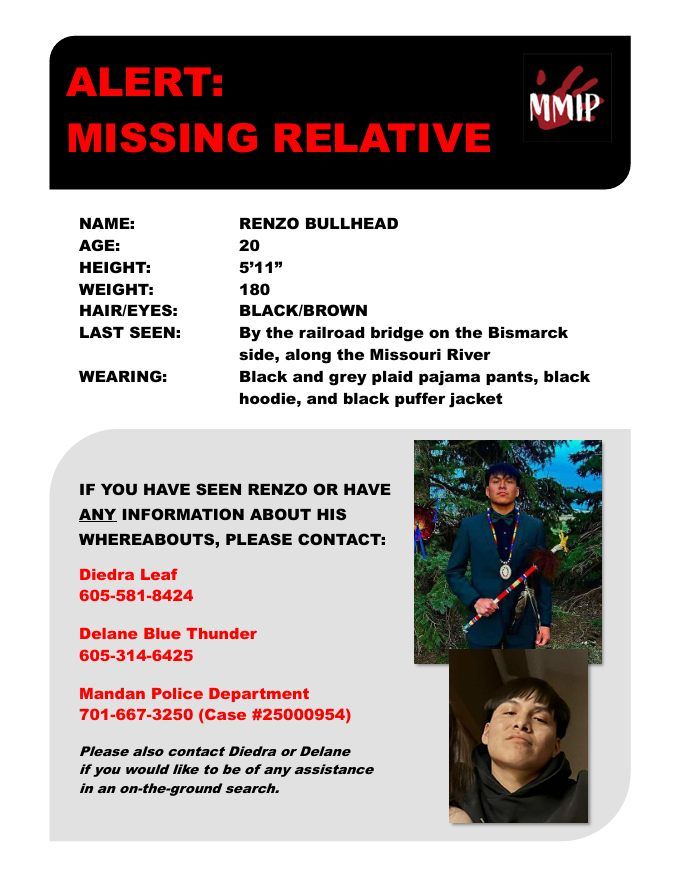
Coordinated search efforts for Renzo Bull Head continue
The family of Renzo Bull Head is grateful for the community’s ongoing support as the search enters another week. To improve coordination, volunteers are asked to sign up for weekday shifts of 10-12 people. The search base remains at United Tribes Technical College, with a new meeting room location to be announced. Updates will be posted on the official Renzo Bullhead Search Page on Facebook.
The Mandan Police Department is seeking assistance in locating 20-year-old Renzo Bullhead, who has been missing since March 16, 2025. Renzo was last seen walking east on the railroad bridge between Mandan and Bismarck around 8 p.m. Surveillance footage shows him entering the bridge but does not show him exiting. Renzo is described as having black hair, brown eyes, standing 5 feet 11 inches tall, and weighing approximately 180 pounds. He was last seen wearing a puffy black jacket, white and black checkered sweatpants, and white and red Jordan basketball shoes.
North Dakota Public Service Commission to hold hearing on proposed Thunder Butte Pipeline
The North Dakota Public Service Commission has scheduled a public hearing for April 2 on a proposed crude oil pipeline project in Ward and Mountrail Counties. Thunder Butte Pipeline, LLC seeks a siting permit for a 3.84-mile new pipeline and the conversion of a 30.8-mile existing pipeline.
Approximately three miles of the pipeline would run through the Fort Berthold Indian Reservation, transporting up to 24,000 barrels of crude oil per day. The project is estimated to cost $19.6 million.
The hearing will take place at 10 a.m. at American Legion Post 0121 in Parshall. Public comments must be submitted at the hearing to be included in the official record.
For more information, contact the Public Service Commission at (701) 328-2400 or visit www.psc.nd.gov.
Veterans Affairs policy removes tribal flags from Phoenix hospital
The Phoenix VA Medical Center has removed the flags of Arizona’s 22 tribal nations under a new Department of Veterans Affairs policy that limits flag displays at VA facilities. The flags were delivered to the Salt River Pima-Maricopa Indian Community for preservation. Tribal leaders and lawmakers have criticized the move, calling it disrespectful to Native veterans, who serve in the U.S. military at five times the national average. Some are urging the VA to reconsider.
Setback in search efforts: Removal of key report on missing Indigenous youth
The U.S. Department of Justice recently removed a key report on missing Indigenous youth, hindering progress on addressing the Missing and Murdered Indigenous Peoples (MMIP) crisis. The Not Invisible Act Commission’s 212-page report, which outlined protections for Indigenous foster youth and other at-risk populations, included recommendations for federal agencies to improve tracking and response efforts. Despite setbacks, leaders like Ruth Buffalo of the Minnesota Indian Women's Resource Center remain committed to pushing for accountability and action. The community continues advocating for law enforcement resources, data collection, and victim support.
UPDATE: Search for missing 20-year-old Renzo Bullhead intensifies
The Mandan Police Department is seeking assistance in locating 20-year-old Renzo Bullhead, who has been missing since March 16, 2025. Renzo was last seen walking east on the railroad bridge connecting Mandan and Bismarck around 8 p.m. Sunday. Surveillance footage shows him entering the bridge from the east side, but it does not show him exiting the east side or returning to the west side.
Renzo is described as having black hair, brown eyes, standing 5 feet 11 inches tall, and weighing approximately 180 pounds. He was last seen wearing a puffy black jacket, white and black checkered sweatpants, and white and red Jordan basketball shoes.
Search efforts have expanded, with additional resources like watercraft and drones. Due to limited staff on Friday, the search headquarters will be moved to United Tribes Technical College, Building #15, with a briefing at 11:00 a.m. on Friday, March 21. Volunteers are encouraged to gather for prayer and instructions.
Community members are urged to help with the search. Anyone with information regarding Renzo’s whereabouts should contact the Mandan Police Department at (701) 667-3250. Your volunteer help is important in these expanded efforts.
Aaniiih Nakoda College featured on ‘The College Tour’
Aaniiih Nakoda College will be featured in an upcoming episode of The College Tour on Amazon Prime, premiering May 27, 2025. The episode highlights ANC’s efforts to blend Indigenous knowledge with Western education, including language immersion and environmental studies. Students and alumni share how the college empowers them to strengthen their community on the Fort Belknap Indian Reservation.
📅 Watch a preview: Here
#AaniiihNakodaCollege #TheCollegeTour #IndigenousEducation
Creek Freedmen seek intervention in Tulsa jurisdiction dispute
The Muscogee Creek Indian Freedmen Band, along with their attorney, Damario Solomon-Simmons, have filed to intervene in a federal court dispute over tribal jurisdiction in Tulsa, Oklahoma. The Freedmen, descendants of those once enslaved by the Muscogee Creek Nation, argue they face similar traffic citations as tribal citizens but lack protections under the 2020 McGirt v. Oklahoma ruling. They seek to ensure their rights are recognized and protected. The case continues amid ongoing settlement talks between the Muscogee Creek Nation and the city of Tulsa.
Senator warns dismantling Education Department would harm Native students
U.S. Sen. Brian Schatz, D-Hawaii, criticized an executive order by President Donald Trump to dismantle the U.S. Department of Education, calling it a "betrayal" of the federal government's commitment to Native American students. Schatz warned the move would slash essential funding for Native students, including special education services, language programs, and college financial aid. The order could also destabilize rural schools and tribal colleges. Tribal nations and Native students are currently suing the administration, seeking to block federal workforce reductions that have already affected Bureau of Indian Education schools.
Trump administration to review WOTUS rule, seeks public input
The Trump administration has announced plans to prioritize clarifying which water bodies are covered under the Clean Water Act’s Waters of the U.S. rule. The Environmental Protection Agency (EPA) and the Army Corps of Engineers are seeking public input on two key aspects: defining "relatively permanent" waters and establishing what constitutes a "continuous surface connection" between wetlands and jurisdictional waters. The review comes after the 2023 Supreme Court ruling in Sackett v. EPA, which set new standards for WOTUS.
New Mexico governor signs bill protecting tribal regalia at graduations
Gov. Michelle Lujan Grisham has signed SB 163 into law, ensuring Native American students in New Mexico can wear traditional regalia at school ceremonies, including graduations. The law, which took effect immediately, prevents public schools from banning culturally significant items for students from federally recognized tribes. The legislation follows a 2024 incident in which a Lakota student’s beaded cap with an eagle plume was confiscated. Officials say the new law affirms Indigenous students’ rights to honor their heritage.
Tribes, experts work to restore Michigan’s manoomin
Michigan tribes, state officials, and researchers have developed a plan to restore manoomin, also known as wild rice, which has declined due to colonization, pollution, and climate change. The Michigan Wild Rice Initiative’s 122-page stewardship plan aims to protect the aquatic grain, integrating Indigenous knowledge with conservation strategies. The effort follows Michigan’s 2023 recognition of manoomin as the state’s native grain.
Schatz: Dismantling Education Department threatens Native students
Sen. Brian Schatz (D-Hawai‘i) criticized former President Donald Trump’s plan to eliminate the U.S. Department of Education, warning it would violate federal trust responsibilities and harm Native students. More than 92% of Native students attend public schools, which rely on federal funding for special education, language programs, and school operations. Tribal colleges could also face severe cuts. Schatz called the proposal a “betrayal of a sacred federal promise.”
Jury orders Greenpeace to pay $660M in Dakota Access case
A North Dakota jury has ordered Greenpeace to pay more than $660 million in damages to Energy Transfer, the company behind the Dakota Access Pipeline. The lawsuit alleged Greenpeace spread false claims about the pipeline, contributing to protests, vandalism, and financial losses. Greenpeace argues the case is a strategic attack on free speech and is pursuing an anti-SLAPP lawsuit in the Netherlands. The verdict comes years after mass protests near the Standing Rock Sioux reservation.