






The Daily Spark
Small sparks from Indian Country, built to catch fire
San Carlos Apache call for investigation after teen’s death
The San Carlos Apache Tribe is demanding an investigation into Arizona’s state-licensed group homes after the death of 14-year-old Emily Pike. Pike, who ran away from the Sacred Journey group home in January, was found unalived weeks later. The tribe says at least 30 children have fled the same facility in recent years and is urging lawmakers to strengthen protections for Native youth in state care. A $75,000 reward is being offered for information.
Congress Prepares for Potential Telecom Subsidy Overhaul
As the Supreme Court reviews the constitutionality of the FCC’s telecom subsidy program, House Republicans signal readiness for legislative action. If justices rule against the current funding structure, Congress may enact a short-term fix to maintain subsidies for rural broadband, low-income phone services, and school connectivity. The long-term debate may expand funding responsibilities to tech companies. A ruling is expected by June.
Lawmakers reintroduce bill to create Georgia’s first national park
A bipartisan group of U.S. lawmakers has reintroduced the Ocmulgee Mounds National Park and Preserve Establishment Act, which would create Georgia’s first national park. The bill, co-sponsored by Sens. Raphael Warnock (D) and Jon Ossoff (D), along with Reps. Austin Scott (R) and Sanford D. Bishop Jr. (D), would expand protections for the ancestral lands and burial mounds of the Muscogee (Creek) Nation. If passed, it would also establish the first national park co-managed by a removed tribe.
Koi Nation seeks to intervene in casino land trust lawsuit
The Koi Nation of Northern California is asking a federal court to intervene in a lawsuit challenging the Interior Department’s decision to take 70 acres into trust for its proposed casino and hotel project. The Federated Indians of Graton Rancheria argue the project threatens their ancestral land and cultural artifacts. The lawsuits have been consolidated as FIGR seeks to reverse the land trust decision.
Western leaders oppose cuts to public land protections
More than 300 local leaders are urging Congress and the Trump administration to reject proposals to sell public lands and reduce national monuments. In a letter to federal officials, the leaders emphasized the economic, environmental, and cultural importance of these lands, including Indigenous sacred sites. The letter warns against weakened protections, increased fossil fuel development, and threats to the Antiquities Act.
Ninth Circuit panel upholds order reinstating federal employees
A divided Ninth Circuit panel has denied the Trump administration’s request to stay an injunction requiring the reinstatement of about 16,000 probationary federal employees across six agencies. The court found the administration unlikely to succeed in its argument that the firings were not directed by the U.S. Office of Personnel Management. The case includes advocacy groups such as Vote Vets Action Fund, which argued the mass terminations disrupted government services. The administration is seeking an emergency stay from the U.S. Supreme Court.
Trump revokes order expanding tribal funding rights
President Donald Trump revoked a 2023 executive order that expanded tribal sovereignty and increased Native American access to federal funding. The order, signed by President Joe Biden, aimed to streamline funding for tribal projects, including emergency response, broadband, and environmental initiatives. The impact of Trump’s decision remains unclear, but tribal leaders are monitoring the situation. The revocation was part of a broader rollback of Biden-era policies.
Judge orders Trump administration to rehire fired federal workers
A federal judge has ordered the Trump administration to reinstate more than 15,000 probationary federal employees fired in February, after finding the Office of Personnel Management (OPM) lacked authority for the mass terminations. However, advocates say the administration has not complied, instead placing workers on administrative leave. The ruling affects employees at agencies including the Department of the Interior and the Department of Veterans Affairs. The coalition pushing for compliance is urging further legal action.
Trump pardons ex-business partner of Hunter Biden in tribal bond case
Former President Donald Trump has pardoned Devon Archer, a former business partner of Hunter Biden, who was convicted in a $60 million bond fraud scheme involving the Oglala Sioux Tribe. Archer was sentenced in 2020 for his role in misappropriating funds meant for tribal development. Trump said Archer was "treated very unfairly." The Oglala Sioux Tribe has not yet responded to the decision.
MHA Nation unveils $2 billion casino-resort project for Las Vegas Strip
The Three Affiliated Tribes of the Fort Berthold Indian Reservation, also known as the Mandan, Hidatsa, and Arikara Nation, have submitted plans for a $2 billion casino-resort project on 23 acres of land south of the Las Vegas Strip. Tribal Chairman Mark Fox has worked with architecture firm Steelman Partners to develop the proposal, which includes a 15,000-20,000 seat event center. The tribe has acquired multiple properties in the area since 2020. While some tribal members question the project’s focus, officials remain cautiously optimistic about its potential.
Rounds proposes commission to combat violent crime on reservations
U.S. Senator Mike Rounds (R-S.D.) is calling for the establishment of a “Violent Crime Reduction Commission” to tackle the growing violence on reservations. In a recent letter, Rounds urged Attorney General Pam Bondi and Secretary of the Interior Doug Burgum to form a cross-jurisdictional commission to address the severe crime rates, which are up to five times higher than the national average in some tribal areas. Tribal leaders support the commission, believing it will enable better resource deployment and cooperation between federal and tribal law enforcement.
BIA uses forensic technology to address MMIP crisis
The Bureau of Indian Affairs (BIA) is taking steps to solve Missing and Murdered Indigenous Persons (MMIP) cases with the launch of “Operation Spirit Return.” The initiative partners with Othram, a Texas-based company using genetic genealogy to identify remains. In January, Othram helped identify Michelle Elbow Shield, missing since September 2023 from the Pine Ridge Reservation. While advocates, like Gina Jackson, welcome the effort, she stresses that larger systemic changes are necessary to protect Native people. The BIA is investigating 15 unsolved cases across tribal lands.
Truman Lowe exhibition opens at National Museum of the American Indian
The Smithsonian’s National Museum of the American Indian will open “Water’s Edge: The Art of Truman Lowe” this fall, marking the first major retrospective of the acclaimed Ho-Chunk artist. The exhibition, featuring 50 works, will explore Lowe’s career and themes of cultural traditions, memory, and human connections to place. The show runs from Oct. 24 through January 2027 in Washington, D.C. A companion catalog will also be released, offering deeper insight into his work.
Ute Tribe fights Utah officials over land sale dispute
Utah officials are seeking to dismiss a lawsuit by the Ute Indian Tribe, which alleges a discriminatory bidding scheme prevented it from purchasing land near its reservation. The state argues the tribe’s claims are barred by federal law. A judge previously ruled that the tribe could sue a former state official over potential bias in the auction process. The lawsuit alleges officials conspired to block the tribe’s bid.
Supreme Court weighs Clean Air Act disputes
The U.S. Supreme Court heard arguments Tuesday on whether challenges to the EPA’s biofuel and ozone regulations should be decided by regional circuit courts or the D.C. Circuit. The cases involve small refiners disputing biofuel waiver denials and states contesting ozone air quality plan rejections. Justices questioned whether bundling multiple rulings makes them nationally applicable. A decision could impact how future environmental disputes are handled.
California bill proposes internet price cap for low-income households
California Assemblymember Tasha Boerner, D-Encinitas, has introduced a bill to cap internet prices for low-income households, similar to a New York law that withstood legal challenges. The proposal follows the shutdown of the federal Affordable Connectivity Program, which had subsidized broadband costs for millions, including those on tribal lands. While telecom groups and state Republicans oppose the measure, digital equity advocates argue it will help struggling families stay connected.
New Mexico to launch Turquoise Alert for missing Native Americans
New Mexico Gov. Michelle Lujan Grisham is expected to sign a bill creating the Turquoise Alert System, designed to quickly share information about missing Native Americans through law enforcement and media channels. The system, set to launch July 1, will function similarly to Amber and Silver alerts. New Mexico will become the fourth state to implement such a system, joining Colorado, California, and Washington.
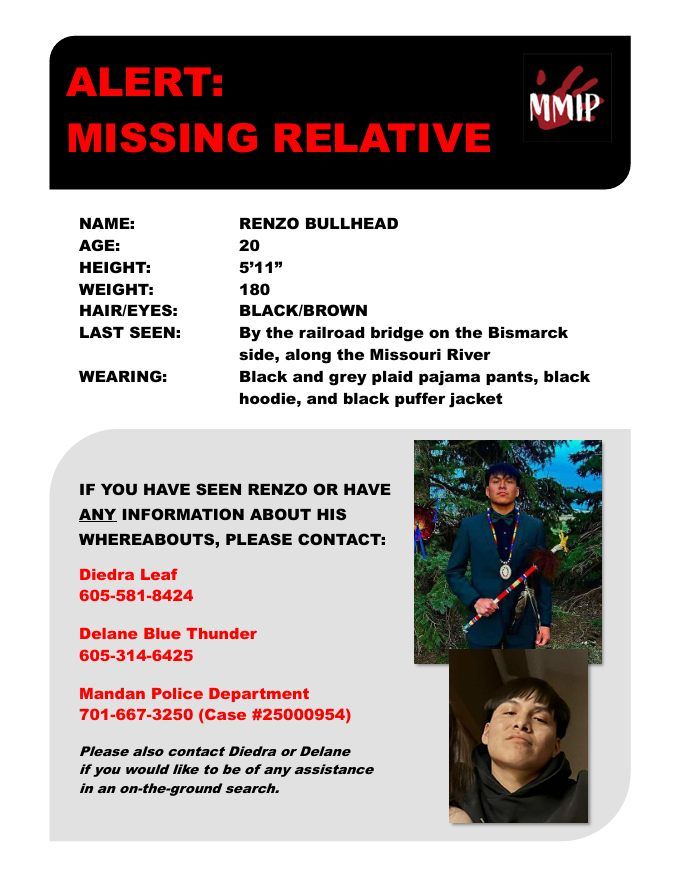
Search for Renzo Bull Head continues
The family of Renzo Bull Head, missing since March 16, 2025, thanks the community for its continued support as the search enters another week. Volunteers are encouraged to sign up for weekday shifts of 10-12 people to assist in the search. The search base remains at United Tribes Technical College (UTTC), where daily briefings will take place at 10:00 AM in the Healing Room, and evening debriefings will be held at 6:00 PM. Transportation will be provided by UTTC after the daily debriefing, with pickups starting at 11:00 PM. After debriefing, contact Marcus at 701-595-1061 for a ride.
The Mandan Police Department is seeking help in locating 20-year-old Renzo Bull Head, who was last seen walking east on the railroad bridge between Mandan and Bismarck. Surveillance footage shows him entering the bridge but not exiting. Renzo is described as having black hair, brown eyes, standing 5'11" tall, and weighing approximately 180 pounds. He was last seen wearing a puffy black jacket, white and black checkered sweatpants, and white and red Jordan basketball shoes. Jana Kate Walker, the family’s primary point of contact, can be reached at 701-329-9150.
For search resources:
Daily Briefings: 10:00 AM in the Healing Room
Evening Debriefing: 6:00 PM in the Healing Room
Transportation: Provided by UTTC Transportation, pickup begins at 11:00 PM
Volunteering: Contact Alva Cottonwood Gabe at 701-880-7060
Primary Contact: Jana Kate Walker at 701-329-9150
Dormitory Accommodations: Limited availability at Sakakawea Hall (bring your own bedding)
Dining Services:
Monday-Friday: Breakfast (7:00-8:30 AM), Lunch (11:45 AM-1:15 PM), Dinner (4:30-6:00 PM)
Saturday-Sunday: Brunch (10:00 AM-Noon), Supper (4:00-5:00 PM)
Additional food available at the UTTC Cultural Center outside dining hours.
For more details, contact Hoksila White Mountain, UTTC point of contact, at 605-926-9731.
Updates will be posted on the official Renzo Bullhead Search Page on Facebook.
ND Trust Lands Act reintroduced to streamline energy development
North Dakota Senators John Hoeven, Kevin Cramer, and Representative Julie Fedorchak have reintroduced the North Dakota Trust Lands Completion Act. The bill would enable equal-value land and mineral exchanges between the state and the U.S. Department of the Interior, aimed at reducing land fragmentation and promoting energy development. The measure seeks to give tribes greater control over reservation lands while providing resources to support state education. The bill has passed the Senate and is expected to move forward in the 119th Congress.