






Which U.S. Cities Get Failing Grades on Parks

Being ranked among the most park-poor cities in America is a fitnesstest no city wants to flunk. But in 2020 amid the pandemic, the national“ParkScore” ratings issuedby The Trust for Public Land (TPL) took on greater meaning asovercrowding at home and lack of school recess put families in a bind.
The nonprofit group, which works with cities, schools andconservation agencies to preserve open space and create parks, in thepast year invested $45.7 million to build new playgrounds in city parks.
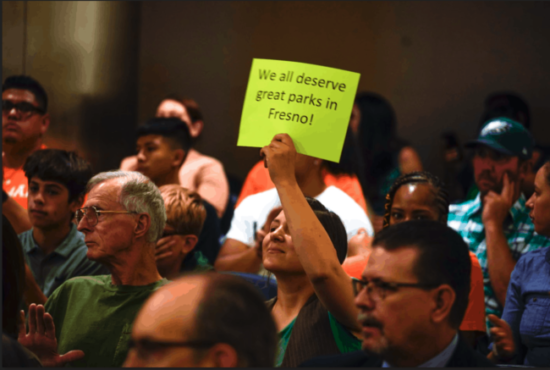
A hearing in Fresno on parks tax measure in August, 2018 (photo courtesy of Fresno Building Healthy Communities)
But TPL is also a judge. Its influential annual ParkScore rankingshowed that in 2020 cities like Scottsdale, Los Angeles and Houston werepark-poor, ranking 44th, 49th and 78th among the 100 largest cities.Yet Rust Belt cities like Cincinnati, Pittsburgh and St. Louis are inthe top 15 — thanks to extensive park systems. The three top-rankingcities in 2020 were Minneapolis, Washington, D.C. and St. Paul.
[Where does your city fall on the ParkScore list? Access your city’s score at this link by scrolling halfway down the page to “See All ParkScore Rankings,’’ then type in your city’s name.]
One ParkScore measure is whether parks are well-equipped withamenities such as playground equipment, benches, athletic fields andrecreation programs. Another is how many residents live within a10-minute walk of a city park. “One hundred million people don’t have a10-minute walk to a park, and of that number 28 million are kids,” saysLinda Hwang, director of research and innovation at TPL.
A diverse mix of cities fall at or near the bottom of the list andvividly illustrate a nationwide struggle to improve parks. The lowrankings of some cities, including Lubbock, Texas, Oklahoma City, andFresno, Stockton and Santa Ana, California, are echoes of racistmunicipal history, city leaders disconnected from residents, or fiscaland natural disasters.
Want more stories like this? Sign up here to get news alerts.
Fresno, ranked 92nd by ParkScore, is in political turmoil over parks. Fromits earliest days in the 1870s, the city was highly segregated and “itis almost ingrained to have the haves and the have-nots still today,”said Sandra Celedon, president and CEO of the non-profit Fresno Building Healthy Communities
Grecia Elenes, a senior policy advocate for the non-profit Leadership Counsel in Fresno County, recalls playing at Fresno’s Hyde Parkas a child: “Right next to it, you can see from the hills ameat-rendering facility with trucks with animal carcasses going in andout.”
In 2018, these and other grassroots groups passed by 52% a sales taxincrease to fund parks. The City of Fresno sued, saying the tax hikeneeded a two-thirds vote. In mid-December, an appeals court ruled for the groups. OutgoingFresno Mayor Lee Brand explained, “We have so many needs. One-third ofFresno is poor. I wanted a balanced measure, with public safetyincluded,” he told FairWarning. But in a nod to the winners, Brand sayshe sees the good in their battle. “We’ll be able to address majorrestoration of our parks and create new ones. We need them.”
In Lubbock, racial disparities fueled its park-poor ranking of 93rd. Joshua Shankles, a produce farmer and board member of the Lubbock Compact,a local group working on such issues as homelessness and expandingparks, says heavy industry, waste treatment plants and “city dumpinggrounds” are concentrated in working-class Latino and Black Lubbock.
“We see parks as a way to attack and counterbalance this.”
Dense, land-poor Santa Ana, torn between parks and development, is in 85th place. Butthat rating by ParkScore may not be forever. The November 2020 electionaltered local politics, which could lead to unconventional parks in thenation’s fourth most-dense city, according to Santa Ana School DistrictBoard President Rigo Rodriguez.
With 12,471 people per square mile, officials say Santa Ana and its residents, about 77 percentof whom are Latino, are paying the price of long-ago planners who gaveparks short shrift. School board members and city officials arediscussing using green fields on school land as semi-permanent publicparks after school hours.
A tougher fight in Santa Ana is focused on the Willowick Golf Course,102 acres of tree-studded land that has been declared surplus by itsowner, the neighboring city of Garden Grove. Advocates hope to save itfrom development, said Cynthia Guerra, an organizer with one of thelocal groups trying to preserve it for a city park. “Low-incomeresidents live next to it, and get the golf balls hit into theiryards,’’ Guerra said, “but have never been inside because they couldn’tpay the fee.”
In Oklahoma City, ranked 97th by ParkScore, officials cameout swinging—with upbeat hopes. This city made up of more than 600neighborhoods, many highly active, is still picking up from a monster ice storm on October 27 that wiped out grand historic trees.
Brian Dougherty, director of parks for the Oklahoma City Community Foundation, a non-profit, says that because Oklahoma lets cities keep only sales tax, not property taxes,developers must build their own greenbelts. The Trust for Public Land,he said, counts scores of parks concentrated in older working-classareas, but not greenbelts in newer, outer areas.
“When the ratings come out, you’re kind of like, oh boy,” saysDougherty. “There’s always room for improvement. But if you are lookingfor parks within a 10-minute walk, having less density is a detriment.”
Georgie Rasco, executive director of the Neighborhood Alliance of Central Oklahoma,describes a city with deeply involved voters who approved an upgrade ofexisting parks, and backed the $132 million Scissortail Park thatopened in 2019 downtown.
“I think I know why we can’t walk to a park in 10 minutes,” Rasco said. “For the longest time we were the mostspread-out city, and we’re still very spread out. It’s not that wehave less parks, but they’re spread out, too. … But so much good ishappening despite that.”
Rising from bankruptcy by cutting deep, Stockton is on the mend. But it’s ranked 87th for parks. In 2020 the city won $8.5 million from the state to remake vandal-ravaged McKinley Park in South Stockton with basketball courts and a renovated pool.
But Erin Reynolds, associate program manager with the non-profit Public Health Advocates,says the city has limited park access in areas that suffereddiscrimination in investment and mortgage lending. “The same communitiesredlined years ago are the most severely disadvantaged now,” she says,primarily downtown and in South Stockton.
Stockton Public Works Director Jodi Almassy says the city is considering a plan to expand an existing parkonto land that is now a defunct golf course “with beautiful oak treesclose to the water,” in an underserved area of South Stockton. IfStockton pulls that off, they won’t be stuck at 87th for long.
Linda Hwang, TPL’s director of research, sees hope in such efforts,particularly in the movement to convert school grounds to parks. NewYork City leads with 220 schoolyards converted through joint-useagreements, often with help from TPL. “We work toconvert from mostly asphalt into green — especially in these pandemictimes, to have a green space, a place outdoors,” Hwang says.
TPL is working with Dallas, Oakland, Tacoma, Los Angeles,Philadelphia, Newark, Camden, Atlanta and other cities to convert schoolyards and other land to parks. “Once we did New York,” she says, “werealized this is a really important thing.”
Editor’s note: An earlier version of the story inaccurately stated that the city of Santa Ana is about 41 percent Latino. The percentage of Latino residents is about 77 percent.
This story was produced by FairWarning (www.fairwarning.org), a nonprofit news organization based in Southern California that focuses on public health, consumer, labor and environmental issues. You can sign up for their newsletter here.
We provide independent Native-focused reporting that gives our communities the context and the facts they need to make informed decisions.
Respect The Fire
At Buffalo's Fire, we value constructive dialogue that builds an informed Indian Country. To keep this space healthy, moderators will remove:
- Personal attacks, harassment, or hate speech
- Spam, misinformation, or unsolicited promotion
- Off-topic rants and excessive shouting (All Caps)
Let’s keep the fire burning with respect.