






The Daily Spark
Small sparks from Indian Country, built to catch fire
Ceremony honors Renée Good, Alex Pretti in Minneapolis
More than 100 people gathered Feb. 1 in Minneapolis for a ceremony honoring Renée Good and Alex Pretti, who were killed in separate incidents involving federal immigration agents. According to reporting by ICT, the event began near the site where Good, a 37-year-old writer and mother of three, was killed on Jan. 7 by a U.S. Immigration and Customs Enforcement agent. Participants held a round dance, sang and offered prayers before moving about a mile and a half to the location where Pretti, a 37-year-old nurse, was killed on Jan. 24.
Star Ishkode Downwind, a Red Lake Nation activist, said the gathering was meant to stand with immigrants and others affected by ICE. Speakers included Nicole Matthews, chief executive officer of the Minnesota Indian Women’s Sexual Assault Coalition, and Tara Geshik, secretary-treasurer of the Bois Forte Band of Chippewa, who spoke about honoring the victims through justice, compassion and unity, according to ICT.
Nathan Chasing Horse convicted on sexual assault charges
A Nevada jury convicted “Dances With Wolves” actor Nathan Chasing Horse on 13 of 21 charges related to sexual assault, according to the Associated Press. Jurors in Las Vegas found most of the guilty verdicts centered on conduct involving a victim who was 14 when the assaults began. Chasing Horse, 49, was acquitted on some charges tied to periods when the victim was older and living with him and others. Sentencing is scheduled for March 11, and he faces a minimum of 25 years in prison.
The verdict followed an 11-day trial that included testimony from three women, some of whom were underage at the time of the alleged assaults, according to AP. Clark County Chief Deputy District Attorney William Rowles thanked the women who testified. Defense attorney Craig Mueller said he plans to seek a new trial.
Oklahoma governor renews calls to limit tribal sovereignty
Oklahoma Governor Kevin Stitt renewed calls to limit tribal sovereignty during his final State of the State address on Feb. 2, saying the state’s criminal and taxation laws should apply to every resident without exception, according to KOSU. Stitt said the state should hold sole sovereignty and criticized what he described as different legal standards. Tribal leaders attended the address and expressed concern over the remarks.
In a statement following the speech, Choctaw Nation Chief Gary Batton said Stitt misrepresents the relationship between tribes and the state, stating tribal sovereignty is based on treaties and agreements with the United States. Cherokee Nation Principal Chief Chuck Hoskin Jr. said Stitt’s comments would erode remaining aspects of tribal sovereignty, while Muscogee Nation Principal Chief David Hill criticized Stitt’s reference to the Land Run of 1889. Oklahoma House Tribal and External Affairs Leader Scott Fetgatter and House Democratic Leader Cyndi Munson also issued statements critical of the governor’s remarks, according to KOSU.
North Dakota reports first measles case of 2026
The North Dakota Department of Health and Human Services reported one confirmed case of measles in Williams County, the first case identified in North Dakota in 2026. The individual was unvaccinated and acquired measles out of state. Health officials have identified and notified people who may have been exposed and said there are no community exposure locations requiring public notification.
“This case serves as a reminder to North Dakotans that measles continues to circulate worldwide and in the United States,” Molly Howell, director of the HHS Disease Control and Forensic Pathology Section, was quoted in a news release.
The release also says that measles is a “highly contagious illness” that spreads through the air and can remain in the air and on surfaces for up to two hours. “Individuals with measles are contagious for several days before and after symptoms appear,” according to HHS, and the disease “can be serious, particularly for young children and people with compromised immune systems.”
Howell said the measles, mumps and rubella vaccine is 97% effective after two doses and that vaccinated people exposed to measles are unlikely to develop the disease. In 2025, North Dakota recorded 36 confirmed measles cases, the first reported in the state since 2011.
Huu-ay-aht First Nation issues U.S. travel advisory
The Huu-ay-aht First Nation on Vancouver Island in Canada has issued an urgent travel advisory advising members to avoid non-essential travel to the United States, citing targeted detentions and identification challenges, according to Chek News.
Chief John Jack said the advisory was issued due to recent issues faced by Indigenous Canadians at U.S. border crossings. Jack told Chek News the nation is urging members to travel to the United States only when necessary and to be cautious when crossing the border. About 50 Huu-ay-aht members currently live and work in Washington and California, according to Chek News.
Jack said U.S. customs officials may request additional documentation, including a blood quantum letter. The Nuu-chah-nulth Tribal Council is also considering issuing a similar advisory to its members, according to Chek News. Travelers are advised to carry a passport, birth certificate and other identification if travel is required.
Lumbee Tribe added to federal recognition list
The Lumbee Tribe of North Carolina has been added to the official list of federally recognized tribes, formalizing its government-to-government relationship with the United States, according to the Department of the Interior. The Department of the Interior Indian Affairs published the updated list in the Federal Register following President Donald J. Trump’s signing of legislation in December 2025 granting full federal recognition to the tribe.
According to the Department of the Interior, the action carries out federal recognition enacted into law and adds the Lumbee Tribe to the annual list of federally recognized American Indian and Alaska Native tribal entities. Interior Secretary Doug Burgum said federal recognition reflects respect, accountability and self-determination and acknowledges the tribe’s history of tribal governance. Assistant Secretary for Indian Affairs Billy Kirkland said the list documents tribes with a government-to-government relationship with the United States and supports tribal sovereignty. The list is maintained and published annually by the Bureau of Indian Affairs Office of Indian Services, Division of Tribal Government Services, according to the Department of the Interior.
Senators propose elevating top Indian Health Service position
Two U.S. senators introduced legislation Tuesday to elevate the director of the Indian Health Service to assistant secretary for Indian health within the Department of Health and Human Services, according to ICT. Sen. Catherine Cortez Masto, D-Nevada, and Sen. Mike Rounds, R-South Dakota, introduced the Stronger Engagement for Indian Health Needs Act, which would change IHS’s top leadership structure.
According to ICT, the senators said the current IHS director lacks certain authorities needed to recruit and retain doctors, nurses and other employees, requiring approval from officials outside the agency and creating delays. If enacted, the assistant secretary for Indian health would report directly to Health and Human Services Secretary Robert F. Kennedy Jr. The legislation was introduced as IHS continues to face staffing challenges, with more than 1,000 employees leaving the agency in 2025 through early retirement or voluntary separation, according to testimony cited by ICT.
Minnesota tribes organize ID events amid ICE concerns
Tribes across the Midwest are organizing pop-up events in Minnesota to help Native community members obtain tribal identification as concerns grow about encounters with federal immigration officers, according to CBS News. About 10 tribes have traveled from Wisconsin and the Dakotas to the Twin Cities to assist with applications, with some lowering fees, according to the report.
Christine Yellow Bird of the Three Affiliated Tribes said she traveled from Fargo, North Dakota, to assist members and estimated helping about 100 people in recent weeks, according to CBS. Some tribal members expressed fear of being stopped by federal officers as Operation Metro Surge continues, Yellow Bird said.
The Minnesota Indian Women’s Resource Center in Minneapolis hosted one of the events. President Ruth Buffalo told CBS that efforts are focused on protecting people. Tribes also reported recent encounters involving ICE, including a Standing Rock Sioux Tribe member who was detained and later released in Minnesota, according to CBS.
Florida man sentenced for misrepresenting Indian-produced jewelry
A Florida man was sentenced to probation and fined after pleading guilty to misrepresenting Indian-produced goods, according to the U.S. Department of the Interior.
Jose Farinango Muenala, 47, of Casselberry, Florida, pleaded guilty Jan. 28, 2026, and was sentenced by U.S. District Judge William M. Conley to three years of probation and a $25,000 fine, according to an Interior Department press release. Officials said Farinango Muenala falsely told customers that jewelry sold through his business, Southwest Expressions, was handmade by Pueblo Indians. An investigation by the U.S. Fish and Wildlife Service determined the jewelry was mass produced and imported from the Philippines.
Farinango Muenala reportedly attended dozens of art shows between 2012 and 2023, including the 2023 Loon Day Festival in Mercer, Wisconsin. During that time, his business made 40,905 individual sales and grossed more than $2.6 million. The case was investigated by the U.S. Fish and Wildlife Service and the Indian Arts and Crafts Board, according to the Interior Department.
National Missing Persons Day aims to raise awareness
55 missing in North Dakota, 13 are Indigenous
Feb. 3 marks National Missing Persons Day. The day is dedicated to raising awareness for missing people and advocating for their return. NamUs, the FBI’s missing person’s database, reports that at any given time up to 100,000 people may be reported missing in the United States. Out of the 55 missing people in North Dakota, according to the state’s Office of the Attorney General, 13 are Indigenous. A Texas mother, Jo Ann Lowitzer, started Missing Persons Day after her daughter went missing in 2010. More information on National Missing Persons Day can be found on the National Day Calendar Website.
Feds approve $2B energy project on Yakama Nation sacred site
Federal energy regulators approved a roughly $2 billion renewable energy project on a Yakama Nation sacred site overlooking the Columbia River in Klickitat County, according to Washington State Standard. The 40-year federal license allows the Goldendale Energy Storage Project to move forward, though legal challenges remain and construction must begin within two years, said Erik Steimle, who is leading the project for Rye Development.
The site is used for ceremonies as well as treaty-reserved fishing and root gathering and has been a village location for the Yakama Nation since time immemorial, said Elaine Harvey, a conservation scientist and member of the Yakama’s Kamíłpa Band, according to Washington State Standard. Yakama Tribal Council Chairman Gerald Lewis criticized the approval in a press release, calling it harmful to sites with religious and cultural significance. Project opponents, including the Yakama Nation and other tribal governments, have 30 days to challenge the license, according to Columbia Riverkeeper.
Polly Cooper honored on 2026 Native American $1 coin
The U.S. Mint will feature Polly Cooper, an Oneida woman known for aiding George Washington’s Continental Army, on the reverse of the 2026 Sacagawea $1 coin, according to the Associated Press. The coin recognizes Cooper’s role in a 1778 relief expedition from Oneida territory to the army’s winter encampment at Valley Forge, where soldiers faced severe food shortages.
Cooper and a delegation of 47 Oneida warriors carried white corn to the encampment, according to the AP. Oneida Indian Nation representative Ray Halbritter said the design shows Cooper offering corn to Washington and was developed in collaboration with the U.S. Mint. The release is part of the Native American $1 Coin Program, established by Congress in 2007 to honor Native Americans and tribes for their contributions to U.S. history.
Pine County Courthouse welcomes Mille Lacs Band flags in ceremony
The Pine County Courthouse held a ceremony Friday morning to welcome flags representing the Mille Lacs Band of Ojibwe into the building, according to MPR News. The tribal flags will be displayed next to Minnesota state flags in all three courtrooms.
Pine County and the Mille Lacs Band established a government-to-government collaboration in 2012, according to MPR News. Mille Lacs Band Chief Executive Virgil Wind said in a statement that the relationship reflects “a shared respect for collaboration, understanding and service to our communities.” District Judge Stoney Hiljus said the flags symbolize coordination between state and tribal courts and noted that individuals appearing in state court may also have cases in tribal court. Hiljus said tribal court has primary jurisdiction over tribal families in Pine County under the Indian Child Welfare Act and the Minnesota Indian Family Preservation Act. Wind said the flags affirm the band’s presence in Pine County and the importance of visibility, cultural recognition and tribal sovereignty within public institutions.
Salmon return after tribes push culvert upgrades in Washington
Salmon are returning to parts of western Washington after tribes pressed the state to upgrade culverts that blocked fish passage, according to the Portland-based nonprofit organization Magic Canoe. At Chico Creek in Bremerton, a multiyear construction project replaced narrow culverts with a wider bridge, reopening historic spawning habitat for chum salmon, which have since returned.
The work follows a 2013 federal injunction that required Washington to fix state-owned culverts that blocked salmon migration and violated tribal treaty rights, according to Magic Canoe. The ruling, later upheld by the U.S. Supreme Court, ordered the state to reopen access to 90 percent of potential upstream fish habitat. By June 2025, the Washington Department of Transportation had corrected 176 barriers but said it would miss the 2030 deadline and need billions more to complete the work.
Tribal leaders said the upgrades reconnect salmon habitat and restore access to traditional fishing areas while improving ecosystem health, according to Magic Canoe.
Blackfeet Community College, Glacier sign collaboration agreement
Blackfeet Community College in Browning, Montana, has entered into a new partnership with Glacier National Park aimed at expanding educational, cultural and professional opportunities for students and community members.
According to the Daily Montanan, the agreement was signed Jan. 22 and will promote park access through the college’s educational programming and allow the college to host cultural events within the park. The partnership also creates additional internships and service-learning opportunities for students through the park, while the college will provide workshops and seminars to help train park staff.
In a statement on the five-year memorandum of understanding, cited by the Daily Montanan, Blackfeet Community College President Brad Hall described the agreement as an “intentional, collaborative relationship,” pointing to the college’s role as a resource for community-based knowledge. A Glacier spokesperson said the agreement formalizes an existing relationship between the park and the college. Superintendent Dave Roemer said the park is honored to commit to education and learning connected to the land.
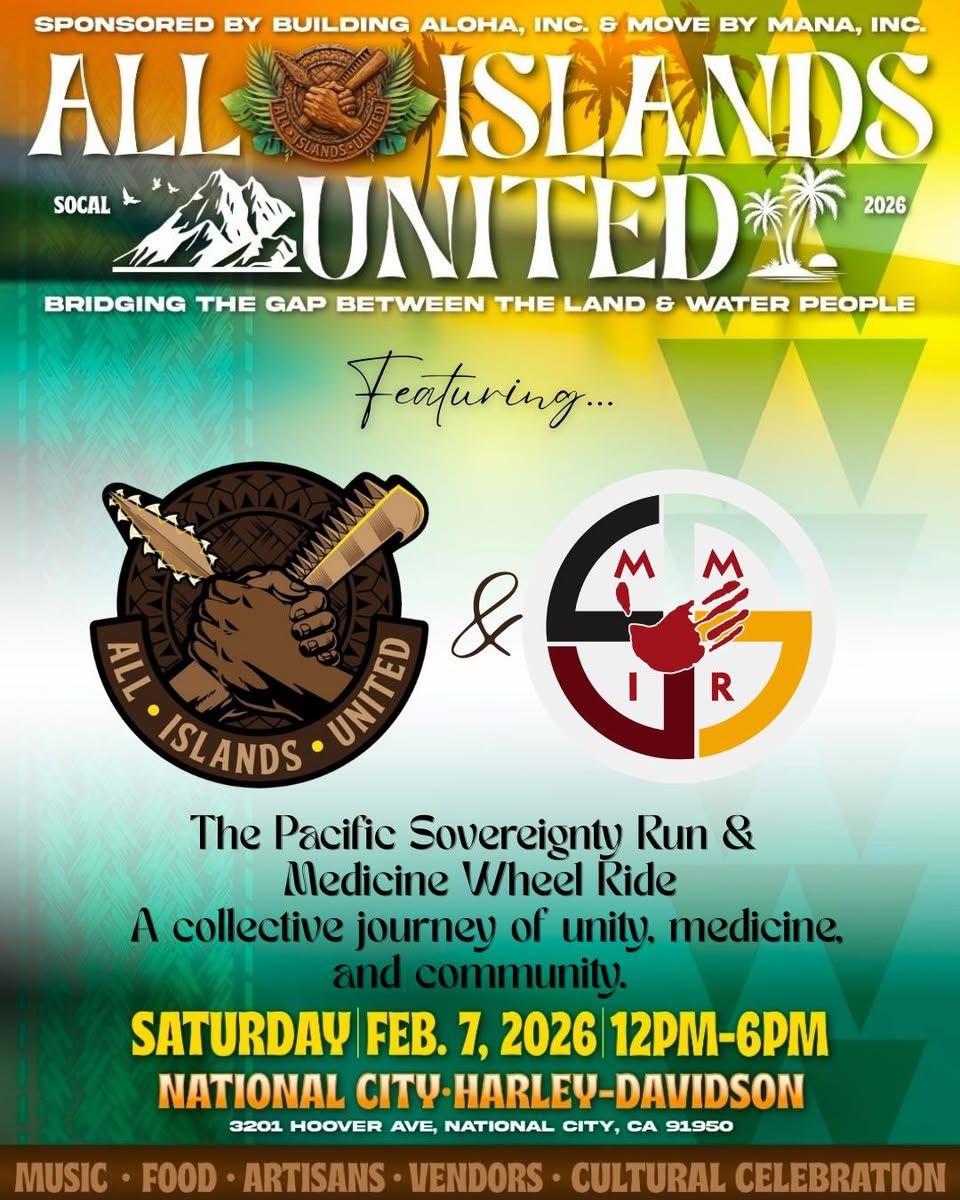
All Islands United ride and gathering set for Feb. 7 in National City, California
All Islands United and Medicine Wheel Ride will host the Pacific Sovereignty Run and Medicine Wheel Ride in National City, California, on Saturday, Feb. 7, according to event materials. The gathering is scheduled from noon to 6 p.m. at National City Harley-Davidson and will include music, food, artisans, vendors and a cultural celebration.
Registration for riders begins at 9 a.m. at Belmont Park, with a kickstands-up time of 10:30 a.m., according to the organizers. Riders are expected to arrive at National City Harley-Davidson between 11 a.m. and 11:15 a.m. Fees are listed as $10 for solo riders and $15 for couples. Prayer and blessings will be offered by Medicine Wheel Ride, according to event details. Organizers also announced a group ride departing from Yuma, Arizona, on Friday, Feb. 6, for riders traveling together to the event.
OST bans ICE and Border Patrol from tribal lands
Asserting its sovereign status, one of the nation’s largest tribes has officially banned Immigration and Customs Enforcement from its 3,500-square miles.
Oglala Sioux Tribal president Frank Star Comes Out issued his proclamation following a tribal council session held Jan. 21. Members passed Resolution No. 26-04, which rejects a partnership proposal between OST and ICE. They also approved another motion banning ICE agents from coming onto the Pine Ridge Indian Reservation.
The OST proclamation also banned U.S. Border Patrol, citing its assistance to ICE with “unlawful conduct against Native people” in the Twin Cities. ICE operations in Minnesota have sparked nationwide furor following the recent shooting deaths of two unarmed people, Renee Good and Alex Pretti.
Four homeless members of the OST and one Standing Rock tribal member are among those reportedly detained by ICE as they continue their immigration crackdown.
Before becoming U.S. Secretary of the Department of Homeland Security, former South Dakota Governor Kristi Noem was banished from all of the state’s reservations for making disparaging remarks about Native people. An OST official told Buffalo’s Fire that the ban on Noem from Pine Ridge remains in effect.
Jingle dress dancers hold healing ceremonies at south Minneapolis memorials
Jingle dress dancers gathered Sunday to hold healing ceremonies at memorial sites for Renee Macklin Good and Alex Pretti in south Minneapolis, where the two were shot and killed while observing federal immigration operations. According to MPR News, hundreds of people attended the ceremonies on Feb. 1, many wearing ribbon skirts and regalia.
Star Downwind, a lead organizer, told MPR the gatherings followed a tradition rooted in community healing: “The dress came to our people when there was a time of sickness. And so that's what we do. We show up when there's people suffering.” A prayer opened the ceremony before dancers moved clockwise around the drum as the crowd looked on.
Several community members helped organize the event, including Minnesota Indigenous Women’s Sexual Assault Coalition CEO Nicole Matthews. Matthews said prayer and gathering together offered strength as federal immigration operations continue.
Dakota woman recounts more than 48 hours in immigration detention
A Mdewakanton Dakota woman said she was detained for more than 48 hours by federal immigration agents in the Twin Cities area after being accused of obstructing an investigation. According to ICT, Sophie Watso, 30, was detained Jan. 14 in Brooklyn Center, Minnesota, and held until Jan. 16.
Watso said agents approached her vehicle while she was monitoring immigration activity and accused her of violating U.S. Code 18 Section 111. She said agents broke the windows of her truck, removed her from the vehicle and detained her. Watso was taken to the Bishop Henry Whipple Building at Fort Snelling, which is being used by the U.S. Department of Homeland Security as an immigration detention and processing site, according to ICT.
Watso said she was later transferred to Sherburne County Jail, where she was released without charges. She said the experience left her traumatized and fearful.
RMICC invites Native community members in Colorado to lead teaching classes
The Rocky Mountain Indian Chamber of Commerce is inviting Native community members across Colorado to start and lead community teaching classes, according to an RMICC announcement. The initiative offers payment to instructors and full funding for approved projects led within their own communities.
According to the announcement, RMICC is open to a wide range of skills that benefit community well-being, including sewing, quilling and beading; outdoor and land-based skills; financial and business education; basic mechanics; entrepreneurship and business mixers; dance, fitness and movement; food, nutrition and health education; and traditional tipi or lodge setup and breakdown. RMICC said additional skill-based classes will also be considered if they serve community needs.
The announcement states the effort aims to support community mental health and encourage knowledge sharing across the state, including in Durango, Fort Collins, Grand Junction, Denver and Fort Morgan. Interested individuals are encouraged to contact RMICC for more information.